For most reporting entities, Form 61 had become a routine Half Yearly exercise. The query ran, the file was generated, the utility validated it and the statement went up on the Reporting Portal. That routine will not survive the move to Form 98.
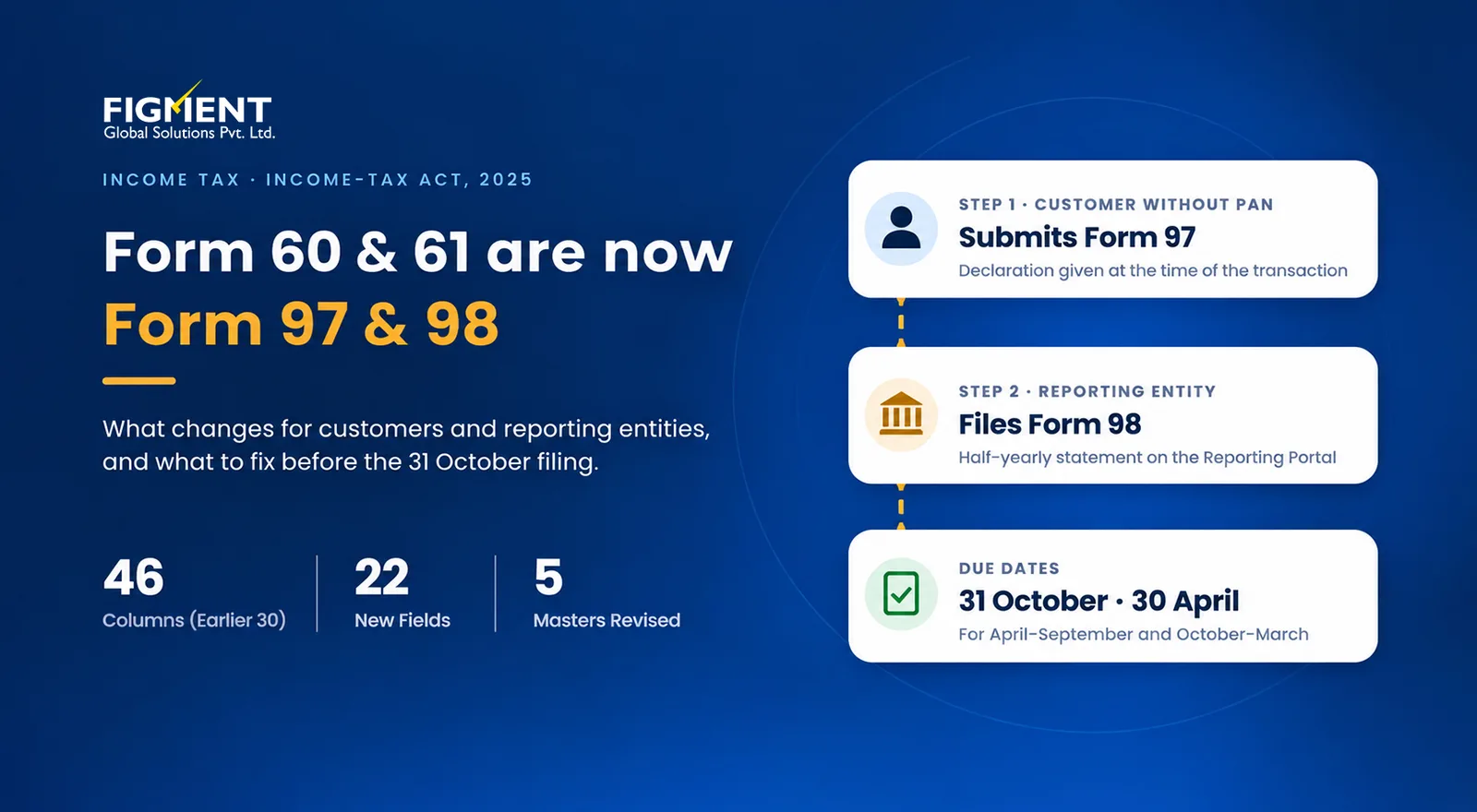
With the Income-tax Act, 2025 in force from 1 April 2026, Form 60 has been replaced by Form 97 and Form 61 by Form 98. The Reporting Portal has released a New Utility and a new XML schema (Version 2.0) in place of the Form 61 schema (Version 1.1). The file format grows from 30 columns to 46, and several masters that most systems treat as fixed have been rewritten.
Form 97 and Form 98: who files what
The two old forms now have two new numbers, and it helps to keep them apart. Form 97 is the declaration a customer without a PAN gives at the time of the transaction. Form 98 is the statement the reporting entity files with the Income Tax Department, listing the Form 97 declarations it received.
| Purpose | Old form | New form | Filed by | Due date |
|---|
| Declaration by a person without PAN | Form 60 | Form 97 | Customer (declarant) | At the time of the transaction |
| Statement of declarations received | Form 61 | Form 98 | Reporting entity (bank, insurer, registrar, hotel, etc.) | 31 October for April–September; 30 April of the next tax year for October–March |
For most entities, this makes 31 October 2026 the first real deadline. That is when the Form 98 statement for declarations received from April to September 2026 falls due.
Form 97 has six parts:
Nature of Transaction (Part A), The Non-PAN Declaration (Part B), Identity and Address Details (Part C), Transaction Details (Part D), Proof Documents (Part E) and
Form 98 Picks Up the Same Details, Which is why so many New Columns appear in the Utility. If a detail is missing On The Form 97 Collected at the Branch, It will be missing in the Form 98 file Too.
The official Form 97 can be downloaded from the Income Tax Department website: Form No. 97 (PDF).
Fewer transactions now allow Form 97
The biggest policy change is not in the utility at all. Under the Income-tax Rules, 2026, PAN is mandatory for several transactions where a Form 60 used to be enough.
| Transaction | Under the new rules |
|---|
| Opening a bank account | Form 97 allowed |
| Time deposit with a bank | Form 97 allowed |
| Account-based relationship with an insurer (premium of Rs. 50,000 or more) | Form 97 allowed |
| Payment to hotel, restaurant, banquet hall or event manager (cash above Rs. 1 lakh) | Form 97 allowed |
| Sale or purchase of immovable property (above Rs. 20 lakh, below Rs. 45 lakh) | Form 97 allowed |
| Sale or purchase of other goods or services (above Rs. 2 lakh per transaction) | Form 97 allowed |
| Sale or purchase of a motor vehicle (above Rs. 5 lakh) | PAN mandatory |
| Credit card application | PAN mandatory |
| Opening a demat account | PAN mandatory |
| Mutual fund, debenture, bond or RBI bond purchase (above Rs. 50,000) | PAN mandatory |
| Cash deposit or withdrawal in a bank account (above Rs. 10 lakh) | PAN mandatory |
| Securities or unlisted shares (above Rs. 1 lakh per transaction) | PAN mandatory |
Three transactions have been taken out of the framework altogether: purchase of foreign currency, purchase of a bank draft in cash and purchase of prepaid payment instruments.
Some persons cannot use Form 97 at all like Firms, companies, the Central and State Governments and consular offices are outside it, as are non-residents for certain transactions.
The one exception is a foreign company with no taxable income in India, which can file Form 97 to open a bank account or time deposit with an IFSC banking unit.
How Form 98 compares with Form 61
Before getting into individual columns, it helps to see the overall shift. Form 98 asks for less about estimated income and much more about who the person is, where they live and which documents were relied on.
| Parameter | Form 60/61 (Income-tax Act, 1961) | Form 98 (Income-tax Act, 2025) |
|---|
| Statement name | Form 61 | Form 98 |
| Schema version | V1.1 | V2.0 |
| Schema namespace | incometaxindiaefiling.gov.in | eportal.incometax.gov.in |
| Columns in utility format | 30 | 46 |
| Columns removed | – | 6 |
| Columns added | – | 22 |
| Customer ID | Reported (optional) | Not reported |
| Identity details | One Identification Type and Number | Three proof blocks: Identity, Address and DOB/DOI |
| Income information | Estimated agricultural and non-agricultural income | Only for foreign companies (chargeable and not chargeable to tax) |
| District | Not captured | Mandatory |
| Email ID | Not captured | Optional |
| Foreign TIN | Not captured | Optional, with issuing country |
| Joint transactions | Not captured | Joint flag, number of persons and declarant's share |
| Cash component | Not captured | Optional, where the transaction is partly in cash |
| Transaction Type codes | 01 to 22 | 01 to 10, all redefined |
| Transaction Mode codes | 01 to 06 | 01 to 08, UPI added |
| Assessment Year in header | Required | Removed |
Two rows in this table deserve more attention than the rest: the proof blocks and the Transaction Type codes. Both are covered in detail below.
What has changed in the data format
The Form 98 utility format has 46 columns. Seventeen come across from Form 61 unchanged, seven have been renamed or widened, and 22 are new. Six old columns have been dropped.
1. Columns removed
| Old column | Remarks |
|---|
| Customer ID | No longer reported |
| Identification Type | Replaced by the Identity, Address and DOB/DOI proof blocks |
| Identification Number | Now reported as the Document Identification Number in each proof block |
| Estimated agricultural income | No longer reported |
| Estimated non-agricultural income | No longer reported (this was mandatory in Form 61) |
| Form 60 Acknowledgement Number | No longer reported |
The removal of Customer ID is worth a second look. Many teams used it to trace a reported row back to their core system. Since it no longer travels in the file, keep your own mapping of Report Serial Number to Customer ID. You will need it when a correction statement has to be filed.
2. Renamed address fields
The address block now follows the style used in PAN and KYC forms. The field lengths are the same as before (up to 50 characters each), but the labels make it clearer what goes where.
| Form 61 column | Form 98 column |
|---|
| Person Name | Name of the Person |
| PAN Acknowledgement Number | PAN Application Acknowledgement Number (if applied for PAN and not yet generated) |
| Flat / Door / Building | House No./Flat No. |
| Name of Premises / Building / Village | Plot No./Name of Premises/Building |
| Road / Street | Road/Street/Lane |
| Area / Locality | Area/Locality/Ward/Sector/Taluka/Sub-Division |
| City / Town | City/Town/Village/Post Office |
| – | District (new, mandatory) |
Note that "Village" has moved. In Form 61 it sat with the premises name. In Form 98 it sits with City/Town. If your query mapped village into the second address line, it now belongs in the city field.
These columns carry over as they were: Report Serial Number, Original Report Serial Number, Date of Birth/Incorporation, Father's Name, Aadhaar Number, Postal Code, State Code, Country Code, Mobile Number, STD Code, Telephone Number, Remarks, Transaction Date, Transaction ID, Transaction Type, Transaction Amount and Transaction Mode.
3. New columns added
| New column | Mandatory or optional | Schema validation |
|---|
| District | Mandatory | 1 to 100 characters |
| Email ID | Optional | Up to 200 characters, valid email format |
| Taxpayer Identification Number (TIN) | Optional | Up to 100 characters |
| TIN Issuing Country Code | Optional | ISO country code |
| Income Chargeable to Tax (for a foreign company) | Optional | Whole number, up to 18 digits |
| Income not Chargeable to Tax (for a foreign company) | Optional | Whole number, up to 18 digits |
| Cash amount involved in transaction amount | Optional | Whole number |
| In case transaction is in joint name | Mandatory | Y or N |
| Number of persons involved in the transaction | Where joint name is Y | Up to 2 digits |
| Share of declarant (in %) | Where joint name is Y | 0 to 100, up to 2 decimal places |
| Document Code (IP, AP, DP) | Mandatory in each block | Code from the relevant proof master |
| Document Identification Number (IP, AP, DP) | Part of each block | Up to 150 characters |
| Name of the authority issuing document (IP, AP, DP) | Part of each block | Up to 200 characters |
| Address of the authority issuing document (IP, AP, DP) | Part of each block | Up to 500 characters |
The last four rows repeat three times, once for Identity Proof (IP), once for Address Proof (AP) and once for DOB/DOI Proof (DP). That is 12 of the 22 new columns.
A few practical points on the new fields:
Joint transactions. The joint-name flag is mandatory on every row, even for single-holder transactions, where it will simply be N. When it is Y, give the number of persons and the declarant's percentage share. Cash component. Form 98 now asks how much of the transaction amount was paid in cash. This pairs with the new Transaction Mode code 06 (Mixed), covered below. Foreign companies. The TIN, TIN country and the two income fields are aimed at foreign companies filing Form 97. For individuals they will usually stay blank. Proof blocks. A Document Code must be given in all three blocks. Where a block genuinely does not apply, code 99 (Not Applicable) is available.
4. A sample record in both formats
Here is how a single, made-up record would look in both formats. It shows a joint fixed deposit of Rs. 6,00,000 placed by cheque.
| Field | Form 61 | Form 98 |
|---|
| Name | Ramesh Patil | Ramesh Patil |
| Customer ID | CUST12345 | Not reported |
| Identification Type / Number | 06 / Z1234567 | Moved to proof blocks |
| Address (house, building, road) | 12, Shanti Niwas, MG Road | 12 / Shanti Niwas / MG Road |
| Area | Gurgaon | Gurgaon |
| City | Haryana | Haryana |
| District | Not captured | Nagpur |
| Estimated non-agricultural income | 450000 | Not reported |
| Transaction Type | 05 (Investment in time deposit) | 06 (Investment in time deposit) |
| Transaction Mode | 02 (Cheque) | 02 (Cheque) |
| Joint name | Not captured | Y |
| Number of persons / declarant share | Not captured | 2 / 50.00 |
| Identity Proof | Not captured | 06, Z1234567, Passport Office, address |
| Address Proof | Not captured | 01, Aadhaar number, UIDAI, address |
| DOB Proof | Not captured | 06, Z1234567, Passport Office, address |
Notice the Transaction Type. The same time deposit was code 05 under Form 61 and is code 06 under Form 98. Code 05 now means something else entirely.
Changes in the masters
New columns tend to get noticed, because the utility rejects a file that is missing them. Master changes are harder to spot. Five Masters have changed, and one of them can produce a file that validates perfectly and is still wrong.
1. Transaction Type master
This is the single most important change in Form 98. The Transaction Type list has been cut from 22 codes to 10, and codes 01 to 10 have been reassigned. None of the ten codes means what it meant under Form 61.
| Code | Form 61 meaning | Form 98 meaning |
|---|
| 01 | Sale of immovable property | Purchase of any immovable property |
| 02 | Purchase of immovable property | Sale of any immovable property |
| 03 | Sale of a motor vehicle | Gift of any immovable property |
| 04 | Purchase of motor vehicle | Joint development agreement of any immovable property |
| 05 | Investment in time deposit | Opening an account (other than basic savings and time deposit) |
| 06 | Deposit in cash | Investment in time deposit |
| 07 | Sale of securities | Commencement of account-based relationship with an insurer |
| 08 | Purchase of securities | Payment to hotel, restaurant, convention centre, banquet hall or event management |
| 09 | Opening an account (other than savings and time deposit) | Sale of goods or services not covered at Sl. Nos. 1 to 15 of the Table under Rule 159(1) |
| 10 | Account with balance exceeding Rs. 50,000 | Purchase of goods or services not covered at Sl. Nos. 1 to 15 of the Table under Rule 159(1) |
| 11 | Purchase of bank drafts or pay orders | Discontinued |
| 12 | Application for issue of a credit or debit card | Discontinued |
| 13 | Payment to hotel | Discontinued (now within code 08) |
| 14 | Payment in connection with travel to any foreign country | Discontinued |
| 15 | Payment for purchase, or remittance outside India | Discontinued |
| 16 | Payment to Mutual Fund for purchase of its units | Discontinued |
| 17 | Payment for acquiring shares | Discontinued |
| 18 | Payment for acquiring debentures or bonds | Discontinued |
| 19 | Payment as life insurance premium | Discontinued |
| 20 | Sale of shares of a company | Discontinued |
| 21 | Purchase of shares of company | Discontinued |
| 22 | Not classified above | Discontinued |
Why this matters: the schema only checks that the code is between 01 and 10. It does not know what your system meant by it. A bank that keeps sending code 06 for cash deposits will get a clean validation, and every one of those rows will be reported as an investment in time deposit.
Most of the missing categories are gone for a reason: PAN is now mandatory for them, so a Form 97 cannot be accepted. This covers motor vehicles, credit cards, demat accounts, mutual funds, debentures and bonds, large cash deposits or withdrawals, and securities. Foreign currency, bank drafts bought in cash and prepaid instruments are out of the framework entirely. Rows for these transactions should simply stop appearing in the file.
Form 97 codes are not Form 98 codes
There is one more trap. The Form 97 that customers fill in uses six transaction codes. The Form 98 utility uses ten. The numbers do not line up, so a code cannot be copied from the declaration into the statement.
| Form 97 code | Form 97 description | Form 98 code |
|---|
| 01 | Purchase, sale, gift or joint development agreement of immovable property | 01, 02, 03 or 04 |
| 02 | Opening an account (other than basic savings and time deposit) | 05 |
| 03 | Investment in time deposit | 06 |
| 04 | Commencement of account-based relationship with an insurer | 07 |
| 05 | Payment to hotel, restaurant, convention centre, banquet hall or event manager | 08 |
| 06 | Sale or purchase of goods and services not classified above | 09 (sale) or 10 (purchase) |
A time deposit, for example, is 03 on the Form 97 and 06 in Form 98. Build this mapping into the query rather than relying on staff to convert codes by hand. Transaction Mode codes, on the other hand, are the same in both forms.
2. Transaction Mode master
| Code | Form 61 | Form 98 |
|---|
| 01 | Cash | Cash |
| 02 | Cheque | Cheque |
| 03 | Card | Card |
| 04 | Draft/Bankers Cheque | Draft/Bankers Cheque |
| 05 | Online transfers | Online transfers |
| 06 | Others | Mixed (cash and other mode) |
| 07 | – | UPI transactions (new) |
| 08 | – | Others (new) |
The same trap applies here on a smaller scale. "Others" has moved from 06 to 08, and 06 now means a mix of cash and another mode. UPI payments, which many systems lumped into online transfers or others, now get their own code.
3. State Code master
| Change | Form 61 | Form 98 |
|---|
| Code changed | OR – Orissa | OD – Odisha |
| Code changed | TS – Telangana | TG – Telangana |
| Merged | DN – Dadra and Nagar Haveli | DD – Dadra & Nagar Haveli and Daman & Diu |
| Renamed | DD – Daman & Diu | DD – Dadra & Nagar Haveli and Daman & Diu |
| Renamed | PY – Pondicherry | PY – Puducherry |
| Added | – | LA – Ladakh |
Rows with OR, TS or DN will fail validation. Customers in Ladakh, who were earlier coded under Jammu & Kashmir in many systems, should now be reported as LA.
4. Country Code master
| Change | Form 61 | Form 98 |
|---|
| Removed | XX – Other | No catch-all code. Report the actual ISO country code. |
| Added | – | XK – Kosovo |
| Renamed | CV – Cape Verde | CV – Cabo Verde |
| Renamed | CZ – Czech Republic | CZ – Czechia |
| Renamed | MK – Macedonia, the former Yugoslav Republic of | MK – North Macedonia |
| Renamed | SZ – Swaziland | SZ – Eswatini |
The removal of XX is the one to act on. Any customer record where the country was left as "Other" will need a real country code before it can be reported.
5. Proof document masters
Form 61 had one Identification Type list with 17 codes. Form 98 replaces it with three lists, one for each proof block. The codes are numbered from a common pool, but each list accepts only its own subset.
| Code | Document | Identity | Address | DOB/DOI |
|---|
| 01 | Aadhaar card | Yes | Yes | – |
| 02 | Bank/Post office passbook with photograph | Yes | Yes | – |
| 03 | Elector's photo identity card | Yes | Yes | Yes |
| 04 | Ration/PDS card with photograph | Yes | Yes | – |
| 05 | Driving licence | Yes | Yes | Yes |
| 06 | Passport | Yes | Yes | Yes |
| 07 | Pensioner photo card | Yes | Yes | – |
| 08 | NREGS job card | Yes | Yes | – |
| 09 | Caste/Domicile certificate with photo | Yes | Yes | – |
| 10 | Certificate signed by MP/MLA/Municipal Councillor/Gazetted Officer (Annexure A, Form 49A) | Yes | Yes | – |
| 11 | Certificate from employer (Annexure B, Form 49A) | Yes | Yes | – |
| 12 | Kisan passbook with photo | Yes | – | – |
| 13 | Arms licence | Yes | – | – |
| 14 | CGHS/ECHS card | Yes | – | Yes |
| 15 | Photo identity card issued by Government/PSU | Yes | – | Yes |
| 16 | Electricity bill (not more than 3 months old) | – | Yes | – |
| 17 | Landline telephone bill (not more than 3 months old) | – | Yes | – |
| 18 | Water bill (not more than 3 months old) | – | Yes | – |
| 19 | Consumer gas card/book or piped gas bill (not more than 3 months old) | – | Yes | – |
| 20 | Bank account statement (not more than 3 months old) | – | Yes | – |
| 21 | Credit card statement (not more than 3 months old) | – | Yes | – |
| 22 | Depository account statement (not more than 3 months old) | – | Yes | – |
| 23 | Property registration document | – | Yes | – |
| 24 | Allotment letter of accommodation from Government | – | Yes | – |
| 25 | Passport of spouse bearing name of the person | – | Yes | – |
| 26 | Property tax payment receipt (not more than one year old) | – | Yes | – |
| 27 | Domicile certificate with photo | Yes | Yes | Yes |
| 28 | Birth certificate | – | – | Yes |
| 29 | Pension payment order | – | – | Yes |
| 30 | Marriage certificate issued by Registrar of Marriages | – | – | Yes |
| 31 | Matriculation certificate or mark sheet | – | – | Yes |
| 32 | Trust deed / registration certificate issued by Charity Commissioner | Yes | Yes | Yes |
| 33 | Agreement / registration certificate issued by a competent authority or Government department | Yes | Yes | Yes |
| 34 | Certificate of Registration/Incorporation from country of location, attested by IFSC banking unit | Yes | Yes | Yes |
| 35 | Tax identification number from country of location, attested by IFSC banking unit | Yes | Yes | Yes |
| 99 | Not Applicable | Yes | Yes | Yes |
Two things to watch when converting old data:
Codes 01 to 15 mean the same document as before. A customer who gave a passport (06) can have 06 carried into the Identity block, and into the Address and DOB blocks if the same passport was relied on. Old codes 16 and 17 do not carry over. Under Form 61 they were the trust deed and registration certificate. Under Form 98 those documents are 32 and 33, while 16 and 17 now mean an electricity bill and a landline bill. A trust reported with old code 16 would be shown as having submitted an electricity bill.
Changes in the statement header and Part A
Part A carries the reporting entity's details and the statement particulars. These are usually set up once in the utility, so they rarely touch the customer-level query. Still, a few fields have gone.
| Field | Where it sits | Form 61 | Form 98 |
|---|
| Form name | Header | Form 61 | Form 98 |
| Schema version | Header | V1.1 | V2.0 |
| Assessment Year | Header | Required | Removed |
| Registration Number | Reporting entity | Optional | Removed |
| Statement Number | Statement details | Required (format YYYY/serial) | Removed |
| Fax | Principal officer | Optional | Removed |
| Original Statement ID | Statement details | Required (0 for an original statement) | No change |
| Statement Type, Correction Reason, Reporting Period, Number of Reports | Statement details | Required | No change |
One point that is easy to misread: the Statement Number is gone, but the Original Statement ID is not. You will still need it to link a correction statement back to the original filing.
Common mistakes to avoid
From the comparison above, these are the errors we expect to see most often in the first few Form 98 filings:
Carrying over old Transaction Type codes. The file validates, but the transactions are reported under the wrong category. Copying the Form 97 code into Form 98. Form 97 has six codes and Form 98 has ten. A time deposit is 03 on the declaration and 06 in the statement. Reporting transactions that now need PAN. A Form 97 should not have been accepted for them, so they have no place in a Form 98 statement. Using 06 for "Others" in Transaction Mode. Under Form 98, 06 means mixed cash and non-cash payment. "Others" is now 08. Mapping old identification code 16 or 17 into the proof blocks. These now mean an electricity bill and a landline bill, not a trust deed or registration certificate. Leaving District blank. It is mandatory. Many core systems hold the city and PIN code but not the district, so this may need a lookup or a data-capture change at the branch. Leaving the joint-name flag blank for single holders. It must be N, not empty. Sending OR, TS, DN or XX. These codes no longer exist and the rows will be rejected. Dropping the Original Statement ID along with the Statement Number. Only the Statement Number has been removed.
What reporting entities should do now
The work splits naturally between compliance, IT and operations. A practical order is:
1. Freeze the new mapping
Prepare a mapping sheet from your products and transaction categories to the ten new Transaction Type codes. Get it signed off by the tax or compliance head. Do the same for Transaction Mode, state, country and proof documents.
2. Update the extraction query
Rebuild the query to the 46-column Form 98 layout, in the same column sequence as the utility. Remove the six dropped fields and add the 22 new ones.
3. Fill the data gaps
Check which new fields your systems already hold, such as email, district and joint-holder details. For fields that are not captured today, particularly the three proof blocks and the issuing authority details, update the Form 97 capture process at branches so future transactions come in complete.
4. Clean up the masters in your system
Replace OR, TS and DN with OD, TG and DD. Replace country code XX with actual ISO codes. Move Ladakh customers to LA.
5. Test before the due date
Run the April–September 2026 data through the new utility well before the 31 October 2026 due date. Look beyond validation errors: spot-check a few rows against source records to confirm the Transaction Type and proof codes say what you intend.
6. Keep an audit trail
Since Customer ID no longer travels in the file, retain a mapping of Report Serial Number to Customer ID and to the source transaction. Keep the mapping sheet from step 1 with each month's filing papers.
Useful links
Final thoughts
Form 98 asks reporting entities to know their Form 97 customers better: where they live down to the district, which documents were checked, and whether the transaction was shared with someone else. Most of the effort will go into data capture and mapping, not into the utility itself.
disclaimer
This article is based on the Form 98 utility format and schema (Version 2.0) published on the Income Tax Reporting Portal, compared with the Form 61 schema (Version 1.1), and on the CBDT brochure on Form Nos. 97 and 98. Always check the latest portal instructions before filing
#Form97 #Form98 #Form60 #Form61 #IncomeTaxAct2025 #ReportingPortal #SFT #TaxCompliance #IncomeTax #Banking #NBFC #CharteredAccountants #TaxProfessionals