


Businesses that buy from MSMEs: companies, LLPs, firms and proprietors under tax audit. MSMEs themselves, whose cash flow depends on these rules being followed. Tax auditors, CA firms and finance teams who prepare and test the numbers.
MSME compliance at a glance
| Law | Requirement | Who it applies to | When |
|---|---|---|---|
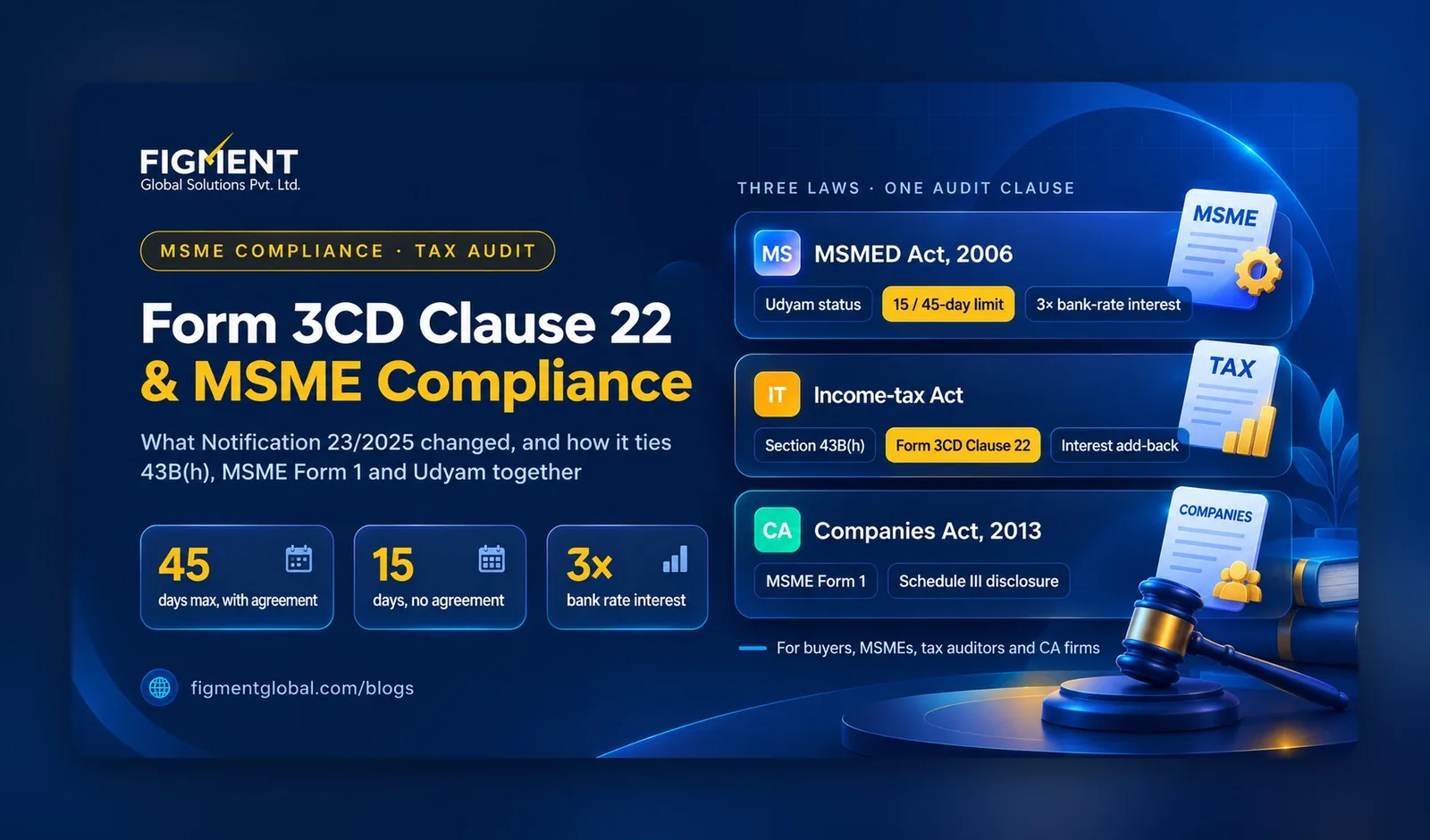
| MSMED Act, Section 15 | Pay micro and small suppliers within the agreed period, capped at 45 days from acceptance (15 days without a written agreement) | Every buyer of goods or services from an MSE | Every payment |
| MSMED Act, Section 16 | Compound interest, monthly rests, at 3× the RBI bank rate on late payments | Buyers who pay late | From the appointed day |
| MSMED Act, Section 22 | Disclose unpaid principal and interest due to MSEs in the annual financial statements | Buyers whose accounts must be audited | Annually |
| MSMED Act, Section 23 | Interest under Section 16 is not deductible under the Income-tax Act | Buyers who pay interest | Annually |
| Income-tax Act, Section 43B(h) | Amounts owed to MSEs are deductible only in the year paid if paid beyond the Section 15 limit | Businesses buying from MSEs (medium enterprises and, generally, traders are excluded) | From AY 2024-25 |
| Income-tax Act, Form 3CD Clause 22 | Report MSE dues, timely and late payments, the 43B(h) disallowance and inadmissible interest | Businesses under tax audit | Tax audit report, first applied to AY 2025-26 |
| Companies Act, MSME Form 1 | Half-yearly return of MSE dues outstanding beyond 45 days | Companies | By 31 October and 30 April |
| Companies Act, Schedule III | Disclose MSE dues in the balance sheet notes | Companies | Annually |
| Udyam registration | Classification as micro, small or medium, based on investment and turnover | MSMEs | On registration, updated from ITR and GST data |
MSME classification: who counts as micro or small
| Category | Investment in plant, machinery or equipment | Turnover |
|---|---|---|
| Micro | Up to ₹2.5 crore | Up to ₹10 crore |
| Small | Up to ₹25 crore | Up to ₹100 crore |
| Medium | Up to ₹125 crore | Up to ₹500 crore |
What changed in Form 3CD Clause 22 MSME
| Before Notification 23/2025 | After Notification 23/2025 | |
|---|---|---|
| What Clause 22 asked | Amount of interest inadmissible under Section 23 of the MSMED Act | Interest inadmissible under Section 23, plus details of amounts due to micro and small enterprises and when they were paid |
| Link to Section 43B(h) | None in Clause 22; 43B(h) was picked up under Clause 26 | Amounts paid beyond the Section 15 time limit and the resulting 43B(h) disallowance are reported directly |
| Supplier-level data needed | Mostly interest workings | Supplier category (micro or small), acceptance date, due date, payment date and amount |
| MSME Form 1 | Not referred to | Whether the company is required to file the half-yearly MSME Form 1 return |
The rules behind the numbers
Section 15, MSMED Act (time limit): a buyer must pay a micro or small supplier within the agreed period. That period cannot exceed 45 days from the day of acceptance or deemed acceptance of the goods or services. Without a written agreement, the limit is 15 days. Section 16, MSMED Act (interest): if payment is late, compound interest with monthly rests at three times the bank rate notified by the RBI is payable from the appointed day. Section 23, MSMED Act: that interest is not allowed as a deduction under the Income-tax Act. Section 43B(h), Income-tax Act, 1961: any sum payable to a micro or small enterprise beyond the Section 15 time limit is allowed only in the year it is actually paid. It applies from AY 2024-25.
Medium enterprises are outside Section 43B(h). Only micro and small suppliers are covered, so each supplier's category on the relevant date matters. Traders. Traders registered on Udyam are generally treated as outside the delayed-payment provisions of the MSMED Act, following the Ministry of MSME's 2021 guidance.
Clause 22 checklist for tax auditors and finance teams
Step 1: Confirm which suppliers are micro or small
Obtain the supplier master with PAN, Udyam Registration Number (if any) and the category the business has recorded. Check how MSE status was identified: supplier declaration, Udyam certificate, or independent verification of the Udyam registration. Test a sample of categories against Udyam. Pay attention to suppliers whose category changed during the year under the revised limits. Confirm each supplier's registration date. Invoices raised before a supplier registered need a view on coverage. Separate traders and medium enterprises, and record why they are excluded.
Step 2: Establish the time limit for each supplier
Collect written agreements or purchase orders that set payment terms. Where agreed terms exceed 45 days, apply 45 days. Where there is no written agreement, apply 15 days. Confirm what the business uses as the date of acceptance (goods receipt, service completion certificate or invoice date), and whether it is applied consistently. Using the invoice date for everything is a common shortcut and can misstate delays.
Step 3: Match invoices to payments
Obtain an invoice-wise ledger of MSE suppliers for the year, including opening balances. Match each invoice to the payment(s) that settled it, including part payments, advances and debit notes. Classify every invoice as one of: paid within the limit; paid late within the same year; paid late in the next year; or unpaid at year end.
Step 4: Compute the Section 43B(h) disallowance
For amounts unpaid at year end and already beyond the time limit, disallow them this year; they are allowable in the year of actual payment. For amounts unpaid at year end but still within the time limit, check the payment date after year end. If paid within the limit, there is no disallowance. If paid late, the amount is disallowed this year. Check only expense and asset items claimed as deductions; the provision applies to sums otherwise allowable as a deduction. Reconcile the reversal: amounts disallowed last year and paid this year should be claimed this year.
Step 5: Compute Section 23 interest
Recompute interest at three times the RBI bank rate, compounded monthly, for each late payment. Check whether the business has provided for it in the books, and whether any interest actually paid was charged to profit and loss. Report the inadmissible interest in Clause 22 and make sure it is added back in the computation.
Step 6: Cross-check the other MSME disclosures
MSME Form 1: companies with MSE dues outstanding beyond 45 days file half-yearly returns with the MCA by 31 October (April–September) and 30 April (October–March). The amounts should agree with Clause 22. Schedule III / Section 22, MSMED Act: the principal and interest owed to MSEs in the financial statements should reconcile to the Clause 22 figures. Clause 26: make sure the same 43B(h) amount is not reported twice, or inconsistently, across clauses.
Step 7: Document and get representations
Keep the MSE supplier list, category evidence, invoice-to-payment matching and interest working in the audit file. Obtain a management representation on the completeness of the MSE supplier list and the payment terms used. Where data is not available, state the limitation clearly in the observations to the tax audit report.
If your business is a micro or small enterprise
Keep your Udyam registration current. Buyers and auditors check it, and your category decides whether the 45-day rule protects you. Tell your customers your status. Quote your Udyam Registration Number and category on invoices and in customer onboarding forms, so buyers classify you correctly from the first invoice. Put payment terms in writing. Without a written agreement, the limit is 15 days. With one, it can be up to 45 days, but never more. Track what is overdue. You are entitled to Section 16 interest on late payments. Unresolved delayed-payment cases can go to the MSE Facilitation Council through the MSME Samadhaan portal. Expect questions near year end. Because of Section 43B(h), buyers often ask MSEs to confirm their status, or to agree payment terms, before 31 March. Having the documents ready speeds up your payments.
Common errors in Clause 22 data
| Error | What goes wrong | How to catch it |
|---|---|---|
| Relying only on supplier self-declaration | Suppliers who registered on Udyam after onboarding are missed | Re-verify the whole supplier master against Udyam before year end |
| Treating medium enterprises as covered | Disallowance is overstated | Check the category, not just "MSME: Yes" |
| Using an old category | Suppliers reclassified under the April 2025 limits are misreported | Verify the category as on the relevant date |
| Using invoice date as acceptance date everywhere | Late payments are understated or overstated | Sample goods receipts and service acceptance records |
| Ignoring opening balances | Last year's disallowances are not claimed this year | Roll forward last year's 43B(h) working |
| Netting advances or debit notes incorrectly | Invoice-level timing is lost | Match at invoice level, not supplier balance |
| Interest not computed at all | Clause 22 shows nil when delays exist | Recompute from the late-payment list |
| Clause 22, MSME Form 1 and Schedule III don't agree | Inconsistent figures across filings invite queries | Reconcile all three before signing |
Worked example
Section 43B(h): the ₹10 lakh is not deductible for FY 2025-26. It is allowed in tax year 2026-27, the year it was paid (under Section 37(2)(g) of the Income-tax Act, 2025). Section 16 interest: interest runs from the appointed day at three times the RBI bank rate, compounded monthly. Under Section 23 it is not deductible. Clause 22: both figures are reported in the FY 2025-26 tax audit report. MSME Form 1: if the company files MSME Form 1, the amount outstanding beyond 45 days on 31 March 2026 falls in the October–March return, due by 30 April 2026.
How Figment helps with MSME compliance
Bulk MSME (Udyam) status verification. Figment MSME Compliance checks the MSME status and category of an entire party list in bulk, for Income-tax Act and Companies Act reporting. Auditors start from verified categories rather than declarations. Section 43B(h) payment tracking. Payments to micro and small enterprises are tracked against the 15-day or 45-day limit, so the finance team sees the late-payment list during the year instead of at audit time. MSME Form 1 and Schedule III support. Data on outstanding MSE dues supports the half-yearly MSME Form 1 and the financial statement disclosures, which Clause 22 should reconcile to. Checks at onboarding. VenCPC verifies PAN, GSTIN and MSME status when a new supplier is added, so each one is categorised before its first invoice.
Key takeaways
MSME compliance comes from three laws, and Form 3CD Clause 22 is where they meet at the tax audit. The revised Clause 22 needs invoice-level data, not a year-end summary. Start with a verified list of micro and small enterprises. Medium enterprises and, generally, traders are outside 43B(h). Apply 45 days where there is a written agreement (never more) and 15 days where there is none. Reconcile Clause 22 with MSME Form 1, the Schedule III disclosure and Clause 26. MSMEs should keep Udyam current and share their status with customers. The rules protect them only when their status is on record.
Frequently Asked Questions
Besides the interest inadmissible under Section 23 of the MSMED Act, the tax audit report shows the amounts due to micro and small enterprises, the amounts paid within and beyond the Section 15 time limit, and the amount disallowed under Section 43B(h).
From tax audit reports for assessment year 2025-26 (financial year 2024-25), because the notification took effect on 1 April 2025.
No. Section 43B(h) and the Section 15 time limit apply only to micro and small enterprises, so payments to medium enterprises are not disallowed under 43B(h).
15 days from the day of acceptance or deemed acceptance of the goods or services. With a written agreement, the agreed period applies but cannot exceed 45 days.
No. Section 23 of the MSMED Act says interest payable under Section 16 is not allowed as a deduction under the Income-tax Act. It is reported in Clause 22.
MSME Form 1 is a half-yearly return filed with the MCA by companies that have dues to micro or small enterprises outstanding for more than 45 days. It is due by 31 October for April–September and by 30 April for October–March.
Check its Udyam registration, which shows the category. Categories use investment and turnover limits that were revised from 1 April 2025, so verify the category as on the relevant date rather than relying on an old declaration.
It is entitled to compound interest at three times the RBI bank rate under Section 16 of the MSMED Act. Unresolved cases can be referred to the MSE Facilitation Council through the MSME Samadhaan portal. Once notified, the MSMED (Amendment) Act, 2026 requires the Council to finish mediation within 90 days and the arbitral award within 90 days of pleadings.