

Why vendor KYC matters for tax compliance
TDS is deducted against the vendor's PAN. A missing, invalid or inoperative PAN means TDS at a higher rate, and credit that may not reach the vendor. GST input tax credit depends on the supplier's registration being valid and on the supplier reporting your invoice in its GST returns. MSME payment rules require payments to micro and small enterprises within the time allowed under the MSMED Act; delayed payments can lose the expense deduction for that year (see our guide on Section 43B(h)). Lower deduction certificates let you deduct TDS at a lower rate, but only within the certificate's limit and period.
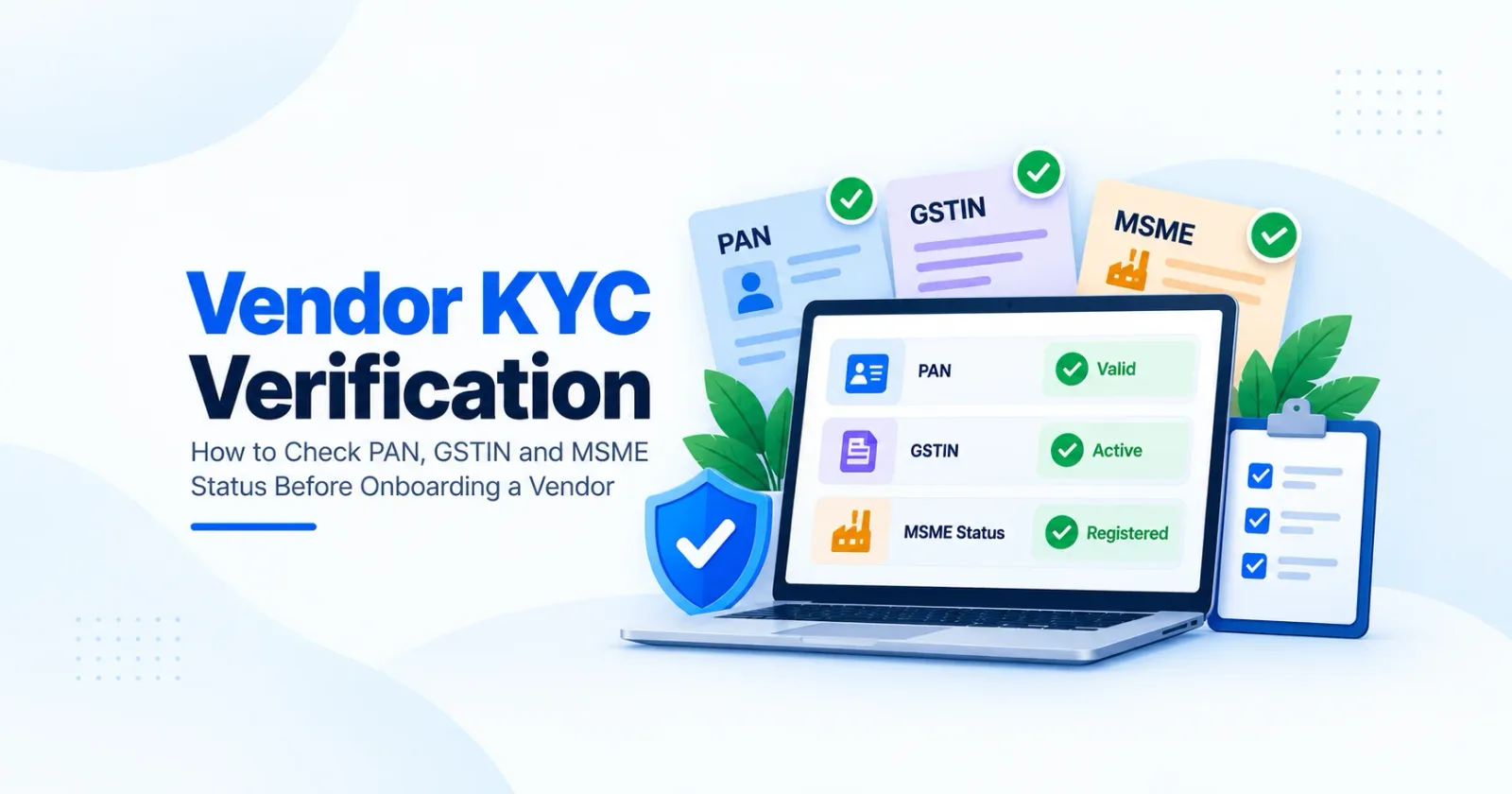
The four vendor KYC checks
| Check | What it tells you | What goes wrong without it |
|---|---|---|
| PAN verification | Whether the PAN is valid, operative and matches the vendor's name | TDS at a higher rate; wrong deductee details in TDS returns |
| GSTIN verification | Whether the GST registration is active, cancelled or suspended, and the legal name | ITC on invoices from an invalid registration is at risk |
| GST filing status | Whether the vendor is filing its GST returns | Your invoices may not reach GSTR-2B, so ITC is at risk |
| MSME (Udyam) status | Whether the vendor is a micro, small or medium enterprise | Payments to micro and small vendors may miss the MSMED Act time limits |
1. PAN verification
2. GSTIN verification
3. GST return filing status
4. MSME (Udyam) status
Other checks worth adding
Bank account validation, so payments go to an account in the vendor's name. Lower or nil deduction certificate, if the vendor gives one: record the certificate number, the limit and the validity period, and stop applying the lower rate once either runs out. Company status on MCA, for corporate vendors, so you are not onboarding a company that has been struck off. See our MCA strike-off status guide.
Vendor onboarding KYC checklist
PAN collected, verified, name matched and status (operative/inoperative) recorded with the date. GSTIN verified as active; legal name and state code match the vendor's documents. PAN inside the GSTIN matches the vendor's PAN. GST return filing status checked. Udyam number verified, or a PAN-based MSME check run; category recorded. Vendor declaration taken if the vendor says it is not registered as an MSME. Bank account validated in the vendor's name. Lower deduction certificate (if any) recorded with limit and validity. Maker-checker approval before the vendor is activated for payment. Re-check date set (at least yearly, and after 1 April for MSME classification).
When to re-check vendors
Every year after 1 April, when MSME classifications can change based on the previous year's data. Before high-value or long-term contracts. When ITC mismatches appear for a supplier in GSTR-2B reconciliation. When a TDS default shows a PAN error for a deductee.
How VenCPC handles vendor KYC
Vendor registration by GSTIN, PAN or MSME data, including vendors registered by PAN only or unregistered. Real-time GST and PAN validation through Income Tax and GSTN APIs, flagging discrepancies and partial matches for review. MSME (Udyam) number and category recorded in the vendor master. Lower deduction certificate details captured for TDS. Maker-checker approval workflows with role-based branch access before a vendor is activated. Vendor GST filing status and ITC monitoring after onboarding.
Key takeaways
Vendor KYC verification protects TDS, GST input tax credit and MSME payment compliance. Check PAN status (operative or not), GSTIN status, GST filing status and MSME category before activating a vendor. The PAN inside a GSTIN is a quick cross-check against the PAN the vendor gives you. Record every check with a date, and re-check at least yearly.
Frequently Asked Questions
It is the set of checks run before a supplier is added to the vendor master: verifying PAN, GSTIN, GST filing status, MSME status and bank details, so payments, TDS and ITC are handled correctly.
TDS is deducted as if no PAN had been furnished, at a higher rate. Check PAN status at onboarding and again before large payments.
Use the Search Taxpayer service on the GST portal, which shows whether the registration is active, cancelled or suspended, or use a GST verification API for bulk checks.
ITC depends on the supplier reporting your invoice in its returns so it appears in your GSTR-2B. A vendor who does not file puts your ITC at risk.
At least once a year, after 1 April for MSME classification, and whenever ITC mismatches or TDS PAN errors appear for a vendor.