MSMED (Amendment) Act, 2026: What Changes for Companies That Buy from MSMEs
Parliament passed the Micro, Small and Medium Enterprises Development (Amendment) Bill on 7 August 2026, and it received Presidential assent on 13 August 2026. It is the first broad rewrite of the MSMED Act, 2006.
Most explainers look at the Act from the MSME's side. This one is for the other side of the invoice: companies, PSUs, banks and their auditors who buy from micro and small enterprises (MSEs). If you owe money to MSEs, the Act changes what you must disclose, how disputes against you run, and how quickly an award can be enforced.
Quick answer :
The payment limit is unchanged: 15 days without an agreement, 45 days at most with one. What changes is enforcement. Buyers who fail to disclose MSE dues face graded penalties up to ₹1 lakh. Central PSUs must pay MSME invoices through TReDS. Disputes run on 90-day timelines at the supplier's location. A buyer challenging an award deposits 75%, and at least half is released to the supplier if the challenge drags past six months.
When does it apply?
The Act takes effect on dates the Central Government notifies, and different provisions can start on different dates. As of 3 October 2026, no commencement notification has been published. Until then, the 2006 provisions apply.
One part is already live: the MSME Ministry's notification of 30 June 2026 requiring Central PSUs to route MSME invoices through TReDS.
What does not change
The payment limit. Section 15 still requires payment within the agreed period, capped at 45 days from acceptance, or 15 days if there is no written agreement. Interest. Section 16 interest is still compound at three times the RBI bank rate with monthly rests, and Section 23 still makes it non-deductible. The tax rule. Section 43B(h) (now Section 37(2)(g) of the Income-tax Act, 2025 from tax year 2026-27) still defers the deduction for late payments to MSEs. MSME Form 1. Companies still file the half-yearly return for MSE dues outstanding beyond 45 days.
The 6 changes that matter to buyers
1. Penalties for not disclosing MSE dues
Section 22 requires a buyer whose accounts are audited to disclose unpaid MSE dues and interest in its annual statement of accounts. Under the 2006 Act the penalty was a fine of at least ₹10,000. The amended Section 27 grades it:
| Default | Consequence |
|---|
| First | Warning |
| Second | Penalty of ₹10,000 to ₹50,000 |
| Third and later | Fine of ₹50,000 to ₹1 lakh |
The minimum amounts rise by 10% every three years. Penalties are imposed by the Development Commissioner (MSME) under a new Section 27A, with appeals decided within 60 days.
What it means: the Section 22 note in your accounts is now an enforced disclosure, not a formality. It must agree with MSME Form 1 and the tax audit report.
2. TReDS for public sector buyers
New Section 15A requires every Central PSU to settle invoices for goods and services bought from MSMEs through an RBI-authorised TReDS platform. The Centre and the States can extend the requirement to other authorities, bodies, PSUs and entities by notification. Entities covered must disclose the MSME invoices routed and settled on TReDS.
The 30 June 2026 notification already requires CPSEs to do this and to get their statutory auditor to certify TReDS registration and compliance. The MSME supplier still decides whether to discount the invoice.
What it means: if you are a CPSE, TReDS compliance is now an audit item. If you are a private company, watch for notifications extending the rule.
3. Faster disputes, at the supplier's location
When an MSE refers a payment dispute to the MSE Facilitation Council (MSEFC):
mediation must finish within 90 days of the first appearance date; if it fails, the Council must refer the case to arbitration within 30 days; the arbitral award must come within 90 days of the completion of pleadings.
The Council or ADR institution where the supplier is registered has jurisdiction, wherever the buyer is. Proceedings can run online. States can now set up several Councils, each with three to five members.
What it means: a buyer can no longer expect a payment dispute to take years. Keep acceptance dates, agreements and payment records ready to produce within weeks.
4. Challenging an award costs more
A buyer who applies to set aside an award or mediated settlement must first deposit 75% of the amount, as before. Now the court may release part of the deposit to the supplier while the case is pending, and must order at least 50% paid to the supplier if the challenge is pending for more than six months.
5. Awards are recoverable like tax arrears
Mediated settlements and arbitral awards can be recovered as arrears of land revenue through the District Collector where the buyer's assets are. They are also treated as legally enforceable debts for the Insolvency and Bankruptcy Code.
6. Classification and registration
The Act now names both investment and turnover as the classification test. The limits notified from 1 April 2025 (micro up to ₹2.5 crore investment and ₹10 crore turnover; small up to ₹25 crore and ₹100 crore; medium up to ₹125 crore and ₹500 crore) continue until new ones are notified. Registration becomes free and voluntary on a national digital platform, and States can run their own.
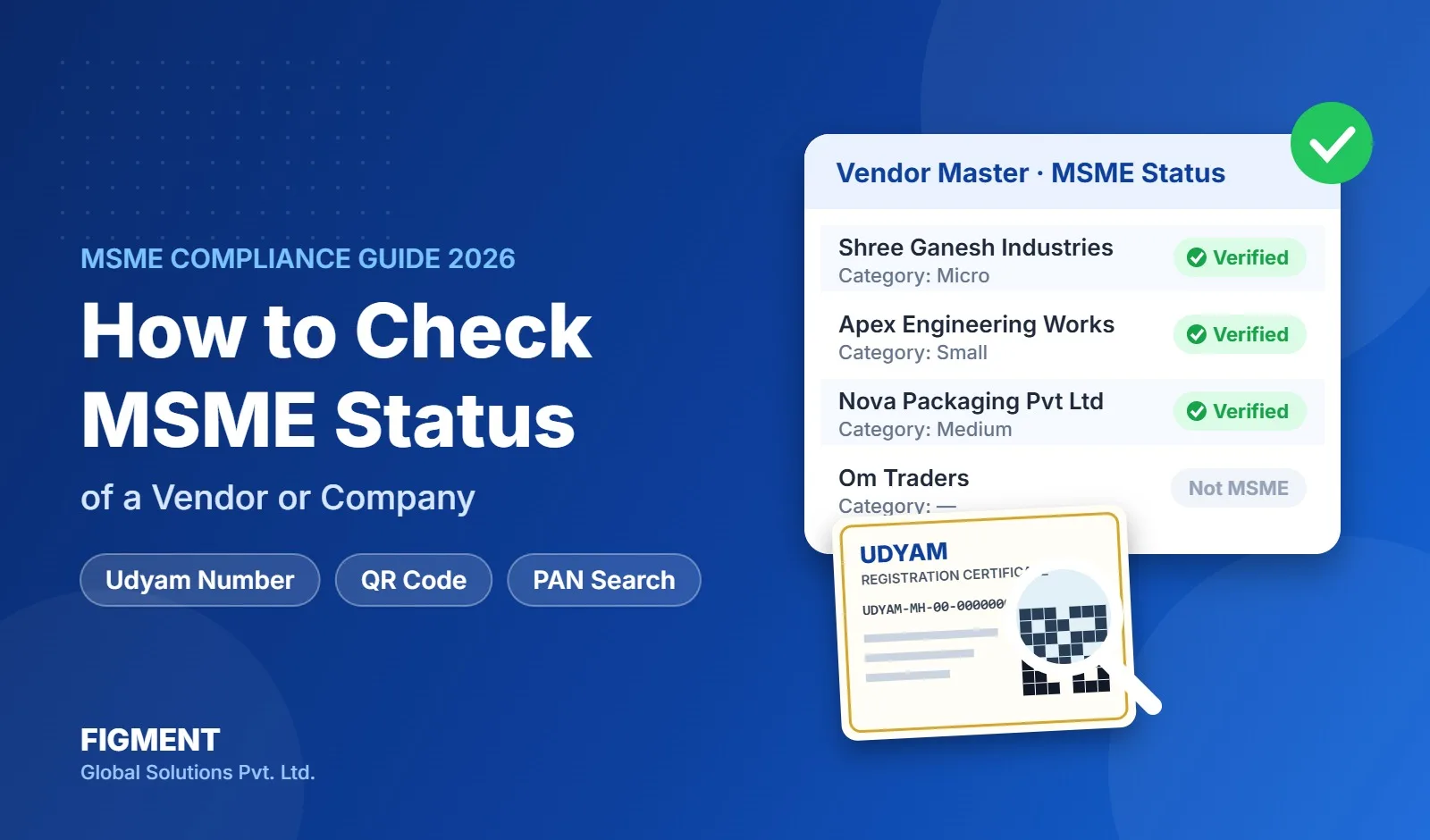
What it means: the MSME status in your vendor master still depends on the supplier's Udyam (or successor) registration and category, and that category can change every year.
What finance teams should do now
Re-verify the vendor master. Confirm which suppliers are micro or small this year, not just "MSME". Medium enterprises are outside Section 15 and 43B(h). Record acceptance dates and agreed terms for every MSE invoice. They decide the 15- or 45-day limit, and they are your evidence before the Council. Reconcile the three MSME numbers: the Section 22 / Schedule III note, MSME Form 1, and the tax audit report. A mismatch is now a penalty risk. PSUs: confirm TReDS registration and that every MSME invoice is routed through it before the statutory audit. Track open MSEFC cases and provide for 50% release where challenges are older than six months.
How Figment helps
Figment's MSME compliance solution verifies the Udyam status and category of your whole vendor list in bulk, so you know exactly which suppliers the payment rule, the Section 22 disclosure and MSME Form 1 cover. The same check runs at vendor onboarding in VenCPC and from your ERP through the MSME verification API.
Key takeaways
The 15/45-day limit and 43B(h) are unchanged; enforcement is what changed. Not disclosing MSE dues now carries graded penalties up to ₹1 lakh. CPSEs must pay MSME invoices through TReDS; others may follow by notification. Disputes run on 90-day timelines at the supplier's location, and half an award can reach the supplier within six months of a challenge. The Act starts on notified dates; check the commencement status before relying on a provision.