

What section 16(4) actually says
It is a cut-off on entitlement, not an extension. It does not extend any return due date, and it does not make a credit available that fails any other test. "Taking" credit means claiming it in GSTR-3B. Recording an invoice in your books, or seeing it in GSTR-2B, is not a claim. The claim happens only when it is reported in a GSTR-3B furnished on or before the cut-off. Debit notes follow the year of the debit note, not the year of the original invoice. A debit note dated April 2026 against a FY 2025-26 invoice belongs to FY 2026-27.
Which return carries the FY 2025-26 claim?
Monthly GSTR-3B filers
| Return | Normal due date | Can it carry FY 2025-26 ITC? |
|---|---|---|
| September 2026 GSTR-3B | 20 October 2026 | Yes |
| October 2026 GSTR-3B | 20 November 2026 | Yes — if filed on or before 30 November 2026 |
| November 2026 GSTR-3B | 20 December 2026 | No — filed after the cut-off |
QRMP (quarterly) filers
| Return | Normal due date | Can it carry FY 2025-26 ITC? |
|---|---|---|
| July–September 2026 GSTR-3B | 22 / 24 October 2026 (by state) | Yes |
| October–December 2026 GSTR-3B | 22 / 24 January 2027 | No — cannot be filed before quarter-end |
The annual return trap
GSTR-2B, IMS and supplier corrections
GSTR-2B is evidence, not permission
invoices for goods not yet received; blocked items such as motor vehicles, food and beverages or works contract for immovable property; invoices already claimed in an earlier period; invoices with errors that the supplier later amends.
Supplier uploads and the October GSTR-2B
Invoice Management System (IMS)
Accepted and no-action (deemed accepted) records flow into GSTR-2B. Deemed acceptance is an administrative default — it does not certify that section 16 conditions are met. Pending records stay out of GSTR-2B. A pending item is not a claim; if it is still pending when the October return is filed, the FY 2025-26 credit is lost. Rejected credit notes affect the supplier's output tax adjustment, so align with the vendor before rejecting. Since GSTN's October 2025 IMS update, credit notes (and downward amendments of documents) can also be kept pending — but only for one tax period. The same update lets the recipient enter the actual ITC reversal amount when accepting a credit note, rather than reversing the full tax shown.
Other rules that interact with 30 November
Rule 37A — supplier has not filed GSTR-3B
Rule 37 — 180-day payment condition
Credit notes and the supplier's deadline
Common credit (Rules 42 and 43)
Sections 16(5) and 16(6) are not a general waiver
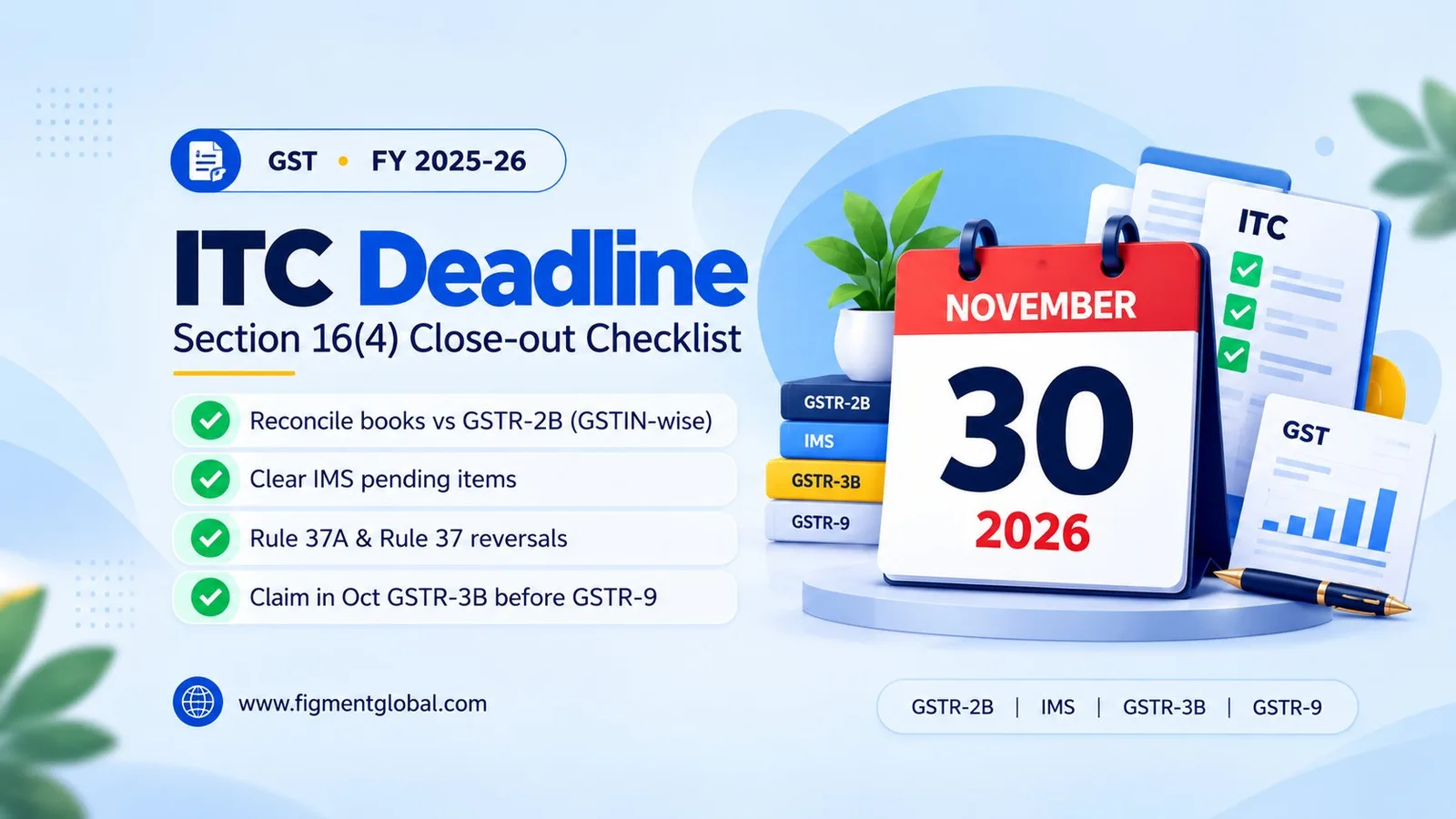
FY 2025-26 ITC close-out checklist
| # | Check | Owner | Action if it fails |
|---|---|---|---|
| 1 | Invoice is in books but not in GSTR-2B | AP / GST team | Ask the supplier to file before the 11 Nov cut-off; do not claim on assumption |
| 2 | Invoice is in GSTR-2B but goods/services not received | Stores / AP | Hold; claim only after receipt and only if before the cut-off |
| 3 | Invoice already claimed in an earlier GSTR-3B | GST team | Block duplicate; use a key of supplier GSTIN + document no. + date + taxable value + tax |
| 4 | Item falls under section 17(5) | Tax reviewer | Mark ineligible; do not claim |
| 5 | Common credit for taxable and exempt use | Tax reviewer | Apply Rules 42/43 and complete the annual true-up |
| 6 | Supplier has not filed GSTR-3B by 30 Sep 2026 | GST team | Reverse under Rule 37A by 30 Nov 2026 |
| 7 | Supplier not paid within 180 days | AP | Reverse under Rule 37; re-avail on payment |
| 8 | Credit note or amendment received | AP / GST team | Link to the original invoice; claim only the net amount |
| 9 | IMS record still pending | GST team | Decide accept/reject before October GSTR-2B is finalised |
| 10 | GSTR-9 being prepared | Tax head | File only after the last ITC-carrying GSTR-3B is filed |
A worked example
| FY 2025-26 position for one GSTIN | Amount (₹) |
|---|---|
| Unmatched pool in books | 8,40,000 |
| Less: already claimed in earlier GSTR-3B | (3,10,000) |
| Less: blocked / ineligible under section 17(5) | (1,25,000) |
| Less: supplier mismatch pending correction | (2,05,000) |
| Balance that may be claimable, subject to all tests | 2,00,000 |
Weekly exception review in November
What 30 November 2026 does not mean
It is not an extension of any GSTR-3B or GSTR-9 due date. It does not allow credit without receipt of goods or services. It does not make blocked credits eligible. It does not guarantee that a late supplier upload will reach a GSTR-2B in time. It does not override an earlier GSTR-9 filing date.
How GSTCPC handles the FY 2025-26 ITC close-out
GSTR-2B/2A reconciliation of the purchase register at invoice level, showing matched, mismatched and missing invoices for each GSTIN, with AI-assisted match suggestions. IMS actions — accept, reject or pending — recorded against the purchase register before records reach GSTR-2B. ITC tracking and mismatch reports before GSTR-3B is filed, plus a temporary reversal and reclaim ledger for Rule 37 and Rule 37A movements. Vendor follow-up, so discrepancies and reminders go to suppliers from one place. Multi-GSTIN management with consolidated and state-wise reports, and maker-checker access controls for preparing, reviewing and filing GSTR-3B and GSTR-9.
Key takeaways
The GST ITC deadline for FY 2025-26 is 30 November 2026, or the GSTR-9 filing date if earlier. For monthly filers, the October 2026 GSTR-3B filed by 30 November is the last return that can carry it; for QRMP filers, it is the July–September 2026 return. Supplier uploads must land before the October GSTR-2B cut-off in mid-November. Treat Rule 37A, Rule 37, credit notes and blocked credits as separate tests. Reconcile at GSTIN and document level, and keep a signed exception register.
Frequently Asked Questions
It is the outer limit under section 16(4). If you file the FY 2025-26 GSTR-9 before 30 November, your cut-off is the GSTR-9 filing date. Every other section 16 and 17 condition must also be met.
Yes, provided the return is filed on or before 30 November 2026 and all conditions are met. If it is filed after 30 November, the FY 2025-26 credit in it is time-barred.
The July–September 2026 GSTR-3B, due on 22 or 24 October 2026 depending on the state. The October–December return can only be filed after 31 December, which is too late.
No. GSTR-2B shows what the supplier reported. You still need receipt of goods or services, a valid document, supplier tax payment, and the item must not be blocked under section 17(5).
No. Re-availment after payment applies only to credit that was claimed in time and then reversed under Rule 37. A credit never claimed before 30 November cannot be claimed later.