
What has changed
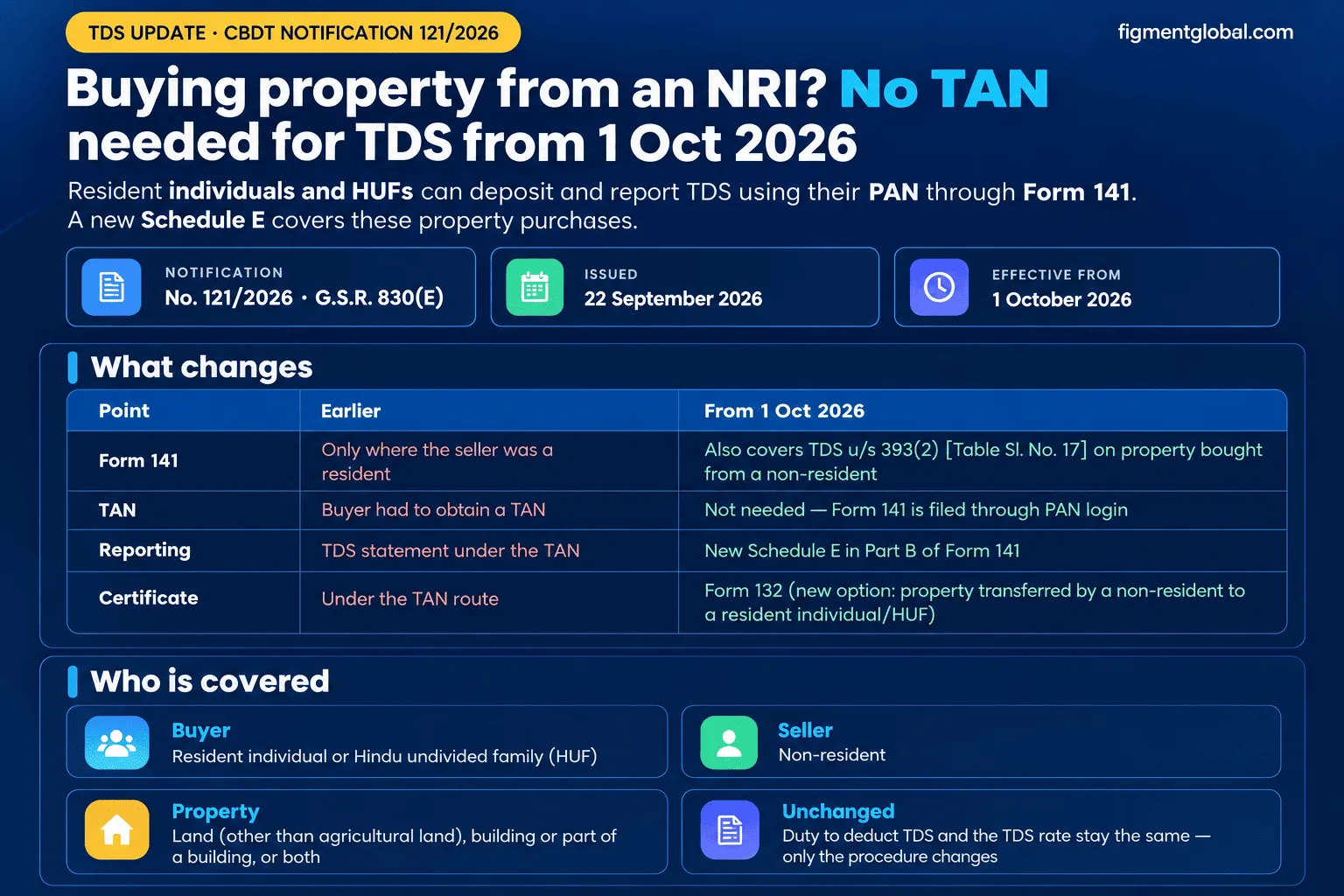
| Point | Before 1 October 2026 | From 1 October 2026 |
|---|---|---|
| Form used | For property purchases, Form 141 previously covered payments to resident sellers | Form 141 also covers TDS under section 393(2) [Table: Sl. No. 17] on property bought from a non-resident |
| TAN | Buyer had to obtain a TAN to deduct and deposit TDS on payment to a non-resident seller | No TAN needed; Form 141 is filed through the buyer's PAN login |
| Reporting | Separate TDS statement under the TAN | New Schedule E in Part B of Form 141 |
| TDS certificate | Issued under the TAN route | Form No. 132, with a new option for property transferred by a non-resident to a resident individual or HUF |
Who can use Form 141 Schedule E
The buyer is a resident individual or a Hindu undivided family (HUF) The seller is a non-resident The property is land (other than agricultural land), a building or part of a building, or both TDS is deductible under section 393(2) [Table: Sl. No. 17] of the Income-tax Act, 2025 on the sale consideration
Details required in Schedule E of Form 141
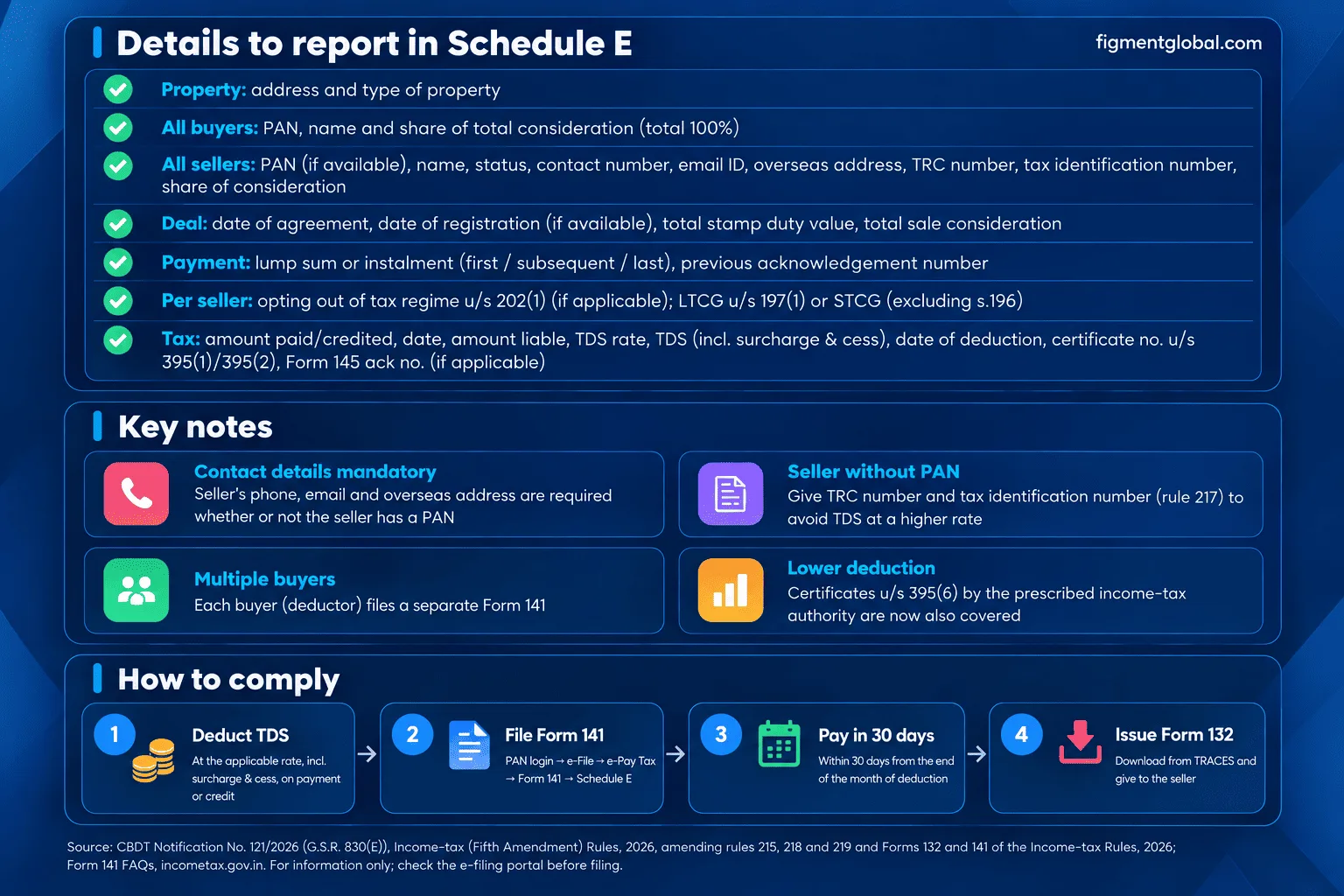
Property: address, and type of property (land other than agricultural land, building or part of a building, or both) All buyers: PAN, name and share of the total sale consideration (total 100%) All sellers: PAN if available, name, status, contact number, email ID, address in the country of residence, tax residency certificate number, tax identification number and share of the consideration (total 100%) Deal: date of agreement, date of registration (if available), total stamp duty value and total sale consideration Payment: lump sum or instalments; for instalments, whether first, subsequent or last, the previous acknowledgement number, and for the last instalment the total consideration paid Per seller: whether the seller is opting out of the tax regime under section 202(1), if applicable, and type of capital gain (long-term under section 197(1) or short-term excluding section 196) Tax: proportionate stamp duty value, amounts paid earlier and now, date of payment or credit, amount on which tax is deductible, TDS rate, TDS amount, date of deduction and lower or nil deduction certificate number under section 395(1) or 395(2), if any Acknowledgement number of the corresponding Form No. 145, if applicable
Important notes in the revised Form 141
The seller's contact number, email ID and overseas address are mandatory, whether or not the seller has a PAN If the non-resident seller has no PAN, obtain the applicable details and documents under rule 217, including overseas tax identification, contact details, etc. Relief from higher TDS depends on meeting its conditions The TDS amount must include surcharge, if applicable, and cess Where there is more than one buyer, each buyer files a separate Form 141 Lower deduction certificates issued under section 395(6) by the prescribed income-tax authority are now also covered Some details in the form will be pre-filled where possible
Deduct TDS at the applicable rate
Deduct tax, including surcharge and cess, when you pay or credit the sale consideration to the non-resident seller. File Form 141 with your PAN
Log in to the e-filing portal with your PAN and go to e-File > e-Pay Tax > Income Tax Act, 2025 > New Payment > Form 141, then choose the non-resident property option and fill Schedule E. Deposit TDS within 30 days
Pay the tax with Form 141 within 30 days from the end of the month in which it was deducted. Issue Form 132 to the seller
Generate and download Form 132 from TRACES portal and give it to the seller within 15 days from the due date for furnishing Form 141
Portal update awaited
Frequently Asked Questions
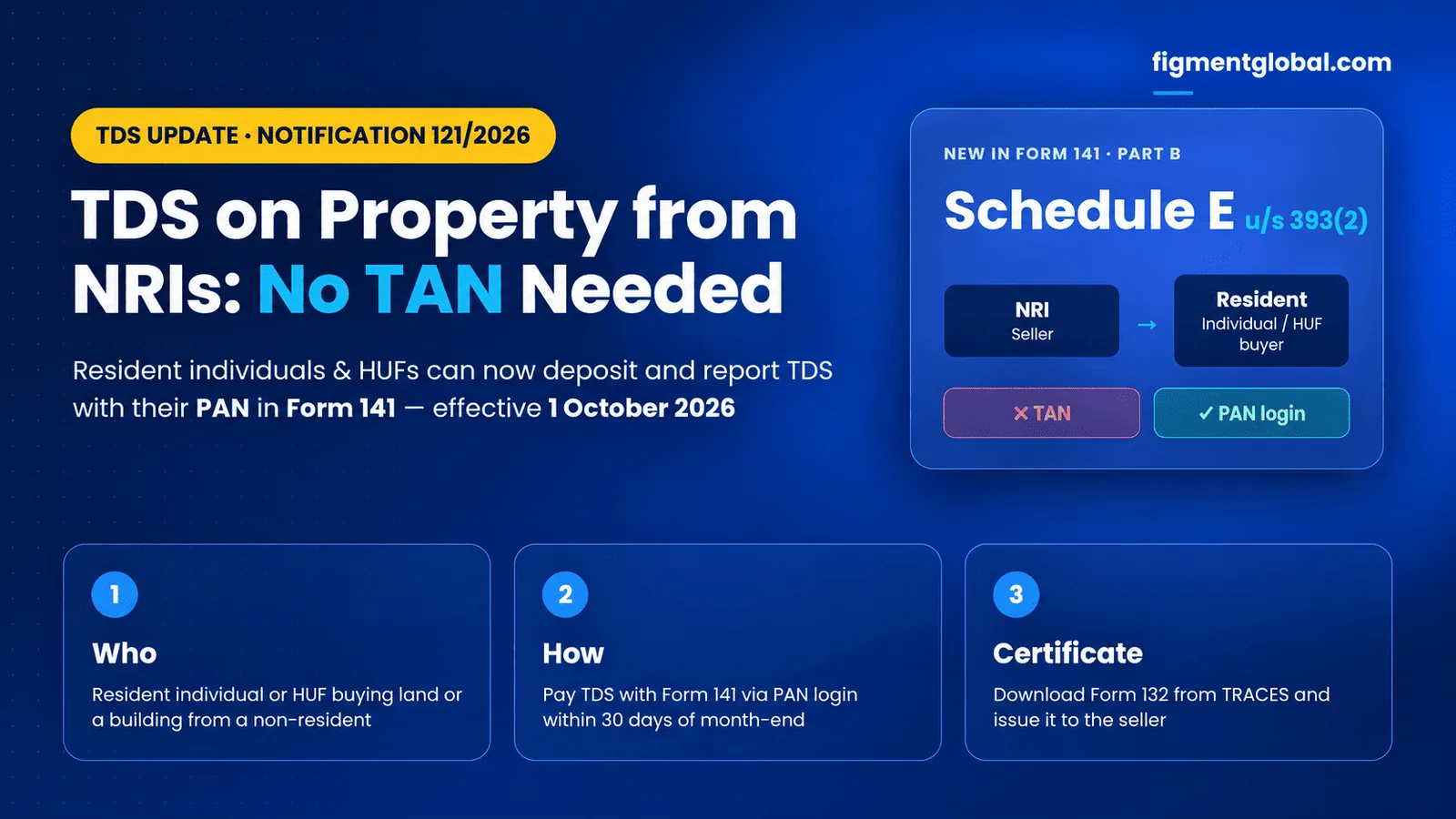
From 1 October 2026, a resident individual or HUF buying immovable property from a non-resident can deposit and report TDS through Form 141 using their PAN, so a TAN is not needed for this.
Schedule E is a new schedule inserted in Form 141 by CBDT Notification No. 121/2026. It is used to report TDS on consideration for transfer of immovable property by a non-resident under section 393(2) [Table: Sl. No. 17].
The Income-tax (Fifth Amendment) Rules, 2026 come into force on 1 October 2026.
The buyer must give the seller's tax residency certificate number and tax identification number as per rule 217, so that tax is not deducted at a higher rate. The seller's contact number, email ID and overseas address are mandatory in all cases.
No. The notification changes only how TDS is deposited and reported. The obligation to deduct tax and the applicable rate stay the same.