Four Reporting Regimes, One Transition: What the Income-tax Act, 2025 Changes for FATCA-CRS, SFT, PAN Quoting and Form 15CC
Note
From 1 April 2026, the reporting that feeds your Annual Information Statement runs on new sections, new rules and new form numbers. FATCA-CRS now reaches e-money, the digital rupee and crypto. SFT thresholds depend on whether you have a PAN. Form 60 has become Form 97, and Form 15CC is now Form 147. Here is what changed and what it means in practice.
Most people never see an SFT return, a FATCA-CRS report, a PAN Quoting statement or a Form 15CC. They see what those filings produce: a line in their AIS, a question from their bank about a foreign remittance, a request to quote their PAN (or sign a declaration if they don't have one), or a FATCA-CRS self-certification form they don't quite understand. Each of these comes from reporting that banks, insurers, mutual funds, registrars, fintech platforms and many businesses file with the Income Tax Department every year. The high-value transactions you see in your AIS come from SFT reporting. Account details of foreign tax residents are reported under FATCA-CRS. Transactions made without a PAN are reported under PAN Quoting. Foreign remittances handled by authorised dealer banks are reported in Form 15CC.
When the Income-tax Act, 2025 replaced the Income-tax Act, 1961 on 1 April 2026, and the Income-tax Rules, 2026 (notified on 20 March 2026) replaced the 1962 Rules, all four of these reporting streams moved at the same time. Some changes are only renumbering. Others are real changes in scope and thresholds that will decide whether a transaction gets reported at all.
The overall shape of the new law is also leaner. The old Act had 819 sections, 511 rules and 399 forms. The new one has 536 sections across 23 chapters, 333 rules and 190 forms. For anyone who files or relies on these statements, that means most of the references in your templates, checklists and system screens are now out of date.
We have gone through the notified rules, the forms and the guidance the CBDT has released since April, and set out below what has changed in each stream, where the real work lies and what individuals and businesses should keep an eye on.
Old forms, new numbers
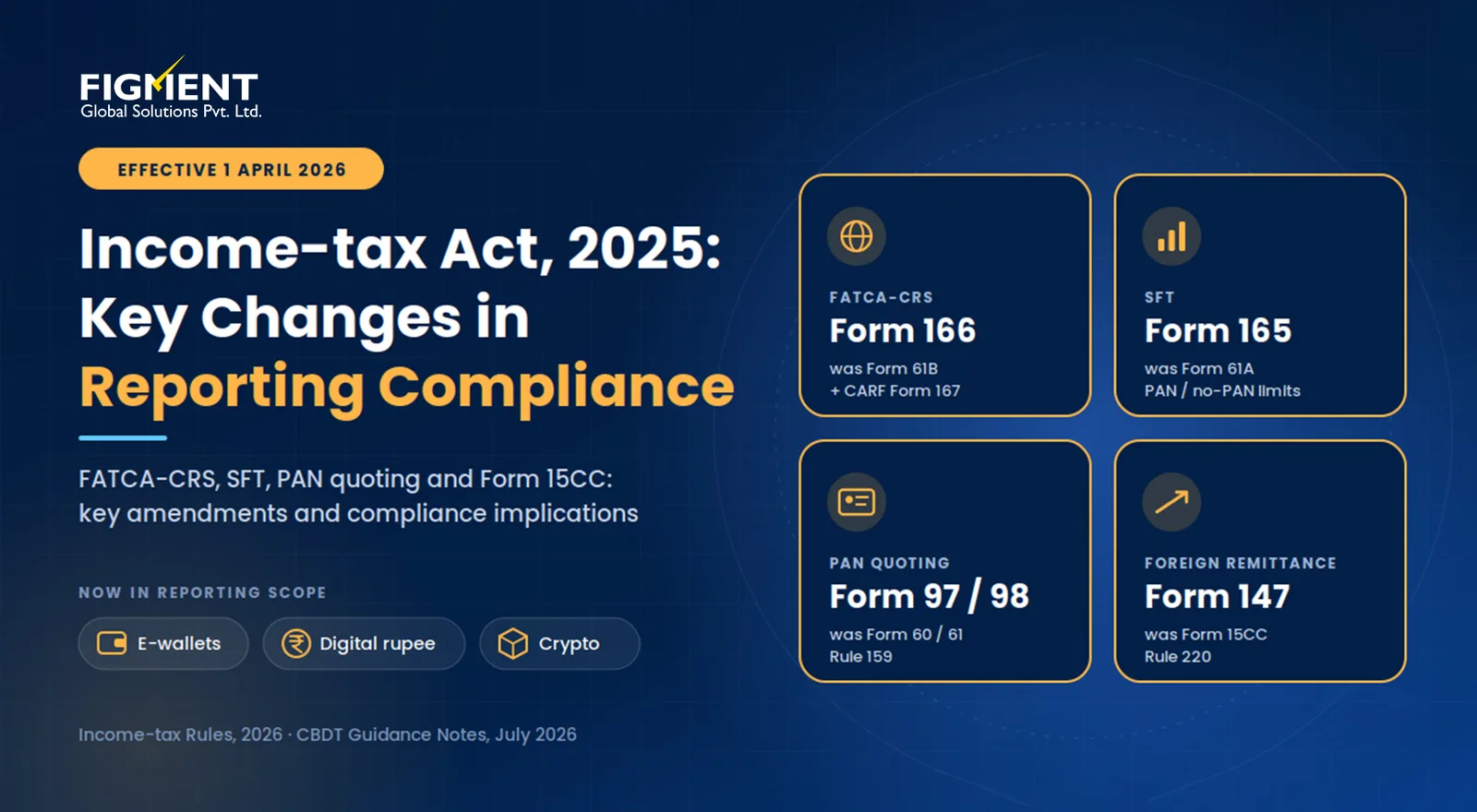
Before looking at what changed inside each stream, it helps to have the new references in one place. Keep this table handy, because you will see both sets of numbers for a while.
| Reporting stream | Under the 1961 Act and 1962 Rules | Under the 2025 Act and 2026 Rules |
|---|
| FATCA and CRS | Section 285BA, Rules 114F to 114H, Form 61B | Section 508, Rules 238 to 240, Form 166 |
| Statement of Financial Transactions (SFT) | Section 285BA, Rule 114E, Form 61A | Section 508(1), Rule 237, Form 165 |
| Crypto-asset reporting (CARF) | No separate framework | Section 509, Rules 241 to 244, Form 167 |
| PAN quoting for specified transactions | Section 139A(5)(c), Rule 114B | Section 262, Rule 159 |
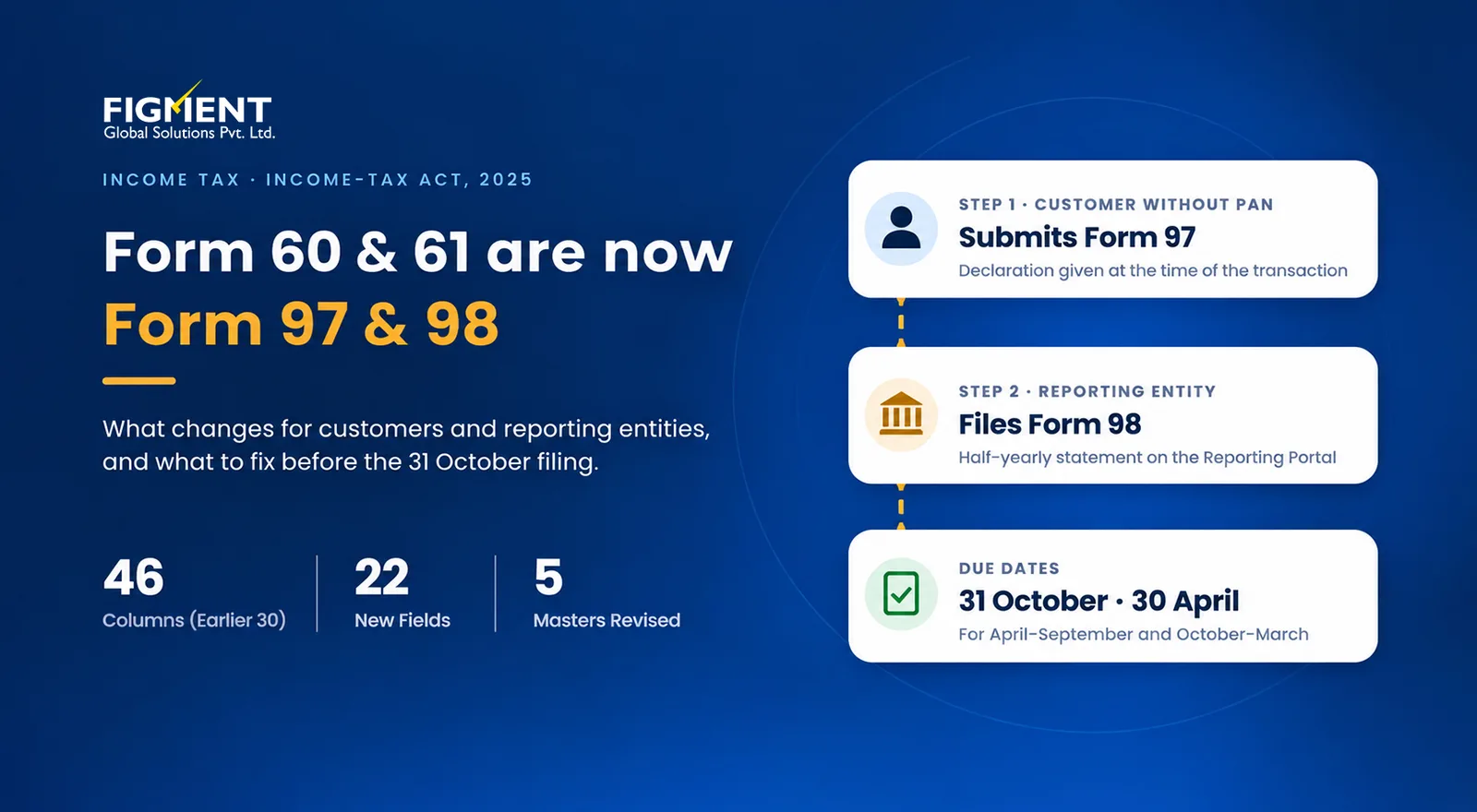
| Declaration where there is no PAN | Form 60 | Form 97 |
| Statement of Form 60 declarations received | Form 61 | Form 98 |
| Pre-remittance declaration by the payer | Form 15CA | Form 145 |
| Chartered accountant's certificate | Form 15CB | Form 146 |
| Quarterly statement by the authorised dealer | Form 15CC (Rule 37BB) | Form 147 (Rule 220) |
| Quarterly statement by an IFSC unit | Form 15CD | Form 148 |
One point that is easy to forget: the old numbers do not disappear on 1 April 2026. Returns, corrections and notices that relate to FY 2025-26 and earlier years still refer to the 1961 Act and its forms. The new numbers apply from Tax Year 2026-27. So for at least a year or two, both sets will sit side by side in most offices.
FATCA and CRS: e-wallets, the digital rupee and crypto are now in scope
FATCA and CRS are how India shares information about financial accounts held by foreign tax residents with other countries, and how it receives similar information about Indians' accounts abroad. The reporting is done by Reporting Financial Institutions (RFIs). Until now, most people linked this only with banks, insurers, mutual funds and depositories. That list is now wider.
From Form 61B to Form 166
FATCA-CRS reporting now sits under Section 508 of the Income-tax Act, 2025, read with Rules 238 to 240 of the Income-tax Rules, 2026. The annual statement is Form 166, which replaces Form 61B from 1 April 2026. The due date has not moved: 31 May every year.
On 24 July 2026 the CBDT released a fully revised Guidance Note on FATCA and CRS. It replaces the version last updated in November 2016, reflects the new Act and Rules, and adds the OECD's 2025 consolidated CRS text. It also carries 100 FAQs, several of which deal with wallets, prepaid instruments, the digital rupee and crypto.
Who is newly covered
The 2025 amendments to the CRS added three things, all effective from 1 January 2026 for non-US accounts:
Specified Electronic Money Products (SEMPs). An entity that holds e-money for customers is now treated as a Depository Institution. The Guidance Note says in plain terms that mobile wallet operators and e-money issuers holding SEMPs fall in this category. Central Bank Digital Currency (CBDC). An account holding the digital rupee (e₹) or any other CBDC for a customer is now a Financial Account. Entities that hold CBDC for retail customers are Depository Institutions for those accounts. Relevant crypto-assets. For CRS, "financial assets" now reads as "financial assets or relevant crypto-assets". An entity that invests, administers or manages crypto-assets for customers can become an Investment Entity. Interests in a fund that invests in crypto-assets can also be reportable accounts.
Not every wallet balance is caught. A product counts as a SEMP only if it is a digital form of a single fiat currency, issued against funds received, accepted by people other than the issuer, and redeemable at par on demand. The Guidance Note also discusses whether every prepaid payment instrument is automatically a SEMP, and it is not. That is a product-by-product assessment.
There is also a relief for small balances. A SEMP account is excluded if its rolling 90-day average end-of-day balance never exceeded USD 10,000 during the year. For most everyday wallet users, this exclusion will apply.
New dates for the new accounts
For these new account types, the old CRS dates of 2015 and 2016 do not apply. Instead:
| Account type | Pre-existing if held on | New if opened on or after |
|---|
| SEMP, CBDC and crypto-linked accounts under CRS 2025 | 31 December 2025 | 1 January 2026 |
| Other CRS accounts | 31 December 2015 | 1 January 2016 |
| US (FATCA) accounts | 30 June 2014 | 1 July 2014 |
In practice, this means anyone opening a wallet or e₹ account from January 2026 should expect to be asked for a tax-residency self-certification at onboarding, just as they would at a bank.
Six new fields in Form 166
Form 166 asks for more than Form 61B did. The new data elements are:
1. Whether a valid self-certification is on file for the account holder. 2. Whether the account is joint, and the number of joint holders. 3. The role of each Controlling Person, such as settlor, trustee, protector or beneficiary. 4. Whether a valid self-certification is on file for each Controlling Person. 5. The account type, and whether it is pre-existing or new. 6. For trusts and similar arrangements that are Investment Entities, the role through which each person holds an equity interest.
Note
For the two role-based fields, there is a transitional relief. For pre-existing non-US accounts, the role need only be reported if it is already held in electronically searchable form, for reporting periods ending up to 31 December 2027. After that, the role must be reported for every reportable account. The Guidance Note also makes clear that all beneficiaries of a trust are Controlling Persons for CRS, regardless of the size of their interest. The 10% PMLA threshold does not apply here.
A separate framework for crypto platforms: CARF and Form 167
On the same day, the CBDT released a separate Guidance Note on Crypto-Asset Reporting Obligations. This puts in place India's version of the OECD's Crypto-Asset Reporting Framework (CARF).
| Point | CRS (Form 166) | CARF (Form 167) |
|---|
| Legal basis | Section 508, Rules 238 to 240 | Section 509, Rules 241 to 244 |
| Who reports | Reporting Financial Institutions | Reporting Crypto-Asset Service Providers (RCASPs), such as exchanges, brokers and some wallet providers |
| What is reported | Account balances, income and holder details | Crypto transactions, such as trades, transfers and certain payments, with user and tax-residency details |
| Starts from | 1 January 2026 for the new account types | Calendar year 2026 |
A business that holds crypto for customers and also runs a crypto-to-fiat exchange could fall under both. The Guidance Note includes a non-duplication rule so the same information is not reported twice. It is worth reading FAQ 24 and FAQ 68 of the FATCA-CRS Guidance Note together with the CARF note before deciding which form covers what.
Note
For individual crypto investors, nothing new needs to be filed. The obligation is on the platforms. What changes is that the platform will ask for your tax residency and, where relevant, a foreign TIN, and that information may reach the tax authority of the country where you are resident.
Penalties
| Default | Penalty under the Income-tax Act, 2025 |
|---|
| Form 166 not filed on time [Section 454(1)] | ₹500 per day of continuing default |
| Form 166 not filed within the period in a notice under Section 508(7) [Section 454(2)] | ₹1,000 per day from the end of the notice period |
| Inaccurate information, failure to correct it, or failure to follow due diligence [Section 455(1)] | ₹50,000 |
| Inaccuracy caused by false information from an account holder [Section 455(2)] | ₹5,000 per inaccurate account, in addition |
SFT: Form 61A becomes Form 165, and PAN now decides the threshold
The Statement of Financial Transactions (SFT) is the main source of the high-value entries you see in your AIS. Banks, post offices, registrars, mutual funds, companies, insurers and others report specified transactions every year, and the department matches them against income tax returns.
Under the new law, Rule 114E is replaced by Rule 237 and Form 61A by Form 165, filed under Section 508(1). The purpose is the same. What has changed is how the thresholds work.
One threshold for PAN holders, a lower one for everyone else
For several transactions, Rule 237 now sets two limits: one where the person has a PAN, and a lower one where they do not. The thinking is simple. If there is no PAN to match against, the department wants to see the transaction earlier.
| Transaction (aggregate in a year, unless stated) | Rule 114E (old) | Rule 237 (new) |
|---|
| Cash deposits in savings and other non-current accounts | ₹10 lakh | ₹10 lakh with PAN, ₹5 lakh without PAN |
| Cash deposits or withdrawals in current accounts | ₹50 lakh | ₹50 lakh (no change) |
| Cash purchase of bank drafts, pay orders or banker's cheques | ₹10 lakh | ₹10 lakh with PAN, ₹5 lakh without PAN |
| Foreign exchange sold, including through forex cards, travellers' cheques and drafts | ₹10 lakh | ₹10 lakh with PAN, ₹5 lakh without PAN |
| Credit card bills paid in cash | ₹1 lakh | ₹1 lakh (no change) |
| Credit card bills paid by any other mode | ₹10 lakh | ₹10 lakh (no change) |
| Shares, mutual fund units, bonds and debentures | ₹10 lakh | ₹10 lakh (no change) |
| Share buyback | ₹10 lakh | ₹10 lakh (no change) |
| Cash receipts for sale of goods or services | ₹2 lakh per transaction | ₹2 lakh (no change) |
| Purchase or sale of immovable property | ₹30 lakh | ₹45 lakh |
The property threshold is the only one that has gone up. Moving from ₹30 lakh to ₹45 lakh takes a large number of smaller property deals out of SFT reporting. The same ₹45 lakh limit now also covers gifts of property and joint development agreements, which were not separately tracked before.
New transactions that are now reported
| New item | Threshold | Usually reported by |
|---|
| Purchase of stamp paper | ₹2 lakh with PAN, ₹1 lakh without PAN | Stock Holding Corporation of India (SHCIL) |
| Insurance premium | ₹5 lakh with PAN, ₹2.5 lakh without PAN | Insurers |
| Gift of immovable property, or a joint development agreement | ₹45 lakh | Registrars and sub-registrars |
Not every SFT is annual any more
Most SFT categories are still filed once a year, by 31 May. But SFT for listed securities and mutual fund units is now reported half-yearly. That data is also used to pre-fill the capital gains schedule in the ITR. If your organisation deals in securities, runs a depository or distributes mutual funds, the reporting calendar now has two cycles, not one.
Penalty is now a capped fee
The late-filing penalty has been restructured as a fee. It is still ₹500 a day before a notice and ₹1,000 a day after it, but the total is now capped at ₹1 lakh per default. The separate ₹50,000 penalty for inaccurate information or failure to follow due diligence continues, and it is not capped. Note that this capped structure applies to SFT. It should not be assumed for Form 166, which has its own penalty provisions, set out above.
What it means for you as a taxpayer
Note
Nothing here creates a new tax. It changes what the department sees. If you have a PAN and deposit ₹8 lakh in cash in your savings account in a year, it will not show up through SFT. If you do the same without a PAN, it will. And if you buy stamp paper worth ₹2 lakh or more for a property deal, expect it to appear in your AIS. The simplest protection is to check your AIS every year before filing your return and raise feedback on any entry that looks wrong.
Transactions without PAN: Rule 159, Form 97 and Form 98
The rule that tells you when you must quote your PAN was Rule 114B. It is now Rule 159, made under Section 262 of the new Act. It is not just a renumbering. The old rule was a table with provisos. The new one has a detailed table, eight sub-rules, and it names who is responsible for collecting the PAN in each case, for example the bank manager, the principal officer or the registrar.
The limits that changed
| Transaction | Rule 114B (old) | Rule 159 (new) |
|---|
| Cash deposits with a bank or post office | More than ₹50,000 in a single day | ₹10 lakh or more in a year, across accounts |
| Cash withdrawals from a bank or post office | Not covered | ₹10 lakh or more in a year, across accounts |
| Sale or purchase of immovable property | More than ₹10 lakh | More than ₹20 lakh |
| Purchase of a motor vehicle | Any vehicle other than a two-wheeler | More than ₹5 lakh, two-wheelers included |
| Payment to a hotel, restaurant, banquet hall or event organiser | More than ₹50,000 | More than ₹1 lakh |
The cash deposit change will be felt most widely. Earlier, anyone depositing more than ₹50,000 in cash on a single day had to give a PAN or a Form 60. Now the test is annual. Day-to-day cash handling becomes simpler, but banks and post offices will need to track each customer's deposits and withdrawals over the whole year. Cash withdrawals appear in this rule for the first time.
What stays the same
The limits for most investment and banking transactions are broadly unchanged. These include credit card applications, opening a demat account, payments above ₹50,000 to mutual funds, for bonds or debentures and for RBI bonds, securities transactions above ₹1 lakh, time deposits above ₹50,000 each or ₹5 lakh in a year, and sale or purchase of goods or services above ₹2 lakh. On insurance, the new rule is framed around starting an account-based relationship with an insurer, so insurers should check the exact entry in Rule 159 against their own products.
What has been dropped
Some items that were in Rule 114B are not in Rule 159:
Payments for foreign travel and for buying foreign currency Cash purchase of bank drafts, pay orders and banker's cheques Prepaid payment instruments The provisions added during demonetisation
Dropping these from the PAN-quoting rule does not mean they have left the reporting net altogether. Foreign exchange and cash purchase of drafts are still covered by SFT, with the PAN and no-PAN thresholds described above.
Form 60 is now Form 97, and Form 61 is now Form 98
If you do not have a PAN and enter into one of these transactions, you give a declaration. That declaration was Form 60. It is now Form 97. The entity that receives Form 97 declarations reports them in Form 98, which replaces Form 61. Form 98 is filed half-yearly on the Reporting Portal: by 31 October for April to September, and by 30 April for October to March.
Form 98 is also a much larger return than Form 61. It asks for the district, identity, address and date-of-birth proofs, joint-holder details and the cash component of the transaction. The Transaction Type codes have also been redefined, so the same number now means a different transaction. We have covered this in detail in our earlier article on Form 98.
A declaration alone is no longer the end of it
The biggest shift in Rule 159 is this. Earlier, a person without a PAN could give Form 60 and complete the transaction. Now, a person entering a specified transaction without a PAN must also apply for one. Entities that accept Form 97 have to make sure PAN is quoted correctly, keep proper records and link the PAN or Form 97 to their reporting. Rule 159 does not, however, require an institution to block the transaction until the PAN is allotted. The practical approach is to flag the transaction and obtain the PAN application acknowledgement in accordance with Rule 159.
For customers, this means you will increasingly be asked for proof that you have applied for a PAN, such as the acknowledgement number, and not just a signed declaration. Once the PAN is allotted, share it with every institution where you gave Form 97, so their records and your AIS line up.
Foreign remittances: Form 15CC is now Form 147
Anyone who has sent money abroad for a business payment knows the Form 15CA and 15CB routine. Behind it sits a third form most people never see: the quarterly statement in which the authorised dealer reports every remittance it has processed. That was Form 15CC. It is now Form 147, under Rule 220 of the Income-tax Rules, 2026 (earlier Rule 37BB), read with Sections 393, 397 and 462 of the new Act. The filing obligations, forms and exempt categories below are verified against Rule 220 of the Income-tax Rules, 2026.
The four forms, renumbered
| Old form | New form | Who files it | What it does |
|---|
| Form 15CA | Form 145 | The person making the payment | Declares the remittance before it is made, including whether tax has been deducted |
| Form 15CB | Form 146 | A chartered accountant | Certifies the nature of the payment, treaty position and the correct rate of TDS |
| Form 15CC | Form 147 | The authorised dealer | Quarterly statement of all remittances made to non-residents and foreign companies |
| Form 15CD | Form 148 | A unit in an IFSC, such as GIFT City | Quarterly statement in place of per-transaction reporting |
Payments that do not need Form 145
As per Rule 220(3), no Form 145 is required for a sum not chargeable to tax in three cases:
A remittance by an individual that does not need prior RBI approval under FEMA. A remittance by a unit in an International Financial Services Centre. A remittance falling under one of the 33 RBI purpose codes listed in the rule. These cover overseas investment, loans to non-residents, imports, travel, education, freight insurance, embassy expenses, gifts and donations, and tax refunds, among others.
The list includes five import-related purpose codes, which matter to almost every business that pays foreign suppliers:
| RBI purpose code | Nature of payment as per Rule 220 |
|---|
| S0101 | Advance payment against imports |
| S0102 | Payment towards import (settlement of invoice) |
| S0103 | Imports by diplomatic missions |
| S0104 | Intermediary trade |
| S0190 | Imports below ₹5,00,000 |
Note
Being exempt from Form 145 does not take a payment out of reporting. As per Rule 220(6), the authorised dealer's quarterly Form 147 covers all remittances under sub-rules (1), (2) and (3), including these exempt ones.
What is new in Form 147
The filing rhythm has not changed, but the form now asks for more. Based on the CBDT's Form 147 guidance and FAQs, most of the new fields are aimed at tying each remittance to its Form 145 and to the person who received the money.
Form 145 acknowledgement number. Each remittance must now carry the acknowledgement number of the Form 145 filed for it. This creates a one-to-one link between what the payer declared and what the authorised dealer reports. A code where Form 145 was not needed. If the payment falls in an exempt category, the authorised dealer enters a prescribed code explaining why no Form 145 was filed. A blank is not acceptable. Taxpayer Identification Number (TIN) of the recipient. Where the recipient has no PAN, their TIN from their country of residence is to be given. Full details of the receiving account. The form now asks for the particulars of the account to which the money was sent, not just a payment reference. Aadhaar fields removed. Aadhaar details of the remitter and remittee are no longer part of the form.
Due dates, filing and penalty
| Quarter | Due date |
|---|
| April to June | 15 July |
| July to September | 15 October |
| October to December | 15 January |
| January to March | 15 April of the following tax year |
Form 147 is filed online on the e-filing portal, using the authorised dealer's ITDREIN, and verified with a Digital Signature Certificate. Once submitted, it cannot be edited or withdrawn. That makes checking before submission far more important than it was for filings that could be revised. The Department's FAQs state that failure to file by the due date can attract a penalty of up to ₹1 lakh under Section 462.
What it means if you send money abroad
Note
For individuals and businesses making foreign payments, the practical point is this. Your authorised dealer will now ask for the Form 145 acknowledgement number before it processes the remittance, and it may ask for the recipient's foreign TIN and full account details. If the payment is exempt from Form 145, expect to be asked which category it falls under. Having these ready avoids delays at the counter or in net banking. The official Form 147 FAQs are a useful reference.
Dates to keep in mind
| Date | What happens |
|---|
| 31 December 2025 | Cut-off for treating e-money, CBDC and crypto-linked accounts as pre-existing under CRS |
| 1 January 2026 | New-account rules begin for these account types; CARF applies to crypto transactions from calendar year 2026 |
| 20 March 2026 | Income-tax Rules, 2026 notified |
| 1 April 2026 | Income-tax Act, 2025 and the new Rules take effect; Forms 97, 98, 145 to 148, 165 and 166 replace the old forms |
| 24 July 2026 | CBDT releases the revised FATCA-CRS Guidance Note and the Crypto-Asset Reporting Guidance Note |
| 15 October 2026 | Form 147 due for July to September 2026 |
| 31 October 2026 | Form 98 due for April to September 2026 |
| 31 May every year | Form 165 (SFT) and Form 166 (FATCA-CRS) due for the previous year |
| 31 December 2027 | Transitional relief for Controlling Person roles and equity-interest-holder roles in Form 166 ends |
Where the real work lies
Much of this transition looks like paperwork: new section numbers, new form numbers. The parts that actually take effort are fewer, but they need attention now rather than a week before the next due date.
If your organisation files these returns
- 1
Check whether you are now a reporting entity.
- Wallet operators, e-money issuers, entities holding the digital rupee for customers and crypto platforms should work through the classification steps in the two Guidance Notes. Some will be Reporting Financial Institutions, some will be RCASPs, and a few will be both.
- 2
Rebuild the threshold checks.
- SFT now needs a PAN and a no-PAN limit for several transactions. Rule 159 needs a full-year view of each customer's cash deposits and withdrawals. Both are structural changes, not a matter of editing a number.
- 3
Collect the new data at onboarding.
- Self-certification flags, joint-holder counts, Controlling Person roles, foreign TINs and Form 145 acknowledgement numbers are far easier to capture when the account is opened or the payment is made than to chase later.
- 4
Replace Form 60 with Form 97 everywhere.
- That includes account-opening kits, branch or counter checklists, and the reports that feed Form 98.
- 5
Add a review step before Form 147 is submitted.
- Since it cannot be edited or withdrawn, a maker-checker check before filing is the only safety net.
- 6
Keep the old references alive for old periods.
- Corrections and notices for FY 2025-26 and earlier will still come under the 1961 Act and the old form numbers.
If you are an individual or a business owner
Check your AIS at least once a year, and give feedback on anything that is not yours or is wrong. If you do not have a PAN, get one. Under Rule 159 you will be asked to apply anyway, and without a PAN several SFT limits are halved. If a bank, wallet, insurer or crypto platform asks you for a tax-residency self-certification, fill it in carefully. It is routine, and an incomplete form can make your account reportable by default. If you are a tax resident of another country, expect your account information, including wallet and crypto balances above the thresholds, to be shared with that country's tax authority. Before sending money abroad, keep your Form 145 acknowledgement, the recipient's TIN and full account details ready.
Final thoughts
It is tempting to treat the new Act as a find-and-replace exercise: 61B becomes 166, 61A becomes 165, 15CC becomes 147. For much of the text in forms and manuals, that is all it is.
The real changes are narrower but deeper. E-wallets, the digital rupee and crypto have joined the list of reportable accounts. PAN status now decides when a transaction gets reported. Cash is watched over a whole year rather than a single day. And every foreign remittance now has to line up with its own Form 145. Those are the areas where a quiet mistake today turns into a notice two years from now.
If you file any of these returns, start with the Guidance Notes and your own data. If you are on the other side of the counter, keep your PAN, your self-certifications and your AIS in order. Either way, the information trail is getting longer, and it pays to know what is in it.
DISCLAIMER
This article is based on the Income-tax Act, 2025, the Income-tax Rules, 2026 and guidance published by the CBDT up to September 2026. It is for general information and is not legal or tax advice. Please refer to the notified rules and the latest departmental guidance before acting on any point.
#IncomeTaxAct2025 #IncomeTaxRules2026 #FATCA #CRS #CARF #Form166 #Form167 #SFT #Form165 #Form97 #Form98 #Form147 #Form15CC #AIS #CryptoTax #DigitalRupee #TaxCompliance #CBDT