

TDS on Dividend in 2026: Section 393 (Old 194) Rate, Limit and Compliance Checklist
Note
Old vs new: section and form numbers
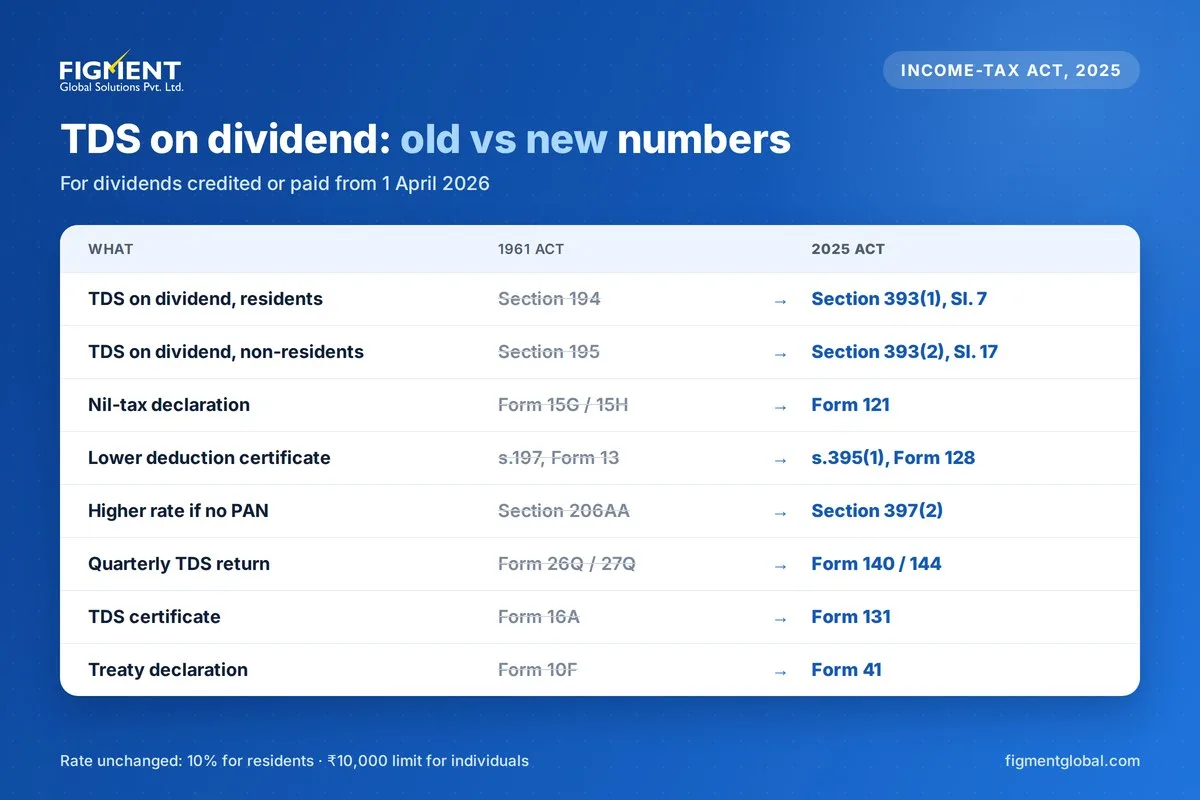
| What | Income-tax Act, 1961 | Income-tax Act, 2025 (from 1 April 2026) |
|---|---|---|
| TDS on dividend, residents | Section 194 | Section 393(1), Table Sl. No. 7 |
| TDS on dividend, non-residents | Section 195 | Section 393(2), Table Sl. No. 17 |
| Dividend to FPIs | Section 196D | Section 393(2), Table Sl. No. 15 |
| No-TDS cases and ₹10,000 limit | Section 194 provisos | Section 393(4), Table Sl. No. 10 |
| Nil-tax declaration | Form 15G / 15H | Form 121 |
| Lower or nil deduction certificate | Section 197, Form 13 | Section 395(1), Form 128 |
| Higher rate if no PAN | Section 206AA | Section 397(2) |
| Quarterly TDS return | Form 26Q / 27Q | Form 140 / Form 144 |
| TDS certificate | Form 16A | Form 131 |
| Treaty declaration | Form 10F | Form 41 |
Which Act applies?
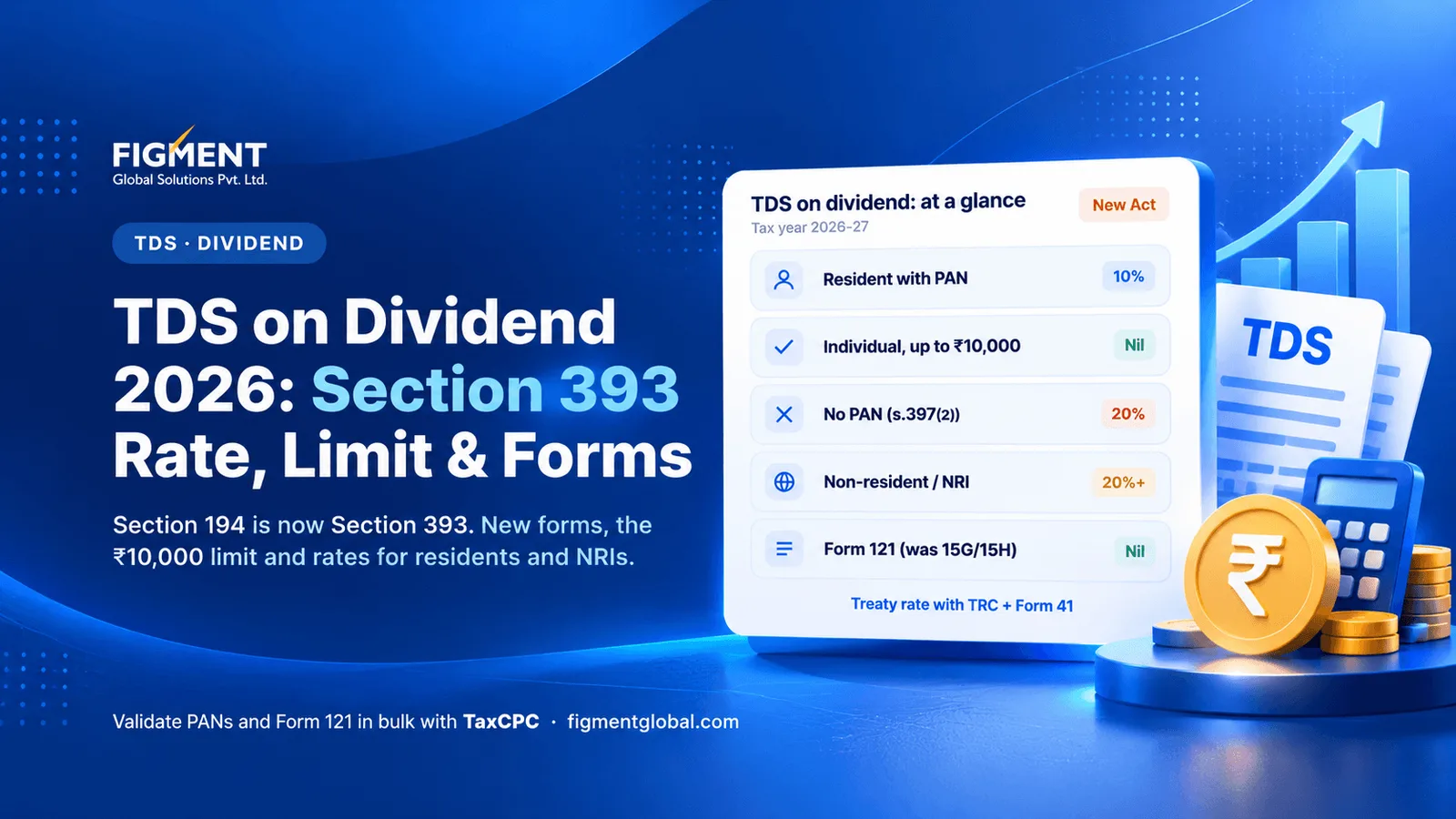
TDS rate on dividend
| Shareholder | Rate | Condition |
|---|---|---|
| Resident individual, dividend up to ₹10,000 in the year | Nil | Paid other than in cash |
| Resident with PAN | 10% | Above ₹10,000 (individuals); no threshold for others |
| Resident without PAN | 20% | Section 397(2) |
| Resident with Form 121 | Nil | Nil tax liability declared |
| LIC, GIC, other insurers on shares they own; business trusts on SPV dividends | Nil | Section 393(4) |
| Non-resident (including NRIs) | 20% + surcharge + cess | Or treaty rate with documents |
| Foreign portfolio investor | 20% + surcharge + cess | Or treaty rate where available [VERIFY] |
| Holder of a Section 395 certificate | Rate in the certificate | Certificate valid for the year |
Documents to collect before the record date
TDS on dividend: compliance checklist
Announce the record date and the document deadline to shareholders by email and on the website. Collect and validate PANs, Form 121, TRCs, Form 41 and certificates. Check that each PAN is valid and linked to Aadhaar. Compute TDS per shareholder: apply the ₹10,000 limit, the 20% no-PAN rate, treaty rates and exemptions. Deduct before payment. Tax is deducted before any distribution or payment of dividend. Deposit TDS by the 7th of the following month (30 April for March). Upload Form 121 declarations received by the 7th of the next month. File the quarterly return: Form 140 for residents and Form 144 for non-residents, by 31 July, 31 October, 31 January and 31 May. Issue Form 131 within 15 days of the return due date, and email shareholders a TDS summary.
Common mistakes
| Mistake | Consequence | Fix |
|---|---|---|
| Quoting Section 194 or Form 26Q for 2026-27 payments | Returns rejected or defaults | Use Section 393 and Forms 140/144 |
| Applying the ₹10,000 limit to companies or firms | Short deduction | Limit is for individuals only |
| Treaty rate without Form 41 or TRC | Short deduction, interest | Collect all documents before the record date |
| Accepting Form 121 from ineligible shareholders | Short deduction | Check age and income conditions |
| PAN not linked to Aadhaar | 20% applies | Validate PAN status in bulk before computing |
What changed for shareholders in Budget 2026
How to automate TDS on dividend: the end-to-end workflow
| Stage | Done manually | Done with dividend TDS software |
|---|---|---|
| 1. Import shareholder data | RTA benpos files reformatted by hand | RTA and depository files imported directly and converted to one standard format |
| 2. Validate PANs | Spot checks | Bulk PAN validation, including PAN–Aadhaar link status, with missing or invalid PANs flagged |
| 3. Review documents | Emails and PDFs checked one by one | Form 121, TRC, Form 41, no-PE and beneficial ownership declarations collected in one place, checked for completeness and validity dates |
| 4. Decide the rate | Formulas per shareholder | Rules engine maps each shareholder to the right rate: ₹10,000 limit, 10%, 20% without PAN, exempt entities, treaty rate |
| 5. Check lower-rate claims | Certificates checked by hand | Section 395 certificates verified in bulk and applied up to the certificate limit |
| 6. Compute and review | Final sheet reviewed at the last minute | Shareholder-wise TDS computed, with an exception and justification report before payment |
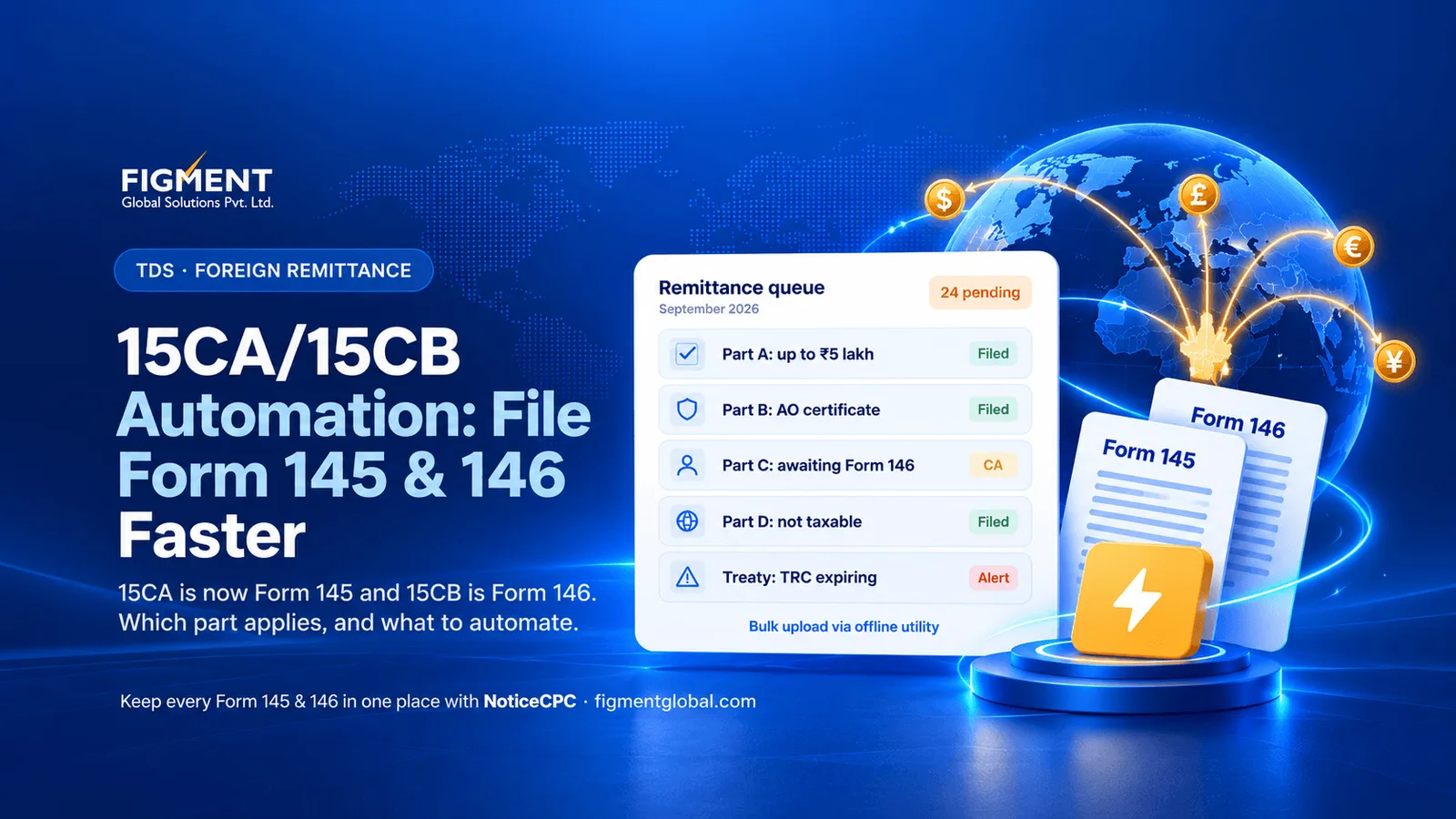
| 7. Foreign remittances | Separate exercise | Form 145/146 (old 15CA/15CB) data prepared for non-resident payments |
| 8. File and certify | Returns prepared separately | Forms 140 and 144 generated and validated, Form 131 issued, Form 121 declarations uploaded |
| 9. Keep records | Scattered across mailboxes | Digital repository of every declaration, certificate and working, with an audit trail |
What to look for in dividend TDS software
Volume: handles your full shareholder base, lakhs of rows, in one run RTA-ready: imports RTA and depository formats without manual reformatting Rules kept current: Section 393 table, Form 121, Form 41 and the new form numbers under the Income-tax Act, 2025 Treaty support: DTAA rate library, with TRC and Form 41 expiry tracking Review before payment: an exception report you can sign off, not just a final file Filing built in: Forms 140/144 validated against TRACES before upload Audit trail: every rate decision linked to the document that supports it
Automate dividend TDS with TaxCPC
Frequently Asked Questions
10% for resident shareholders with a PAN, 20% without a PAN, and 20% plus surcharge and cess (or the treaty rate) for non-residents.
Section 393(1), Table Sl. No. 7 of the Income-tax Act, 2025 for residents, replacing Section 194 from 1 April 2026. Dividends to non-residents fall under Section 393(2).
Yes, for resident individuals, if the total dividend from that company in the year is ₹10,000 or less and it is paid other than in cash.
For payments from 1 April 2026, Forms 15G and 15H are replaced by a single Form 121.
Yes. Non-residents claiming treaty benefits now file Form 41, along with a Tax Residency Certificate.
Use dividend TDS software that imports RTA shareholder data, validates PANs in bulk, checks Form 121, TRC and Form 41 declarations, maps each shareholder to the right rate, produces an exception report before payment, and generates Forms 140 and 144.
Valid and Aadhaar-linked PANs, the ₹10,000 limit for individuals, eligible Form 121s, valid lower-deduction certificates, and complete treaty documents (TRC, Form 41, no-PE and beneficial ownership declarations) for non-residents.