

Registration reforms
A comprehensive circular with FAQs listing the documents and information required for GST registration. FORM GST REG-01 to be amended with drop boxes for selecting prescribed documents, and a more user-friendly portal interface. Rule 19 amendment: automatic acceptance of amendments to all registration particulars except Principal Place of Business (PPoB); for taxpayers registered under Rule 14A, PPoB amendments will also be auto-accepted. Cancellation on application (REG-16) to be accepted automatically once all returns are filed and dues paid, in two phases. New Rule 14B: small sellers supplying goods through e-commerce operators in States where they have no physical presence can declare the ECO's warehouse as their PPoB, with automatic registration if they pass on ITC of not more than Rs 2.5 lakh per month.
Return and ITC reconciliation reforms (from the April 2027 return)
Refund reforms
Phase 1: refund of excess cash ledger balance sanctioned automatically by the system. Phase 1: acknowledgement or deficiency memo time cut from 15 days to 10 days, with deemed acknowledgement after 10 days. Phase 1: 90% provisional refund sanctioned automatically for zero-rated supplies and inverted duty structure, based on system risk evaluation. Phase 2: automated acknowledgement and full automated sanction for zero-rated supply refunds, after adjusting pending dues. RFD-01 to capture details in system-readable format, removing scanned document uploads for zero-rated and inverted duty refunds. Removal of the 1.5 times cap on turnover of zero-rated supply of goods in Rule 89(4)(C). Refund of ITC on input services under inverted duty structure for ITC availed on or after 1 November 2026; refund of ITC on capital goods (spread over 60 months) for ITC availed on or after 1 April 2027.
Disputes, penalties, arrest and prosecution
| Recommendation | Current position | Proposed change |
|---|---|---|
| Arrest powers | Section 69 of the CGST Act | Complete withdrawal by omitting Section 69 |
| Prosecution threshold | Rs 1 crore | Rs 5 crore |
| General penalty under Section 125 | Up to Rs 25,000 | Up to Rs 10,000 |
| Show cause notices under Sections 73, 74 and 74A | No minimum amount | No notice if tax involved is below Rs 10,000 (also applied to pending cases) |
| Penalty in non-fraud cases | Minimum penalty of Rs 10,000 | Minimum removed; 5% penalty if tax and interest are paid within 30 days (Section 73) or 60 days (Section 74A) of the order |
| Pre-deposit in penalty-only appeals | No upper limit | Capped at Rs 40 crore (Rs 20 crore CGST + Rs 20 crore SGST) |
| Blocking of credit under Rule 86A | No formal objection mechanism in the rule | Right to file an objection and get a personal hearing |
ITC, exports and e-way bills
Section 17(5) amendment to remove blocked credit restrictions on outdoor catering, health and life insurance, telecommunication towers, pipelines laid outside factory premises, free samples, and goods destroyed or written off on expiry of shelf life as required by law. Services supplied to a foreign office or branch of the same entity to qualify as export of services, by omitting Section 2(6)(v) of the IGST Act. Supplies to an overseas buyer delivered in an SEZ/FTWZ, with payment in convertible foreign exchange or permitted INR, to be treated as supplies to an SEZ/FTWZ. Interception of conveyances only on specific intelligence with Joint Commissioner authorisation, and no interception in transit States where neither supplier nor recipient is located. Transfer of title in intellectual property rights to be uniformly treated as a supply of services. E-invoicing to be extended to RCM inward supplies from unregistered persons and to import of services, for taxpayers with turnover of Rs 5 crore and above.
Relief for small taxpayers: late fee waiver and ARQP scheme
What CA firms and businesses should do now
Continue reconciling purchase registers with GSTR-2B and filed returns under the current rules; the new reconciliation mechanism starts with the April 2027 return. Identify exporters and inverted duty clients who will benefit from input services refunds for ITC availed from 1 November 2026. Review pending show cause notices below Rs 10,000 and Rule 86A credit blocks for possible relief once the amendments are notified. Flag small B2C clients for ARQP eligibility and update ERP and return software once CBIC issues notifications.
Not yet law
Frequently Asked Questions
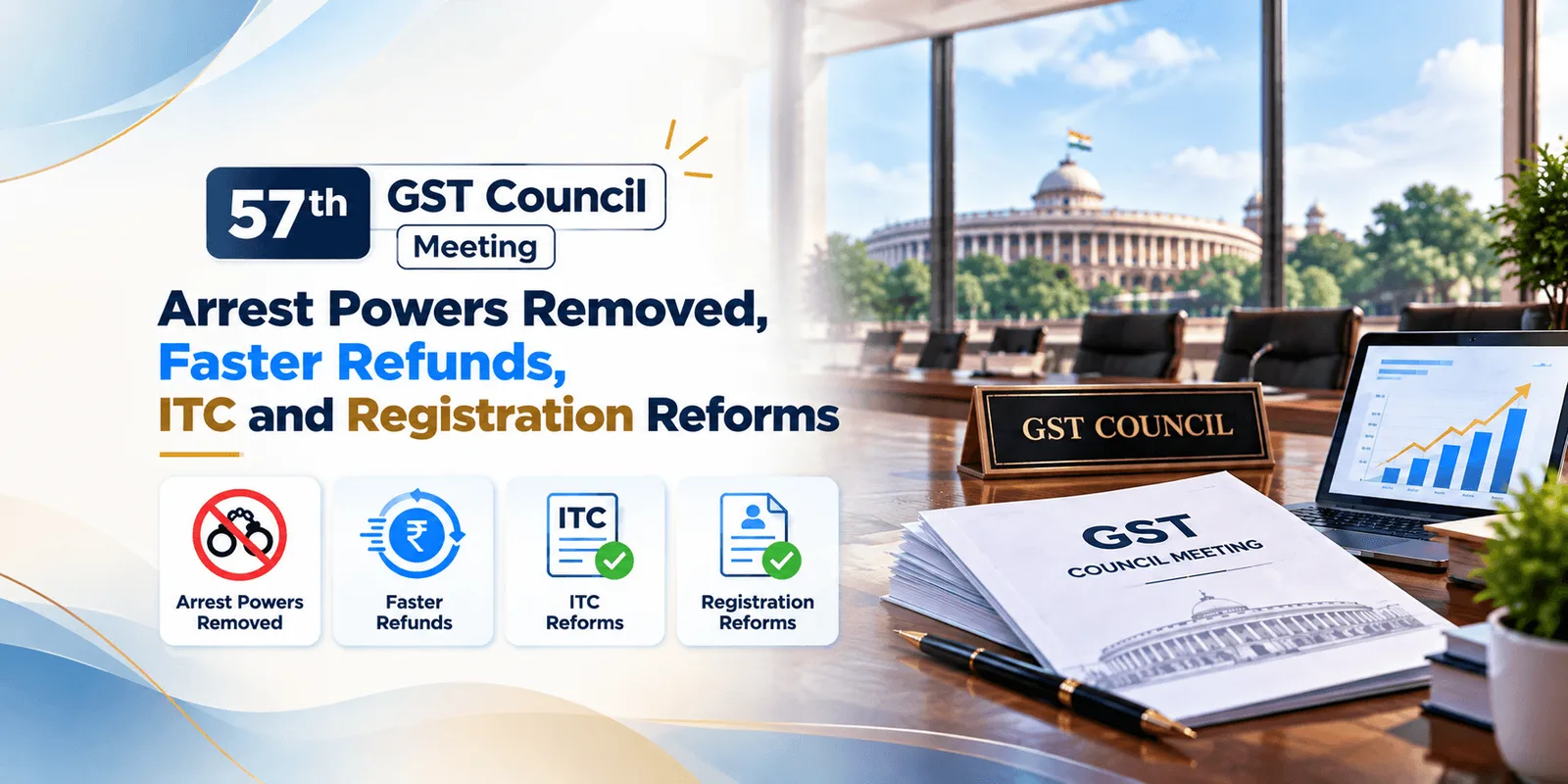
On 8 October 2026 in New Delhi, chaired by Union Finance Minister Nirmala Sitharaman.
The Council recommended complete withdrawal of arrest powers by omitting Section 69 of the CGST Act and raising the prosecution threshold from Rs 1 crore to Rs 5 crore. This requires an amendment to the CGST Act.
An optional Annual Return Quarterly Payment scheme, approved in principle by the 57th GST Council, for taxpayers with turnover up to Rs 5 crore in the preceding financial year who make only B2C supplies.
Waiver of late fee on delayed GSTR-3B filing for taxpayers with turnover up to Rs 5 crore in the preceding financial year, if the return is filed by the end of the month in which it was due.
The Council recommended bringing it into force from the return for April 2027, after a time-bound public consultation.