

E-Invoicing for RCM Self-Invoices: RCMDOM and RCMIMP Explained
What GSTN announced
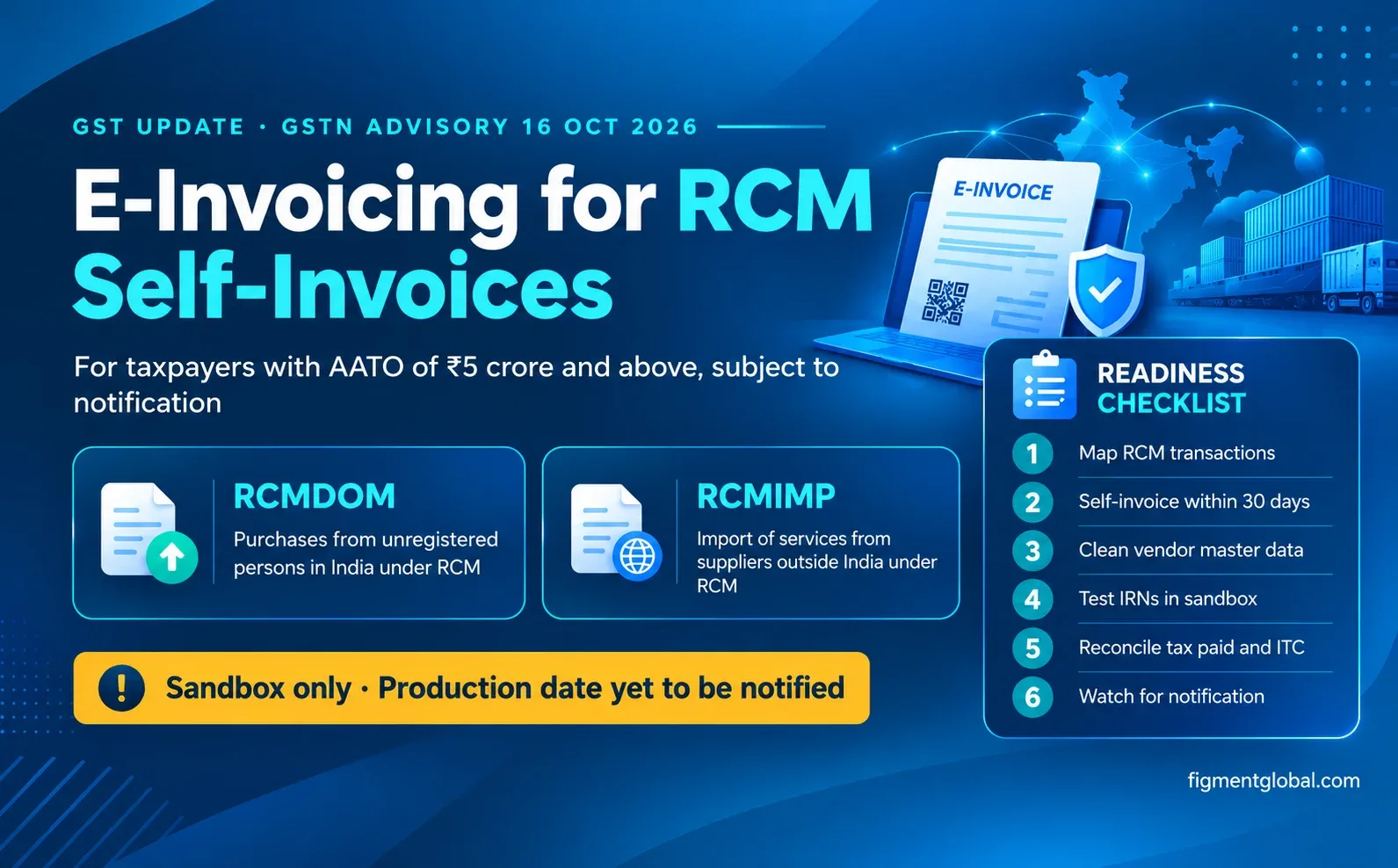
| Supply type | Covers | Supplier | Who generates the IRN |
|---|---|---|---|
| RCMDOM | Self-invoices for specified domestic supplies liable to RCM | Unregistered person in India | Registered recipient |
| RCMIMP | Self-invoices for import of services liable to RCM | Supplier outside India | Registered recipient |
Who it applies to and where things stand
| Point | Position as of 30 October 2026 |
|---|---|
| Intended for | Registered taxpayers with AATO of ₹5 crore and above |
| Legal trigger | Statutory provisions and notifications, still awaited |
| Current status | Sandbox testing on NIC IRP-1, NIC IRP-2, Cygnet (IRP-3), Clear (IRP-4), EY (IRP-5) and IRIS (IRP-6) |
| Production date | Not announced; to be "communicated in due time" |
| Developer sandbox | NIC e-Invoice API sandbox (einv-apisandbox.nic.in) |
The law has not changed: self-invoicing is already mandatory
Issue the self-invoice within 30 days
Section 31(3)(f) of the CGST Act: a registered recipient paying tax under RCM on supplies from an unregistered supplier must issue an invoice for that supply. For import of services, the recipient issues the self-invoice because the overseas supplier is outside the GST system. Rule 47A of the CGST Rules: this self-invoice must be issued within 30 days of receipt of the goods or services. Rule 47A has applied since 1 November 2024.
Get the time of supply right
Services (Section 13(3)): where the recipient must issue the invoice, the time of supply is the earlier of the date of payment and the date the recipient issues the invoice. This has applied since 1 November 2024. Goods (Section 12(3)): follow the RCM time-of-supply rules in Section 12(3) for each transaction. Services from an overseas associated enterprise: the time of supply is the date of entry in the books of the recipient or the date of payment, whichever is earlier. Do not apply a blanket "60 days from invoice" rule. That test depends on a supplier invoice, which an unregistered or overseas supplier may not issue.
Pay tax in cash, then claim ITC
RCM tax is paid in cash, under Section 9(3) or 9(4) of the CGST Act (Section 5(3) of the IGST Act for imported services). It cannot be paid from the ITC ledger. ITC is claimed on the self-invoice under Rule 36(1)(b), after the tax is paid. CBIC Circular 211/5/2024-GST (26 June 2024) clarifies that for supplies from unregistered persons, the Section 16(4) time limit runs from the financial year in which the recipient issues the self-invoice. Late payment of tax attracts interest. Late or no issuance of the self-invoice can attract penalty under Section 122.
Readiness checklist for finance teams
| # | Action | Owner |
|---|---|---|
| 1 | Map transactions. List RCM purchases from unregistered suppliers and all imports of services. Record supplier location and place of supply. | Tax / procurement |
| 2 | Fix the 30-day control. Track receipt date, self-invoice date and payment date for each RCM transaction. | Finance |
| 3 | Clean master data. Mark unregistered and overseas vendors clearly in the vendor master. Check PAN, address and state codes. | Procurement / IT |
| 4 | Test in sandbox. Generate test IRNs with RCMDOM and RCMIMP through your IRP or GSP. Check ERP validations against the NIC release note when published. | IT / tax |
| 5 | Reconcile. Match self-invoices to RCM tax paid in GSTR-3B and to ITC claimed, by period. | Tax |
| 6 | Watch for notification. Track GSTN, the e-invoice portal and CBIC for the production date and final scope. | Tax desk |
How Figment's products fit in
Key takeaways
GSTN Advisory No. 678 (16 October 2026) adds RCMDOM and RCMIMP supply types for self-invoices. It is intended for taxpayers with AATO of ₹5 crore and above, subject to notification. It is in sandbox only. No production date has been announced. The underlying rules already apply: a self-invoice within 30 days, tax paid in cash, and ITC on the self-invoice. Use the sandbox window to clean data, fix controls and test ERP integration.
Frequently Asked Questions
No. As of 30 October 2026 it is available only for sandbox testing. It becomes mandatory only from the date set by a notification.
They are new e-invoice supply type codes. RCMDOM is for self-invoices on specified purchases from unregistered persons under RCM. RCMIMP is for self-invoices on import of services.
GSTN says registered taxpayers with AATO of ₹5 crore and above, subject to notification. The final threshold wording and any exemptions will come with the notification.
Rule 47A requires the self-invoice within 30 days of receiving the goods or services. This applies today, with or without an IRN.
After the RCM tax is paid in cash. Under Circular 211/5/2024-GST, the Section 16(4) time limit for supplies from unregistered persons is linked to the financial year in which the self-invoice is issued.