

What GST reconciliation covers in 2026
| Reconciliation | What is matched | Why it matters |
|---|---|---|
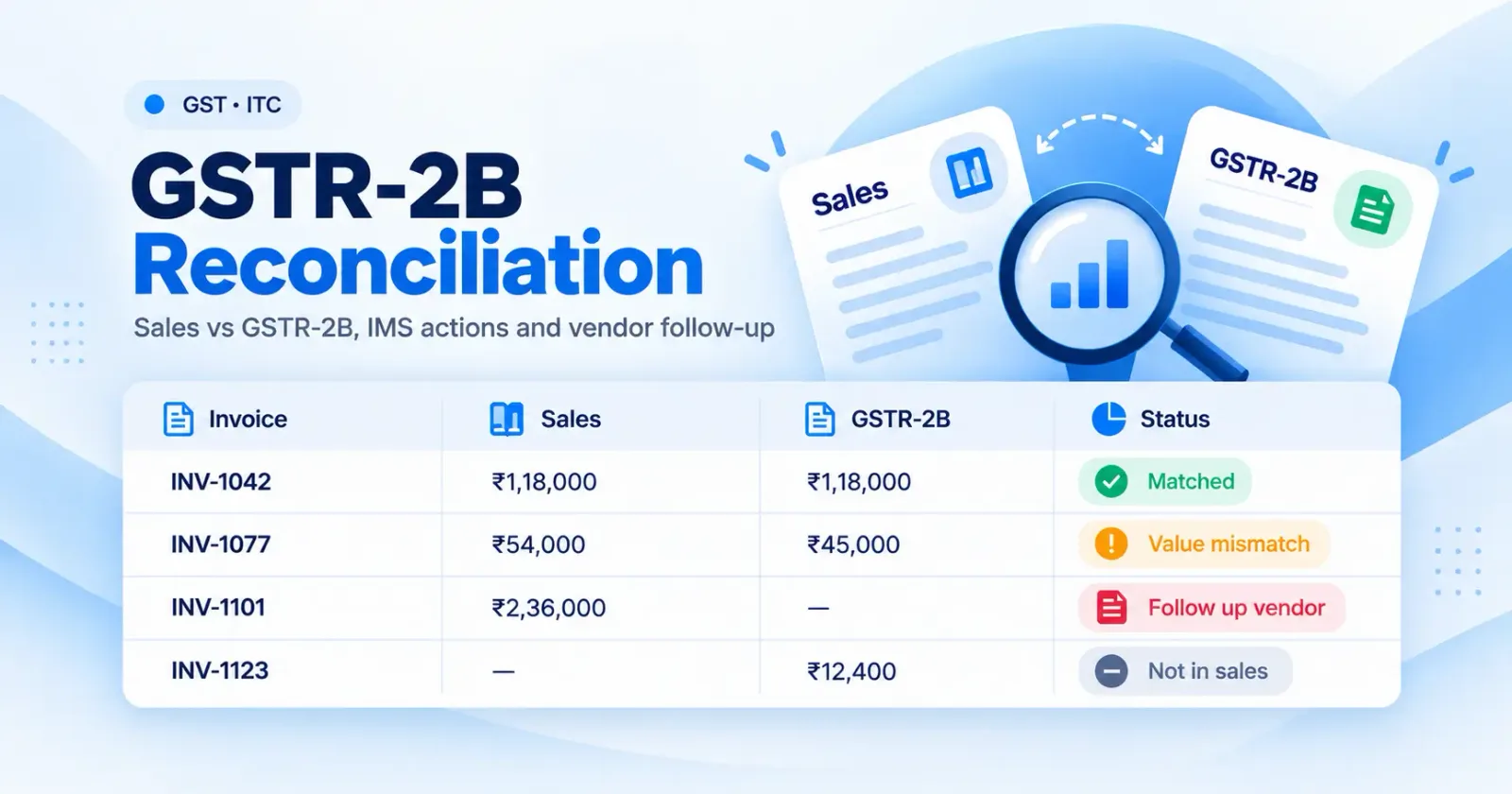
| Purchase register vs GSTR-2B | Your booked invoices vs the static monthly ITC statement | ITC is generally available only on invoices that appear in GSTR-2B |
| Purchase register vs GSTR-2A | Your invoices vs supplier filings, including late uploads | Catches invoices filed late by suppliers |
| IMS actions | Accept, reject or keep pending each supplier document before GSTR-2B is generated | Decides what flows into GSTR-2B |
| GSTR-3B vs GSTR-2B | ITC claimed vs ITC available | Excess claims lead to queries and notices |
| GSTR-1 vs GSTR-3B | Outward tax declared vs tax paid | Short payment draws interest and notices |
| Books vs annual return | Year-end turnover, tax and ITC | Feeds GSTR-9 and GSTR-9C |
Signs a spreadsheet is no longer enough
You reconcile many GSTINs and need one view of where each stands. Invoice numbers in your books and in supplier filings rarely match exactly (prefixes, dates, rounding), so exact-match formulas miss genuine matches. The same suppliers repeat on the mismatch list every month and follow-up happens by email. IMS decisions are taken by different people with no record of who accepted or rejected what. ITC reversals and reclaims (for example under Rules 37 and 37A) are tracked in separate files. Year-end work for GSTR-9 and GSTR-9C starts from scratch every December.
Features to compare
Data and matching
Bulk fetch of GSTR-2A, GSTR-2B and returns from the GST portal for every GSTIN, month by month. Invoice-level matching with fuzzy or suggested matches for near-identical invoice numbers, dates and amounts. Clear buckets: matched, mismatched, missing in books, missing in GSTR-2B.
IMS and ITC control
IMS accept, reject and pending actions recorded against the purchase register before GSTR-2B is generated. ITC tracking and mismatch reports before GSTR-3B is filed. A reversal and reclaim ledger for temporary reversals.
Vendor follow-up
Sending discrepancies and reminders to suppliers from one place. Tracking which suppliers fixed their filings, so ITC can be claimed in time. Bulk GSTIN validation, so you are not reconciling against cancelled registrations.
Control, scale and security
Multiple GSTINs under one organisation, with assignment of GSTINs or clients to team members. Role-based access and review before filing. Reports with period-wise comparisons for management and auditors. Security certifications (for example ISO 27001 and SOC 2) and, for portal connectivity, a GSP-authorised connection.
Buyer's checklist
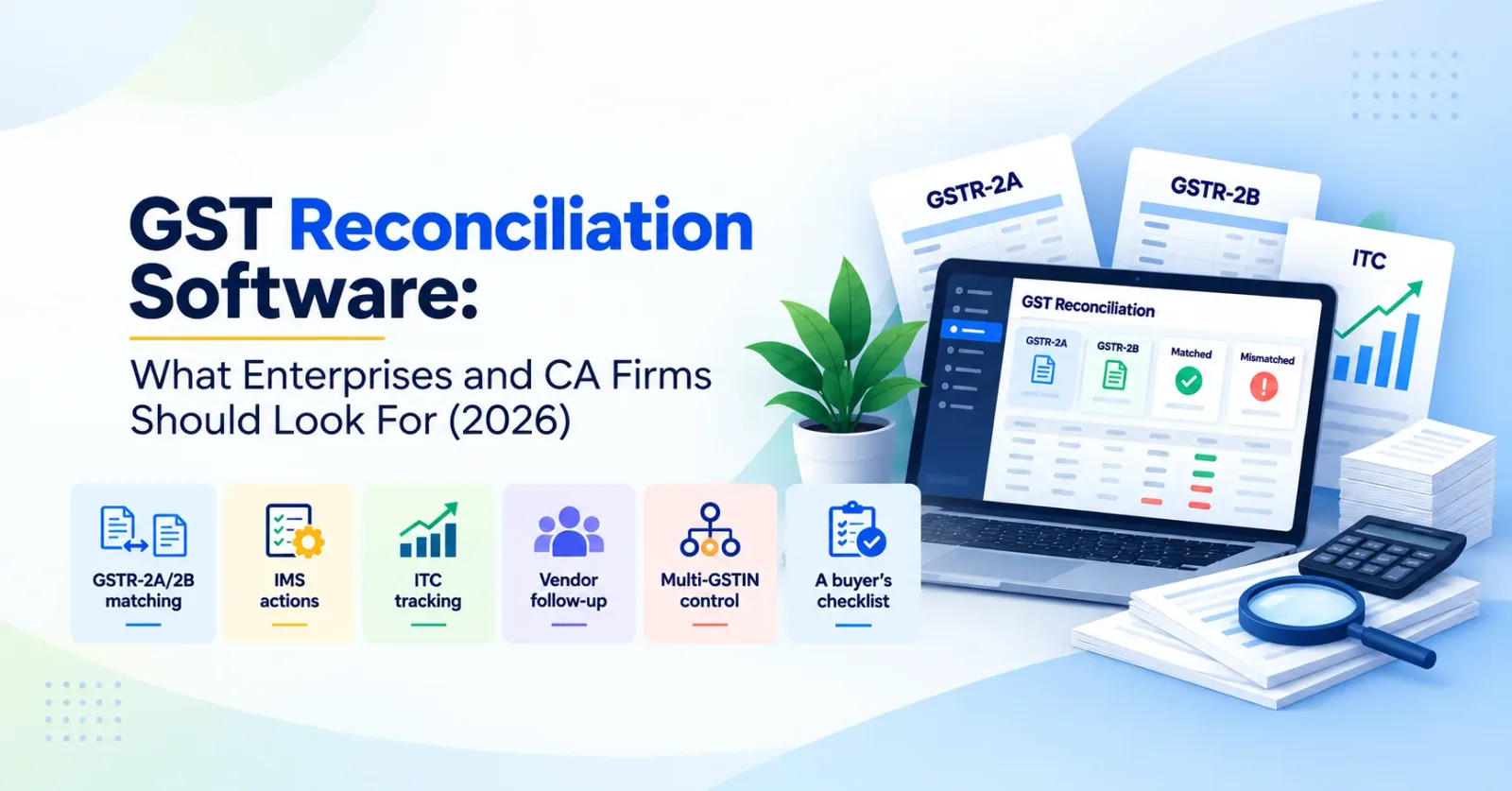
| # | Question to ask | Why it matters |
|---|---|---|
| 1 | Does it fetch GSTR-2A and GSTR-2B in bulk for all GSTINs? | Manual downloads don't scale |
| 2 | Does it suggest matches for near-identical invoices? | Exact matching misses genuine credit |
| 3 | Can IMS accept/reject/pending be done and recorded in the tool? | IMS decides what reaches GSTR-2B |
| 4 | Does it report ITC mismatches before GSTR-3B is filed? | Fixes are cheaper before filing |
| 5 | Does it keep a reversal and reclaim ledger? | Rule 37 and 37A movements need tracking |
| 6 | Can it send vendor follow-ups and track responses? | Supplier fixes have deadlines |
| 7 | Does it handle many GSTINs and clients with team assignment? | CA firms and large groups need this |
| 8 | Does it carry the year's data into GSTR-9 and 9C? | Year-end work starts from reconciled data |
| 9 | Is the portal connection through a GSP, and what certifications does the vendor hold? | GST data is sensitive |
| 10 | What support is available around the 20th of each month? | That is when GSTR-3B pressure peaks |
How GSTCPC handles GST reconciliation
GSTR-2A and GSTR-2B reconciliation against the purchase register, with AI-powered matching suggestions. Invoice Management System (IMS) accept, reject and pending actions. ITC tracking and ITC mismatch reports, and a temporary ITC reversal and reclaim ledger. Vendor follow-up: reminders and discrepancies sent from one place. Multiple GSTINs under one organisation, bulk GSTIN validation, team assignment and role-based filing controls. GSTR-1, GSTR-1A, GSTR-3B, GSTR-9 and GSTR-9C filing, plus GSTR-6, GSTR-7 and ITC-04.
Key takeaways
GST reconciliation now includes monthly IMS decisions, not just a month-end GSTR-2B match. Spreadsheets stop working with many GSTINs, fuzzy invoice data and repeat supplier mismatches. Compare tools on bulk data fetch, suggested matching, IMS control, ITC reports, vendor follow-up and multi-GSTIN control. Choose a tool that carries reconciled data into GSTR-9 and GSTR-9C at year-end.
Frequently Asked Questions
Software that matches your purchase register with GSTR-2A and GSTR-2B (and your returns), so ITC is claimed only on qualifying invoices and mismatches are fixed early.
GSTR-2B is a static monthly ITC statement used for claiming credit; GSTR-2A is dynamic and also reflects later supplier filings. Most teams reconcile with GSTR-2B for the claim and use GSTR-2A to catch late uploads.
Through IMS, the recipient accepts, rejects or keeps pending each supplier document before GSTR-2B is generated, so reconciliation now includes those monthly decisions.
For one GSTIN with low volume, yes. With many GSTINs, inconsistent invoice numbers and repeated supplier follow-ups, software saves time and reduces missed credit.
Yes. Monthly reconciled data on ITC, reversals and supplier mismatches is the starting point for the annual return and GSTR-9C.