

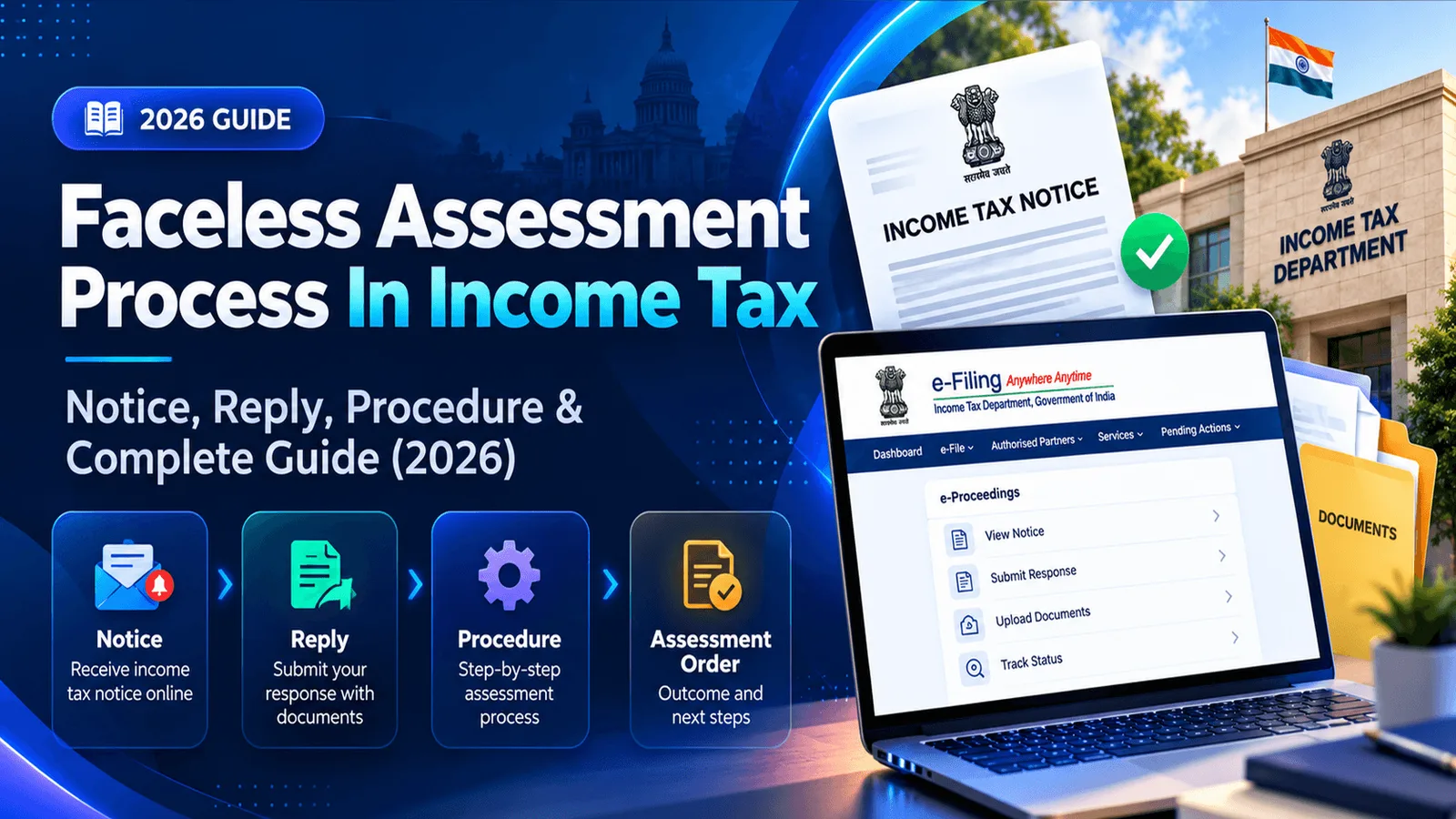
Faceless Assessment Process in Income Tax: Notice, Reply, Procedure & Complete Guide (2026)
What Is Faceless Assessment in Income Tax?
Key features of faceless assessment
Digital communication: Notices and other assessment communications are handled electronically. Automated case allocation: Cases covered by the applicable framework may be assigned to assessment units through an automated allocation system. Online document submission: Taxpayers can upload explanations and supporting evidence. Electronic assessment proceedings: The process generally takes place without routine physical meetings with the assessing authority. Digital records: Submitted responses and acknowledgements can help taxpayers maintain a record of their compliance.
How Does the Faceless Assessment System Work?
Case selection and allocation
Where applicable, a case is selected for assessment and allocated to the designated assessment unit under the relevant legal framework. Notice issued to the taxpayer
The taxpayer receives an assessment notice or a request for information, documents, or clarification. The notice specifies the relevant proceeding and the response deadline. Submission of information
The taxpayer or an authorised representative submits the required explanation and supporting documents through the prescribed online facility. Review and verification
The assessment unit examines the taxpayer's response and the information available on record. Further information or clarification may be requested where necessary. Opportunity to explain proposed adjustments
Where the applicable procedure requires it, the taxpayer may receive a show-cause notice explaining proposed variations to income or tax liability and be given an opportunity to respond. Assessment order
After considering the relevant material and following the applicable procedure, the department issues an assessment order or other appropriate communication.
Why Do You Receive a Faceless Assessment Notice?
A mismatch between income reported in the ITR and information available to the department. Differences between reported income and information in Form 26AS, AIS, or TIS. Questions regarding deductions, exemptions, or expenses claimed in the return. Unexplained high-value transactions or investments requiring clarification. Differences in reported business turnover, receipts, or financial information. Verification of income, tax credits, or supporting documents. Information required during a scrutiny assessment or reassessment proceeding.
Types of Income Tax Notices Related to Assessment
| Notice or communication | General purpose |
|---|---|
| Notice under Section 143(2) of the Income-tax Act, 1961 | Initiates scrutiny assessment for the relevant return where applicable. |
| Notice under Section 142(1) of the Income-tax Act, 1961 | Requests a return, accounts, documents, or other information for assessment. |
| Show-cause notice | Gives the taxpayer an opportunity to explain why a proposed action or adjustment should not be made. |
| Reassessment-related notice | Relates to proceedings concerning income that may have escaped assessment, subject to applicable law. |
| Defective return notice under Section 139(9) of the Income-tax Act, 1961 | Requests correction of a defective income tax return. |
| Intimation under Section 143(1) of the Income-tax Act, 1961 | Communicates the outcome of return processing and any applicable adjustments or demand/refund details. |
Important for 2026:
Faceless Assessment Process in India: Step-by-Step Guide
Step 1: Log in to the Income Tax e-Filing portal
Step 2: Open the relevant notice
Step 3: Understand the notice requirements
PAN or taxpayer identification details. Assessment year or tax year. Notice number and date. Applicable statutory provision. Reason for the notice or scrutiny. Questions and documents requested. Response deadline. Submission instructions and permitted attachment categories.
Step 4: Collect the supporting documents
Step 5: Prepare the written explanation
Step 6: Submit the response online
Step 7: Save the acknowledgement
Step 8: Monitor further communications
How to Reply to a Faceless Assessment Notice Online
Recommended format for an income tax notice reply
Note
Tips for preparing an effective notice reply
Answer each question raised in the notice. Use factual, concise, and professional language. Ensure that figures agree with the relevant financial records and tax return. Upload legible documents in the prescribed format and size. Avoid unsupported claims or irrelevant attachments. Verify that the correct notice and assessment year or tax year have been selected. Submit the response within the specified deadline. Save the acknowledgement after successful submission.
Documents Required for Faceless Assessment
Copy of the income tax return and computation of income. Form 26AS, Annual Information Statement (AIS), and Taxpayer Information Summary (TIS), where relevant. Bank statements and transaction details. Salary slips, Form 16, and other income certificates. Business financial statements, ledgers, invoices, and expense records. Proof of deductions, exemptions, and eligible investments. Capital gains statements and supporting transaction documents. Loan confirmations, interest certificates, or investment evidence, where relevant. Reconciliation statements explaining discrepancies. Copies of earlier submissions and related departmental communications.
What Happens If You Do Not Reply to an Income Tax Notice?
Complete the assessment using the material available on record. Make an assessment to the best of its judgment where legally permitted. Consider the absence of supporting evidence when deciding disputed issues. Initiate applicable penalty proceedings or other consequences where the statutory conditions are met. Determine additional tax liability, interest, or other amounts as applicable.
What should you do if the deadline has passed?
What Happens After Submitting Your Response?
Review the submitted explanation and supporting evidence. Request additional documents or clarification. Issue a show-cause notice proposing an adjustment. Provide a further opportunity to respond where required. Complete the assessment and issue an order. Determine the applicable tax payable or refund, subject to the outcome.
What if you disagree with the assessment order?
How to Check Faceless Assessment Notice Status
Log in to the e-Filing portal. Open Pending Actions. Select e-Proceedings, where applicable. Review the relevant notice or proceeding. Open the notice to check its details and available actions. View the response history or download acknowledgements where available. Check for new communications and any remaining response deadlines.
Common Mistakes to Avoid During Faceless Assessment
Ignoring the notice
A notice should be reviewed promptly, even when the taxpayer believes the return was filed correctly. Missing the response deadline
Record the deadline and allow sufficient time for document collection, review, and submission. Submitting incomplete information
A response that does not address all the questions may lead to additional queries or leave issues unresolved. Providing inconsistent figures
Reconcile income, deductions, tax credits, and transaction details before submission. Uploading incorrect documents
Check the relevant financial year, taxpayer details, document quality, and attachment category. Failing to save acknowledgement details
Maintain proof of submission and copies of all responses for future reference. Assuming the matter is closed after replying
Continue monitoring the proceeding until its status and outcome are clear. Using the wrong legal provision
For 2026, carefully distinguish proceedings governed by the Income-tax Act, 1961, from those governed by the Income-tax Act, 2025.
Benefits of the Faceless Assessment System
Greater convenience
Improved record management
Reduced routine physical interaction
More structured communication
Better compliance tracking
How Tax Professionals Can Simplify Income Tax Notice Management
Centralise income tax notices for multiple clients. Track notice dates, response deadlines, and proceeding status. Organise supporting documents and submitted replies. Maintain a record of acknowledgements and assessment orders. Identify pending actions and follow-up requirements. Improve visibility into compliance work across the team.
Simplify notice tracking with NoticeCPC
Note
Conclusion
Frequently Asked Questions
Faceless assessment is an electronic process for conducting specified income tax assessments through the designated departmental framework, reducing routine face-to-face interaction between taxpayers and tax officials.
Yes. The faceless assessment framework continues in 2026. The Income-tax Act, 2025, took effect on 1 April 2026, while provisions of the earlier Act continue to govern relevant earlier tax years and pending proceedings under the transition and savings provisions.
Log in to the official Income Tax e-Filing portal, open the relevant notice through the applicable e-Proceedings or other designated facility, prepare your response, upload the requested documents, submit it, and save the acknowledgement.
An assessment-related notice generally requests information, clarification, or a response during a proceeding. A demand notice or demand communication concerns an amount determined as payable. The precise legal effect depends on the document and applicable provisions.
Acceptance depends on the applicable procedure and the status of the proceeding. Check whether a permitted extension or other remedy is available and act promptly. Late submission is not automatically accepted.
Depending on the notice and applicable law, the department may proceed using the information available on record, complete an assessment, or initiate other legally permitted action. The consequences depend on the circumstances.
An authorised representative may be able to respond where the portal's requirements and applicable rules permit it. The representative should be properly authorised for the relevant proceeding.
The system generally removes routine physical interaction, but the applicable procedure may provide for electronic hearings or other forms of interaction. Taxpayers should follow the instructions in their specific communications.
Submit the documents relevant to the questions raised. These may include the ITR, financial statements, bank statements, tax credit records, invoices, deduction proofs, and reconciliation statements.
Review the findings, calculations, demand or refund details, and available remedies. If you disagree with the order, seek advice promptly because the applicable remedy and limitation period depend on the order and relevant law.
No. Routine return processing and detailed assessment proceedings are different processes. Faceless assessment involves a structured examination of a case under the applicable assessment framework, while return processing may involve checks and adjustments under separate provisions.
A centralised notice-management workflow can help track clients, notice dates, response deadlines, documents, acknowledgements, and follow-up actions. A platform such as NoticeCPC can support this coordination according to its available features.