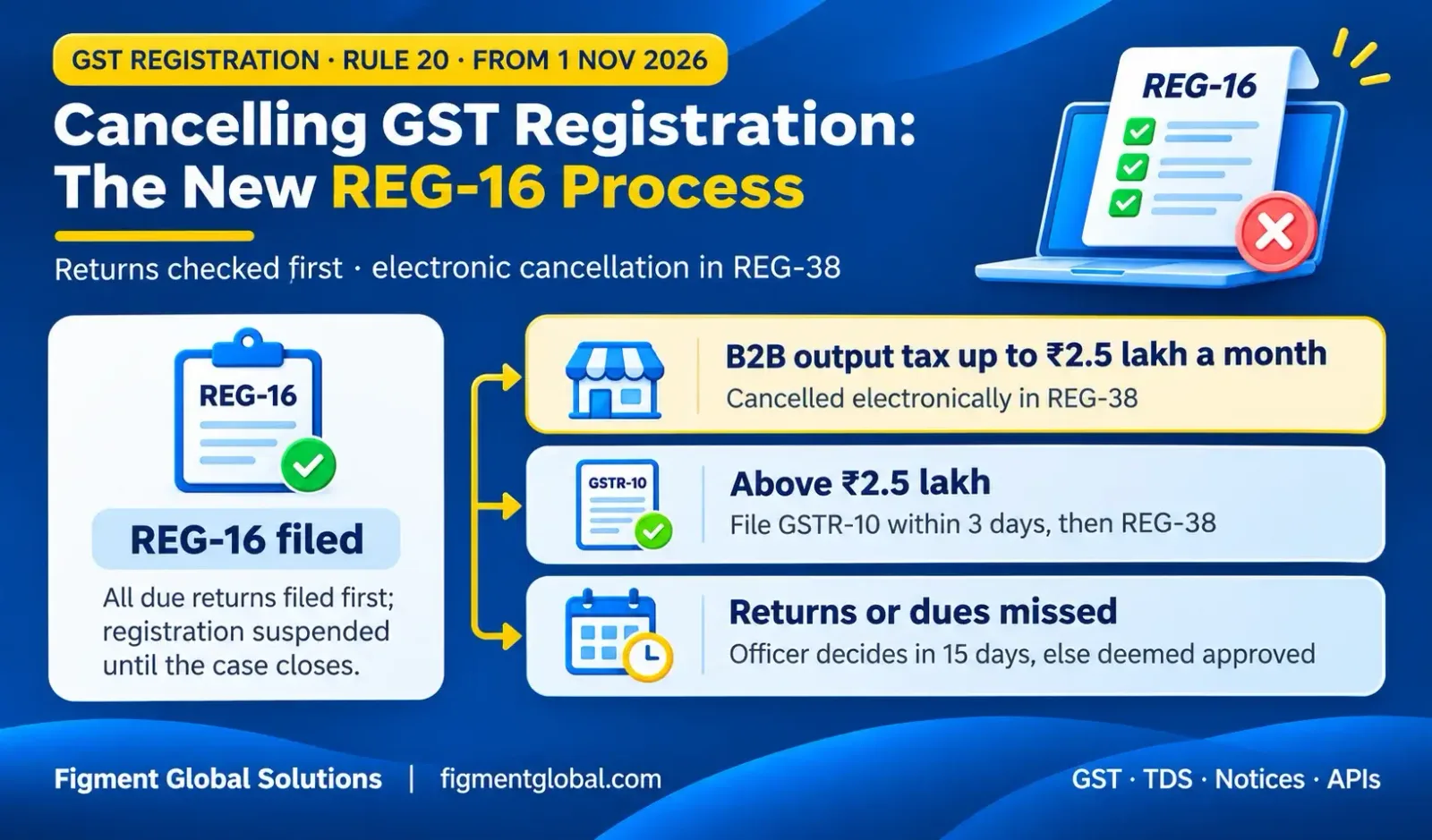
GST registration cancellation on your own application now works differently. Notification No. 05/2026-Central Tax substituted Rule 20 of the CGST Rules with effect from 1 November 2026, and GSTN rolled out the new process on the portal the same day. The portal now checks returns before it accepts a FORM GST REG-16 application. In many cases the registration is then cancelled electronically, without an officer, and communicated in a new form, REG-38. Applications that miss a step go to the jurisdictional officer, who has fixed 15-day timelines, with deemed approval if the officer does not act.
This guide covers who can apply, the new pre-conditions, the three routes an application can take, and what changes in the REG-16 form from 1 December 2026.
What has changed at a glance
| Point | Position from 1 November 2026 |
|---|
| Time limit to apply | Within 30 days of the event that warrants cancellation (not applicable on death of a sole proprietor) |
| Before you can submit | All returns due up to the date of application for periods up to the cancellation date must be filed; if GSTR-1 or IFF is filed for a period, GSTR-3B for that period must also be filed |
| After you submit | Registration is suspended until the cancellation proceedings are complete |
| Returns still to come | Must be filed by their normal due dates |
| Automatic cancellation | By the portal, in FORM GST REG-38, when the conditions below are met |
| Officer route | Officer decides within 15 days; deficiency memo in REG-03, reply in REG-04 within 15 days; order in REG-19 or rejection in REG-05 |
| Deemed approval | If the officer does not act within 15 days |
| REG-16 form changes | Revised reasons and new fields from 1 December 2026 |
Step 1: check the pre-conditions
Under the new Rule 20(2), the portal will not accept a REG-16 application unless:
all returns, including CMP-08 where applicable, that are due on or before the date of application for any period up to the date from which cancellation is sought have been filed; and for any tax period in which GSTR-1 or IFF has been filed, GSTR-3B for that period has also been filed.
The rule gives two illustrations. A person applying on 13 July 2026 must already have filed GSTR-3B for May 2026. A person who filed GSTR-1 for June 2026 on 11 July 2026 must also file GSTR-3B for June before applying.
The application must also include details of inputs and capital goods held in stock, the tax payable on them and any payment made against that liability.
Step 2: "Pending for Returns Filing"
Some returns for the period up to the cancellation date may not yet be due when you apply. GSTN's advisory of 1 November 2026 says the application then moves to the "Pending for Returns Filing" stage. Those returns must be filed by their normal due dates (Rule 20(3)). If they are not, the application is assigned to the jurisdictional officer.
Once the application is submitted, the registration stands suspended until the proceedings are complete (Rule 20(4)).
Step 3: automatic cancellation or the officer route
If the returns are filed on time and all tax, interest, fee, penalty and other dues are paid, the portal decides the next step.
| Taxpayer type | What happens |
|---|
| Composition taxpayers, non-resident taxable persons, OIDAR suppliers and Input Service Distributors | Cancelled electronically, without officer intervention |
| Regular, casual and SEZ taxpayers whose output tax on supplies to registered persons is ₹2.5 lakh or less in every month from registration to the application | Cancelled electronically, without officer intervention |
| Regular, casual and SEZ taxpayers above ₹2.5 lakh in any month | Must file the final return, GSTR-10, within 3 days of the due date of the pending returns (or of the application, if none are pending). The application moves to "Pending for Final Return". If GSTR-10 is filed in time, the registration is cancelled electronically. If not, the application goes to the officer. |
The ₹2.5 lakh test looks at the output tax (CGST, SGST/UTGST, IGST and compensation cess) declared in GSTR-1, as amended in GSTR-1A, or through IFF, on supplies to registered persons.
Electronic cancellation takes effect from the date from which cancellation was sought and is communicated in FORM GST REG-38.
When the officer decides
An application goes to the proper officer if any return is not filed on time, any dues are unpaid or GSTR-10 is not filed within 3 days where required. The officer then has fixed timelines under Rule 20(7) to (12):
| Step | Timeline | Form |
|---|
| Officer cancels if the application is in order | Within 15 days of receiving it | REG-19 |
| Officer issues a deficiency notice | Within 15 days of receiving it | REG-03 |
| Applicant replies | Within 15 days of the notice | REG-04 |
| Officer approves after a satisfactory reply | Within 15 days of the reply | REG-19 |
| Officer rejects after an unsatisfactory reply | Within 15 days of the reply | REG-05 |
| No reply from the applicant | Deemed rejected | REG-05A |
| Officer takes no action within 15 days | Deemed approved | REG-19 |
If the officer cancels the registration, the GSTR-10 final return must still be filed within 90 days from the effective date of cancellation, where applicable.
Changing the effective date later
After cancellation, if the officer believes the effective date should be earlier under Section 29(3), a show cause notice can be issued in REG-34. The taxpayer replies in REG-35 within 30 days, and the officer either drops the proceedings in REG-36 or changes the date in REG-37.
Notification 05/2026-Central Tax also revises FORM GST REG-16 with effect from 1 December 2026. Among the changes:
"Ceased to be liable to pay tax" is replaced by "No longer liable to be registered under section 22 or section 24, or opting out of voluntary registration under section 25(3)". "Death of Sole Proprietor" becomes "Transfer of the business on account of death of the proprietor", and a new reason is added: "Transfer of the business for any other reason, including amalgamation with other legal entity, demerger or other disposal". "Others (specify)" is removed from the list of reasons. A new question asks whether you wish to file a NIL return for the period after the last return filed up to the date from which cancellation is sought.
Checklist before you file REG-16
Record the date of the event that warrants cancellation and file within 30 days. File every return due up to today for periods up to the cancellation date, including CMP-08 where applicable. Where GSTR-1 or IFF is filed for a period, file GSTR-3B for that period too. Pay all tax, interest, late fee and other dues. Work out stock of inputs, semi-finished and finished goods and capital goods, and the tax payable on them. Check whether output tax on B2B supplies exceeded ₹2.5 lakh in any month; if so, plan GSTR-10 within 3 days of the last pending return. Diarise the due dates of returns still to come after the application. Track REG-03 notices and reply in REG-04 within 15 days.
How Figment's products help
GSTCPC files GSTR-1, GSTR-3B and other returns across GSTINs and shows filing status for every registration, which makes it easier to confirm that no return is pending before you apply. If the application goes to the officer, or a cancellation show cause notice (REG-17) arrives for another GSTIN, NoticeCPC tracks registration notices from receipt to reply, with alerts before each due date. Businesses that buy from many suppliers can confirm a vendor's registration status through Figment's GST verification API.
Key takeaways
Rule 20 was substituted from 1 November 2026: apply in REG-16 within 30 days of the event, with all due returns filed. Registration is suspended once the application is submitted. Many applications are now cancelled electronically by the portal in REG-38, including all regular taxpayers whose B2B output tax stayed at or below ₹2.5 lakh a month. Above that limit, GSTR-10 must be filed within 3 days to keep the electronic route. Officer cases have 15-day timelines, with deemed approval if the officer does not act.