

Section 17(4) in brief
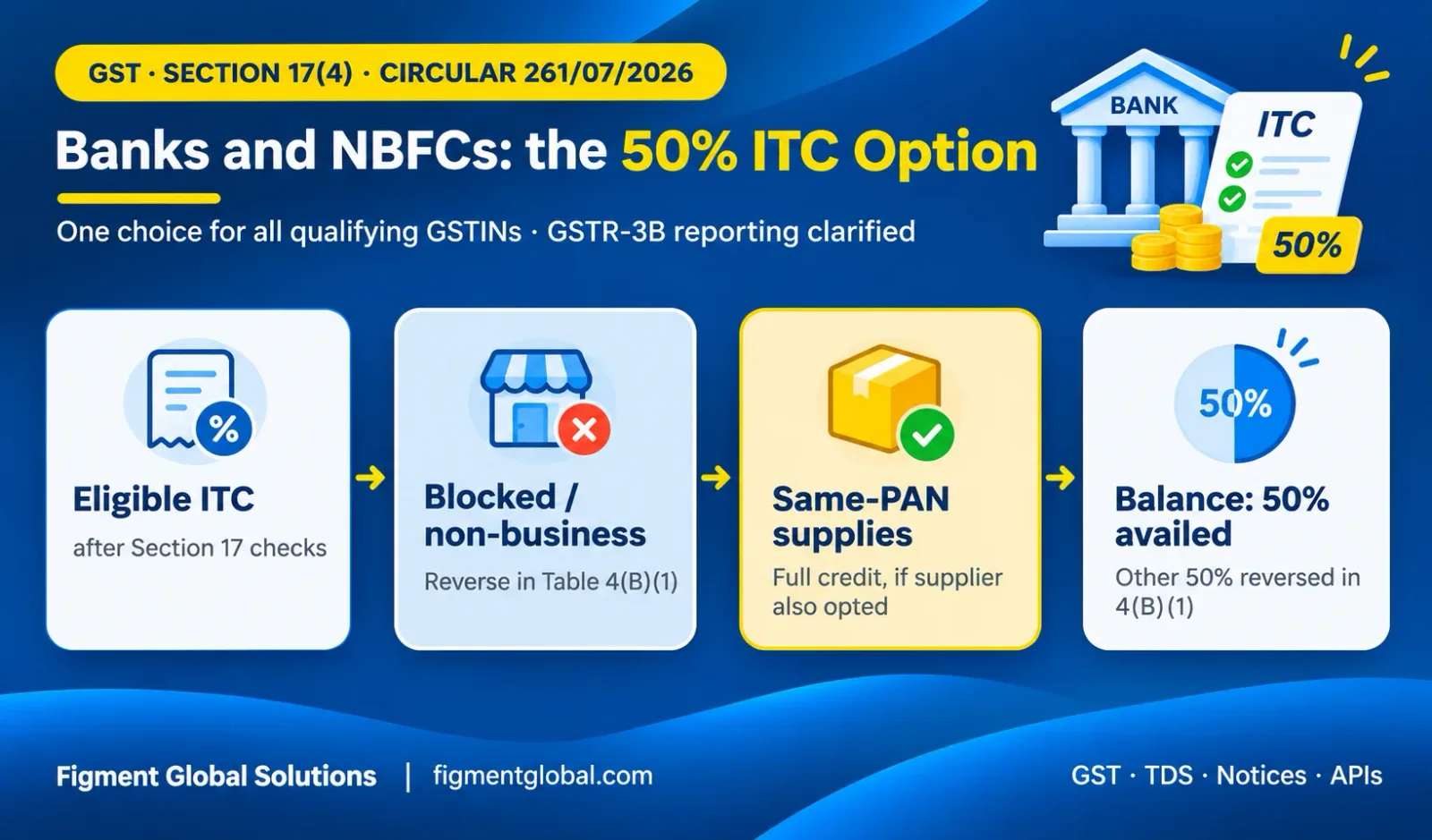
Opt for a flat 50%. The entity avails 50% of its eligible ITC on inputs, input services and capital goods every month. The remaining 50% lapses. Same-PAN relaxation (second proviso). The 50% restriction does not apply to tax paid on supplies received from another registered person with the same PAN. Option is fixed for the year (first proviso). Once exercised, the option cannot be withdrawn during the remaining part of the financial year.
What Circular 261/07/2026-GST clarifies
| # | Issue | CBIC's clarification |
|---|---|---|
1. Eligibility is linked to deposit and lending services
2. One choice across all registrations
3. The same-PAN relaxation needs both sides to have opted
How to report ITC in GSTR-3B under Section 17(4)
Method A: where IMS was not used
Find eligible ITC
Start with ITC auto-populated in GSTR-3B from GSTR-2B (other than reverse charge) plus ITC claimed on reverse charge supplies. Determine how much is eligible under Section 16. Permanently reverse blocked and non-business credit
ITC on inputs and input services used for non-business purposes and ITC on supplies covered by Section 17(5) goes to Table 4(B)(1). Take full credit on same-PAN supplies
ITC on inputs and input services covered by the second proviso to Section 17(4) is availed in full. Take 50% of the rest
50% of the remaining ITC is availed. The other 50% is permanently reversed in Table 4(B)(1) of the same return. Temporarily reverse what is not yet eligible
ITC that fails a Section 16 condition today but may qualify later goes to Table 4(B)(2). Reclaim later
When the condition is met, reclaim it in Table 4(A)(5) of a later return, within the Section 16(4) time limit, apply steps 2 to 4 to it, and also show it in Table 4(D)(1).
Method B: after the IMS-related rule amendments are notified (and where IMS is already used)
Sort invoices on IMS
Accept, reject or keep pending each inward invoice on IMS. Keep pending what is not yet eligible
Keep pending invoices whose ITC is not yet eligible because a Section 16 condition is not met. These do not flow to GSTR-2B or GSTR-3B. Accepted invoices flow to GSTR-3B
Accepted and deemed-accepted invoices flow to GSTR-2B and are auto-populated in GSTR-3B. Apply the Method A steps
On the auto-populated ITC (other than reverse charge) plus reverse charge ITC, apply the same steps as in Method A: reverse blocked credit, take same-PAN credit in full, avail 50% of the rest and reverse the balance in Table 4(B)(1).
Checklist for banks, NBFCs and their auditors
Confirm that each entity actually supplies deposit, loan or advance services before applying Section 17(4). List every GSTIN under the PAN and make sure all qualifying registrations follow the same method. Tag same-PAN inward supplies, and confirm the supplying GSTIN has also opted for Section 17(4). Map GSTR-3B reporting: Table 4(B)(1) for permanent reversals (blocked credit and the 50% lapse), Table 4(B)(2) for temporary reversals, Table 4(A)(5) and Table 4(D)(1) for reclaims. Use IMS "keep pending" for invoices whose ITC is not yet eligible. For past periods, document the method used and show that the ITC availed is consistent with the circular. Remember the option cannot be withdrawn during the remaining part of the financial year.
How Figment's products help
Key takeaways
Only banks, financial institutions and NBFCs engaged in deposit, loan or advance services can opt for Section 17(4). If one qualifying GSTIN opts, all qualifying GSTINs of the entity must follow Section 17(4). Full credit on same-PAN supplies is available only when the supplying registration has also opted for Section 17(4). In GSTR-3B, both the blocked credit and the 50% lapse are permanent reversals in Table 4(B)(1); not-yet-eligible ITC goes to Table 4(B)(2). CBIC has told officers not to take an adverse view of past reporting methods if the ITC availed matches the circular's principles.
Frequently Asked Questions
An option for banking companies and financial institutions, including NBFCs, engaged in accepting deposits or extending loans and advances, to avail 50% of eligible ITC every month instead of apportioning credit under Section 17(2).
No. Circular 261/07/2026-GST clarifies that an entity not engaged in deposit, loan or advance services has neither the option nor the obligation to follow Section 17(4).
No. If one qualifying registration opts, all qualifying registrations of that entity must comply with Section 17(4).
Not if the supplying registration has also opted for Section 17(4). The second proviso then allows full credit on those supplies.
As a permanent reversal in Table 4(B)(1) of the same tax period, along with blocked and non-business credit.