


ITC Reversal and Reclaim: Maintaining the Electronic Credit Reversal and Re-claimed Statement
Quick answer:
Temporary vs permanent ITC reversal
| Reason for reversal | Legal basis | Can it be reclaimed? | GSTR-3B row |
|---|---|---|---|
| Supplier not paid within 180 days of invoice date | Section 16(2), second proviso; Rule 37 | Yes, once you pay the supplier | 4(B)(2) |
| Supplier has not filed GSTR-3B for the period by 30 September of the next year | Rule 37A | Yes, once the supplier files the return | 4(B)(2) |
| ITC availed but goods or services not yet received | Section 16(2)(b) | Yes, on receipt | 4(B)(2) |
| Tax on the invoice not yet paid to the government by the supplier | Section 16(2)(c) | Yes, once tax is paid | 4(B)(2) |
| Blocked credits (motor vehicles, food, personal use and similar) | Section 17(5) | No | 4(B)(1) |
| Common credit for exempt or non-business use | Rules 42 and 43 | No (annual true-up aside) | 4(B)(1) |
| Credit on capital goods or inputs for exempt supplies under special rules | Rule 38 (banks/NBFCs, 50% option) | No | 4(B)(1) |
The two rules behind most temporary reversals
Rule 37: payment to supplier not made within 180 days
Rule 37A: supplier has not filed GSTR-3B
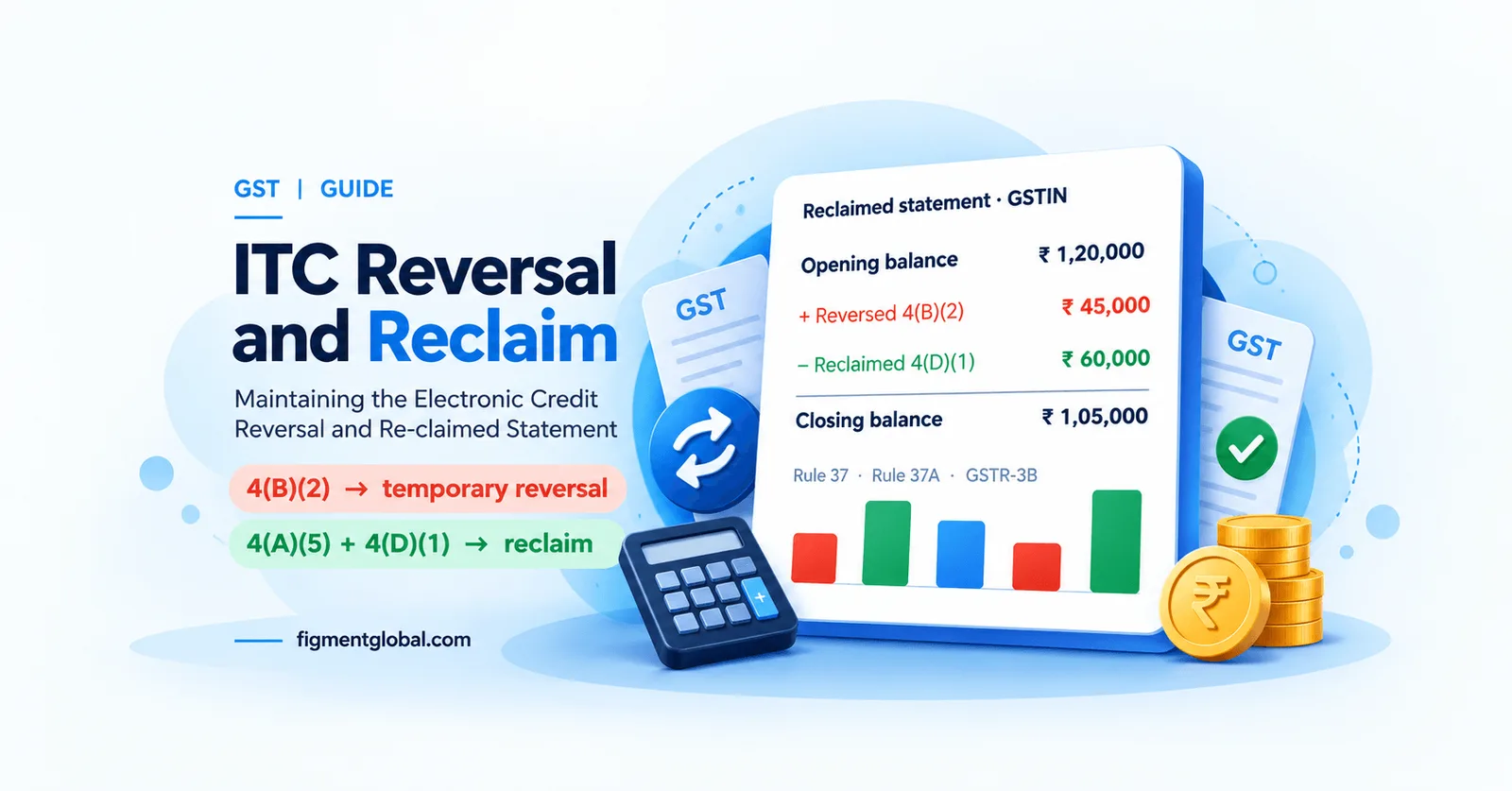
How the Electronic Credit Reversal and Re-claimed Statement works
| Movement | Where it comes from |
|---|---|
| Opening balance | One-time declaration by the taxpayer of ITC reversed earlier and not yet reclaimed |
| Add: ITC temporarily reversed | Table 4(B)(2) of each GSTR-3B filed |
| Less: ITC reclaimed | Table 4(D)(1) of each GSTR-3B filed |
| Closing balance | Carried forward to the next tax period |
Monthly process for ITC reversal and reclaim
Build the 180-day list
From the payables ledger, list every invoice where ITC was taken and the invoice is more than 180 days old with an unpaid balance. Partial payments need a proportionate reversal. Run the Rule 37A check (annually, before 30 November)
Match invoices in your GSTR-2B for the previous financial year against suppliers' GSTR-3B filing status for each period. Flag suppliers who still have not filed by 30 September. Report reversals in 4(B)(2)
Put temporary reversals in 4(B)(2) and permanent reversals in 4(B)(1). Keep an invoice-level list behind each figure: GSTIN, invoice number, date, tax head, amount and reason code. Identify what can be reclaimed
Each month, check which reversed invoices have now been paid (Rule 37) or whose suppliers have now filed (Rule 37A). These are your reclaim candidates. Report reclaims in 4(A)(5) and 4(D)(1)
Enter the same amount in both rows. Check it against the portal's closing balance before filing. Reconcile your register with the portal statement
After filing, download the statement and compare its closing balance, by tax head, with your own register. Investigate any difference the same month.
Monthly checklist
Payables ageing run; invoices over 180 days with unpaid amounts listed Reversals classified as temporary (4(B)(2)) or permanent (4(B)(1)) Invoice-level register updated with reason code and tax head Payments made since last month matched to earlier Rule 37 reversals Supplier GSTR-3B filing status checked for Rule 37A cases Reclaim amounts entered in both 4(A)(5) and 4(D)(1) 4(D)(1) checked against the portal statement balance, by tax head Interest under section 50 computed where ITC was used before reversal Portal statement downloaded and reconciled after filing Unpaid or non-filing suppliers sent a follow-up
Common mistakes
No opening balance, or the wrong one. Reversals made before the statement launched cannot be reclaimed through 4(D)(1) unless they were declared as the opening balance. Reclaiming in 4(A)(5) only. If you skip 4(D)(1), the statement balance does not fall, and your books and the portal drift apart. Mixing tax heads. A CGST reversal cannot be reclaimed as IGST. One register for many GSTINs. The statement is per GSTIN. A group-level spreadsheet hides which state has the balance. Forgetting the supplier. A reversal only turns into a reclaim when the supplier is paid or files. Without vendor follow-up, temporary reversals become permanent losses.
How Figment's GSTCPC handles ITC reversal and reclaim
Temporary Reversal & Reclaimed ITC ledger: an invoice-level ledger of every temporary reversal and every reclaim, kept per GSTIN, so the figures in 4(B)(2) and 4(D)(1) can be traced to invoices. Auto-computation of GSTR-3B: the return is computed from your data, including the reversal and reclaim rows. GSTR-2B reconciliation with vendor follow-up: unreconciled invoices and suppliers who have not filed are flagged, and follow-ups can be sent to the vendor. One Excel upload for all states and GSTINs, plus direct SAP and Tally integration, so payables data does not need to be re-keyed for each state.
Key takeaways
Temporary reversals (Rule 37, Rule 37A, section 16(2)(b)/(c)) go in Table 4(B)(2); permanent ones go in 4(B)(1). Reclaims go in both Table 4(A)(5) and Table 4(D)(1). The portal's Electronic Credit Reversal and Re-claimed Statement caps what you can reclaim, per GSTIN and tax head. Plan the Rule 37A check for FY 2025-26 invoices before 30 November 2026. Reconcile your own register with the portal statement every month.
Frequently Asked Questions
It is the process of reversing input tax credit that is temporarily not allowed, such as when a supplier is unpaid after 180 days or has not filed GSTR-3B, and claiming it back once the condition is met. Reversals go in GSTR-3B Table 4(B)(2); reclaims go in Tables 4(A)(5) and 4(D)(1).
A statement on the GST portal that tracks, for each GSTIN, the ITC reversed in Table 4(B)(2) and reclaimed in Table 4(D)(1). Its closing balance is the most you can reclaim.
If the supplier has not filed GSTR-3B by 30 September of the following financial year, the reversal must be made in a return filed on or before 30 November of that year.
Interest under section 50 applies where ITC was wrongly availed and utilised. For Rule 37 and Rule 37A reversals, interest is generally payable if the credit was used before reversal.
Only if it was declared as the opening balance of the statement within the window GSTN allowed.