

GST Show Cause Notice Rules After CBIC Instruction 02/2026 and Circular 258
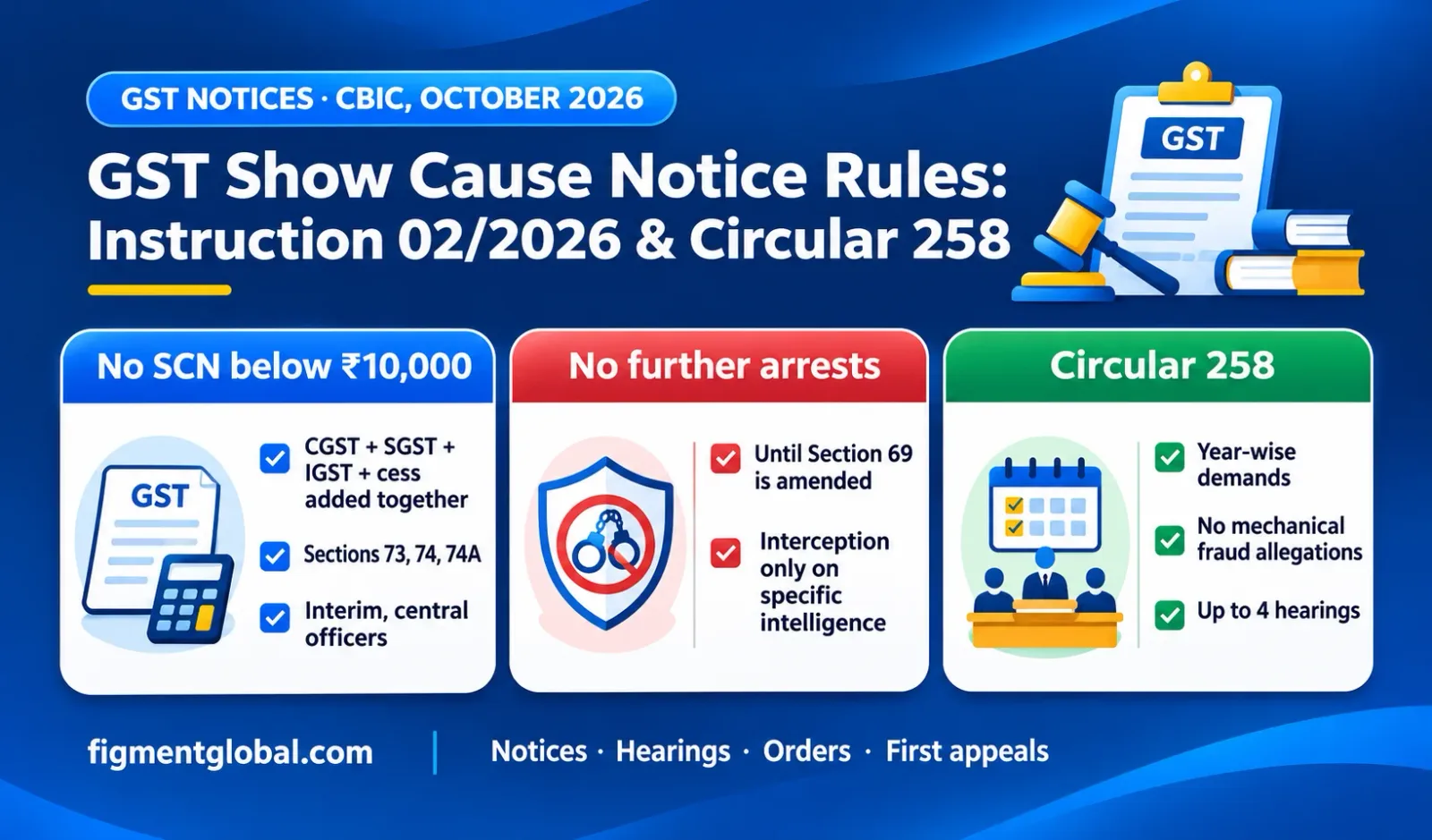
Instruction No. 02/2026-GST (30 October 2026): central tax officers are told not to issue show cause notices (SCNs) where the amount involved is below ₹10,000, not to make further arrests under GST, and to follow new limits on intercepting goods in transit. Circular No. 258/04/2026-GST (26 October 2026): detailed guidelines on drafting SCNs, invoking fraud, personal hearings, adjudication orders, rectification and first appeals.
Instruction 02/2026-GST at a glance
| Area | What the instruction says |
|---|---|
| Small demands | No SCN under Section 73, 74 or 74A where the amount involved is below ₹10,000 |
| How the amount is counted | CGST + SGST/UTGST + IGST + compensation cess, added together |
| Arrests | No further arrests under GST until Section 69 is amended |
| Interception of goods | Only on specific intelligence, with written authorisation from an officer not below Joint Commissioner |
| Transit States | Officers of a State where neither supplier nor recipient is located must let the vehicle pass and pass information to the officer with jurisdiction |
| Confiscation in transit | No confiscation of goods or conveyances in transit under Section 130 |
1. No SCN for amounts below ₹10,000
It is an administrative restraint, not a waiver. Tax that is actually payable remains payable. Businesses should still correct small errors through their returns or DRC-03. It does not deal with notices already issued. The Council also recommended withdrawing pending small-value notices, but that needs the law to be amended. Until then, reply to existing notices on time. It binds central tax officers. A copy was sent to the GST Council Secretariat for circulation to States, which may issue similar instructions. As of 3 November 2026, no State had published a matching instruction. If your GSTIN is administered by the State tax department, check your State's position before relying on it.
2. No further arrests under Section 69
3. Limits on stopping vehicles and goods in transit
A conveyance may be intercepted only on specific intelligence, with reasons recorded in writing and authorisation from an officer not below Joint Commissioner. An officer may inspect only if the supplier or recipient is registered or located in that officer's State or UT. If neither is in that State, the officer must let the goods pass and send the information to the officer with jurisdiction. If no e-way bill has been generated and no origin or destination document is produced, the goods may be inspected, detained or seized regardless of jurisdiction. Goods and conveyances in transit may not be detained or seized for any other reason, and may not be confiscated under Section 130.
Circular 258/04/2026-GST: standards for notices, hearings and orders
What a valid SCN should contain
| Element | What the circular expects |
|---|---|
| Pre-SCN intimation | Issue DRC-01A (Rule 142(1A)) where feasible, so the taxpayer can explain before a notice |
| Noticee profile | GSTIN, registration status, jurisdiction, periods and the audit or scrutiny background, for each noticee separately |
| Facts | Stated objectively, in neutral language such as "it appears that" |
| Law | Only relevant provisions, each linked to specific conduct |
| Charges | Stated clearly; gaps cannot be cured later |
| Quantification | Demand split by financial year where possible, with interest stated where applicable |
| Closing | Adjudicating authority, reply deadline and consequence of not replying |
| Summary | DRC-01 uploaded on the portal |
Fraud cannot be alleged mechanically
Personal hearings and orders
A hearing must be given on written request, or where an adverse decision is contemplated (Section 75(4)). Adjournments are limited to three (Section 75(5)). The circular allows a maximum of four hearing opportunities before an order, and reasons must be recorded when an adjournment is refused. Virtual hearings are encouraged, and hearing dates and attendees must be recorded in the order. Orders must be speaking orders. Each submission must be accepted or rejected with reasons; a line such as "reply has been considered" is not enough. No demand may be confirmed on grounds not in the SCN (Section 75(7)), and the confirmed demand cannot exceed the SCN amount. Where AI tools are used, information must be verified independently by the officer.
Rectification and first appeals
Rectification under Section 161 is limited to errors apparent on the record. It is not a substitute for an appeal. First appeals: three months to file under Section 107(1), plus one more month on sufficient cause. Appeals should not be rejected on merits at the registration stage, and the appellate authority should aim to decide within one year.
What finance teams and CA firms should do now
Sort open notices by amount. Flag notices or DRC-01A intimations below ₹10,000 issued by central tax officers after 30 October 2026, and raise the instruction in reply. Keep replying to older notices. Notices issued before 30 October 2026 are not withdrawn by the instruction. Check every SCN against Circular 258. Look for year-wise figures, specific facts behind any fraud allegation and clear charges. Ask for a personal hearing in writing, and keep a record of each hearing and adjournment. Diarise appeal deadlines from the date of each order. Brief logistics teams on the new interception rules and keep e-way bills and documents with every consignment.
How Figment's products help
Key takeaways
Instruction 02/2026-GST (30 October 2026) bars central tax SCNs where the amount is below ₹10,000 and stops further arrests under GST. It is interim, binds central tax officers, and does not withdraw notices already issued. Interception of goods in transit now needs specific intelligence and Joint Commissioner authorisation. Circular 258/04/2026-GST (26 October 2026) sets standards for SCNs, fraud allegations, hearings, orders and first appeals. Use Circular 258 as a checklist when reviewing any GST show cause notice.
Frequently Asked Questions
Yes. Instruction 02/2026-GST bars SCNs only where the amount involved is below ₹10,000, totalled across CGST, SGST/UTGST, IGST and compensation cess.
No. The instruction deals with new notices. The Council's recommendation to withdraw pending small notices needs a change in the law. Reply to existing notices on time.
It is addressed to central tax officers. A copy was sent to the GST Council Secretariat so that States can issue similar instructions. As of 3 November 2026, no State had published one.
Circular 258 says the adjudicating authority may give up to four hearing opportunities before an order, within the three-adjournment limit in Section 75(5).
No. Circular 258 says Sections 74(1) and 74A(5)(ii) need specific evidence of intent to evade, set out in the SCN. Non-payment alone is not enough.