

GST on Scrap from 1 November 2026: Reverse Charge, Registration and 2% TDS Explained
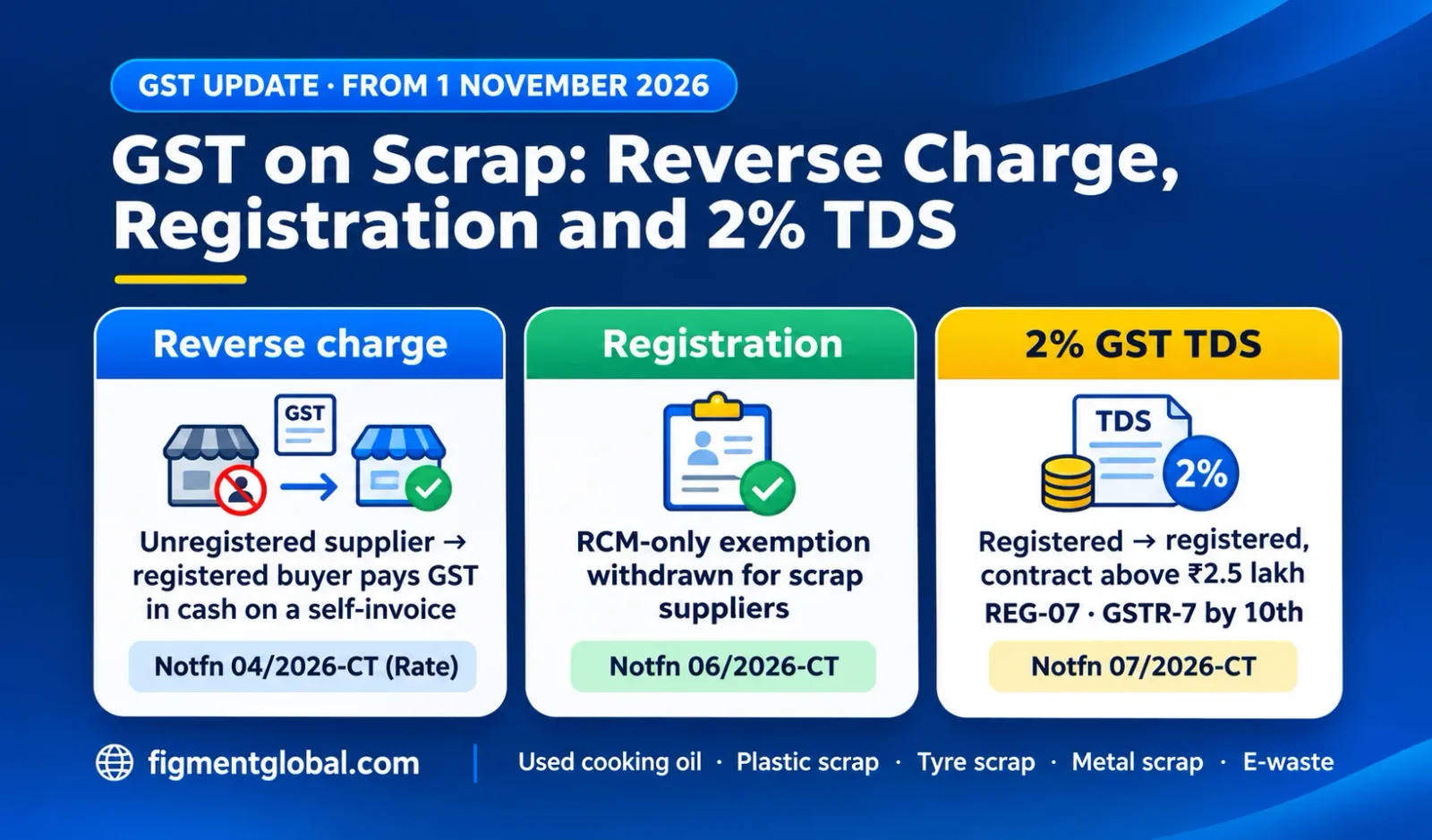
The three notifications at a glance
| Notification (27 Oct 2026) | Amends | What it does from 1 Nov 2026 |
|---|---|---|
| 04/2026-Central Tax (Rate) | Notification 4/2017-Central Tax (Rate), the RCM list under Section 9(3) | Puts four more items under reverse charge when an unregistered person supplies them to a registered person |
| 06/2026-Central Tax | Notification 5/2017-Central Tax, the registration exemption under Section 23(2) | Substitutes the proviso so that suppliers of all five items cannot use the exemption for RCM-only suppliers |
| 07/2026-Central Tax | Clause (d) of Notification 50/2018-Central Tax, under Section 51 | Requires registered buyers of all five items from registered suppliers to deduct GST TDS |
Goods covered
| Item | Customs Tariff heading | Reverse charge (from unregistered supplier) | Registration exemption withdrawn | GST TDS (between registered persons) |
|---|---|---|---|---|
| Used cooking oil | 1518 | New from 1 Nov 2026 | Yes | Yes |
| Waste and scrap of plastics | 3915 | New from 1 Nov 2026 | Yes | Yes |
| Waste and scrap of tyres | 4004 | New from 1 Nov 2026 | Yes | Yes |
| Electrical and electronics waste and scrap | 8549 | New from 1 Nov 2026 | Yes | Yes |
| Metal scrap | Chapters 72 to 81 | Already applies since 10 Oct 2024 | Yes (already since Oct 2024) | Yes (already since Oct 2024) |
1. Reverse charge on purchases from unregistered suppliers
S. No. 2A: used cooking oil (1518) S. No. 3B: waste and scrap of plastics (3915) S. No. 3C: waste and scrap of tyres (4004) S. No. 9: electrical and electronics waste and scrap (8549)
Pay tax in cash. RCM tax is paid through the electronic cash ledger. It cannot be set off against ITC. Issue a self-invoice. Under Section 31(3)(f) of the CGST Act, the registered recipient issues an invoice for supplies received from an unregistered supplier. Rule 47A requires it within 30 days of receiving the goods. Issue a payment voucher under Section 31(3)(g) when paying the supplier. Claim ITC on the self-invoice after paying the tax, subject to Sections 16 and 17. Report correctly in GSTR-3B, with RCM liability and the matching ITC shown separately.
2. Registration: the RCM-only exemption no longer helps scrap suppliers
Turnover threshold (Section 22): a supplier must register once aggregate turnover crosses the threshold. For suppliers of goods only, this is ₹40 lakh in most States, with lower limits in some States. Inter-State supplies (Section 24): a person making inter-State taxable supplies of goods must register regardless of turnover. Timeline (Section 25(1)): a person who becomes liable must apply within 30 days.
3. 2% GST TDS on purchases between registered persons
How the deduction works
| Point | Rule |
|---|---|
| Who deducts | The registered buyer (recipient) |
| When | When the supplier is also registered (if unregistered, RCM applies instead) |
| Threshold | Deduct only where the total value of the supply under a contract exceeds ₹2.5 lakh |
| Rate | 2% of the taxable value: 1% CGST + 1% SGST/UTGST for intra-State supplies, or 2% IGST for inter-State supplies |
| Value | Excludes the GST shown on the invoice |
| Inter-State exception | No deduction where the supplier's location and the place of supply are in a State/UT other than the buyer's State/UT of registration |
| Registration | Separate registration as a tax deductor in FORM GST REG-07 |
| Return and payment | FORM GSTR-7 by the 10th of the following month |
| Certificate | FORM GSTR-7A, made available to the supplier on the portal |
| Supplier credit | Credited to the supplier's electronic cash ledger once accepted |
Worked example
TDS registration in REG-07
Who is affected and what to do
| Business | Main impact | Action |
|---|---|---|
| Recyclers, re-processors, bio-diesel and refining units | RCM on purchases from unregistered collectors; TDS on purchases from registered dealers | Take REG-07 registration, set up RCM and TDS tax codes, start self-invoicing |
| Scrap dealers and aggregators | Exemption for RCM-only suppliers gone; TDS deducted by buyers | Check turnover and inter-State sales, register within 30 days if liable, reconcile TDS credits |
| Hotels, restaurants, food processors (used cooking oil sellers) | Registered buyers deduct TDS on contracts above ₹2.5 lakh | Share correct GSTIN, track GSTR-7A credits |
| Electronics, IT and telecom companies (e-waste sellers) | Same as above for e-waste disposals | Review disposal contracts and GSTIN on invoices |
| Manufacturers selling plastic or tyre scrap | Buyers deduct TDS; contracts above ₹2.5 lakh affected | Reconcile receivables net of TDS |
Compliance checklist
Map every vendor and customer that deals in the five items, and record whether each is registered. Verify GSTIN status of scrap vendors, so the choice between RCM and TDS is correct. Apply for REG-07 if your business buys the covered items from registered suppliers. Track contract values so you know when the ₹2.5 lakh limit is crossed. Set up self-invoice and payment voucher numbering for RCM purchases. Configure ERP tax codes for RCM and for TDS at 1% + 1% or 2% IGST. File the first GSTR-7 for November 2026 deductions by 10 December 2026. Suppliers: check the cash ledger each month for TDS credits and accept them in time.
How Figment's products help
Key takeaways
From 1 November 2026, GST on scrap follows one set of rules for five items: used cooking oil, plastic scrap, tyre scrap, metal scrap and e-waste. Purchases from unregistered suppliers: the registered buyer pays GST under RCM, in cash, against a self-invoice. Suppliers of these items can no longer rely on the registration exemption for RCM-only suppliers. Purchases between registered persons: the buyer deducts 2% TDS on contracts above ₹2.5 lakh and files GSTR-7 by the 10th. Metal scrap was already covered in October 2024; the other four items are new.
Frequently Asked Questions
From 1 November 2026, under Notifications 04/2026-Central Tax (Rate), 06/2026-Central Tax and 07/2026-Central Tax, all dated 27 October 2026.
No. RCM applies when the supplier is unregistered. TDS applies when both the supplier and the buyer are registered. A purchase falls under one or the other.
2% of the taxable value, excluding GST: 1% CGST plus 1% SGST/UTGST within a State, or 2% IGST between States. It applies only where the contract value exceeds ₹2.5 lakh.
No. The registration threshold and the inter-State rule still decide. What has gone is the exemption that let suppliers making only RCM supplies stay unregistered even above those limits.
No. These notifications change who pays the tax, who must register and who deducts TDS. They do not change the GST rate on these goods.