

LDC Verification: How to Verify Lower Deduction Certificates in Bulk Before Deducting TDS
Quick answer:
What is a lower deduction certificate?
| # | Income-tax Act, 1961 | Income-tax Act, 2025 (from 1 April 2026) |
|---|---|---|
| Provision | Section 197 | Section 395(1) (TDS); 395(3) for lower TCS |
| Application form | Form 13 | Form 128 |
| Rule | Rule 28AA | Rule 213, Income-tax Rules 2026 |
| Period | Assessment year / previous year | Tax year |
| Filed on | TRACES | TRACES (online only) |
Payer-specific. The certificate is generally issued in the deductor's name and covers specified payments from that deductor only. Period-bound. It is valid only for the part of the tax year stated in it. Amount-bound. It applies only up to the amount stated in it. Payments beyond that amount attract the normal rate.
Child certificates (new under the 2025 Act)
Transition from Section 197
Why LDC verification matters
Common causes of these defaults:
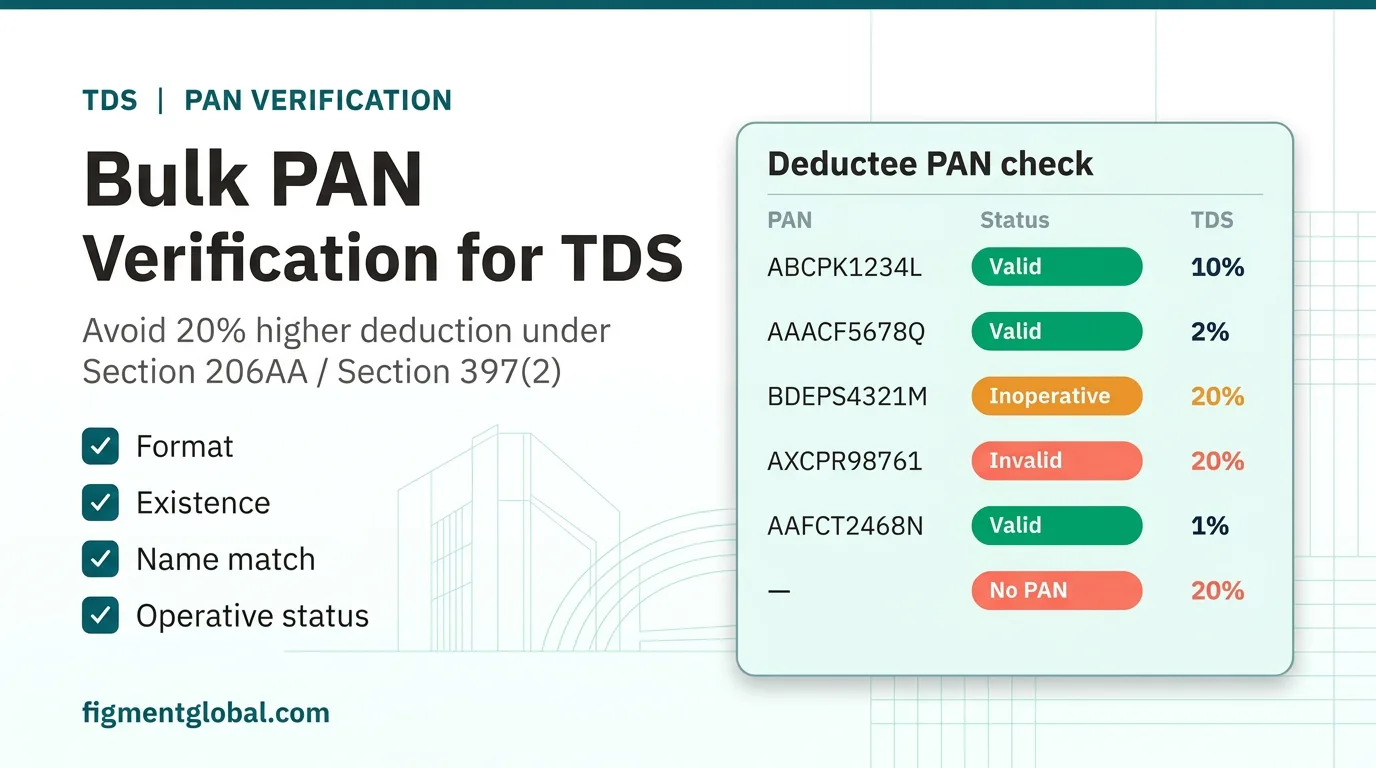
A manually issued or scanned certificate that was never on the system. CBDT has required system-generated certificates since Instruction No. 36 of 2009, and TRACES validates only those. The certificate is issued to a different TAN of the same group (for example, head office instead of a branch). The certificate expired mid-year, or was cancelled, and the vendor master was not updated. Cumulative payments crossed the limit because several business units paid the same deductee. The certificate covers one nature of payment (say, contract payments) but was applied to another (say, professional fees). Wrong rate keyed in the ERP, or a typo in the certificate number. The deductee's PAN in your master does not match the PAN on the certificate, or the PAN has become inoperative. See our guide on bulk PAN verification.
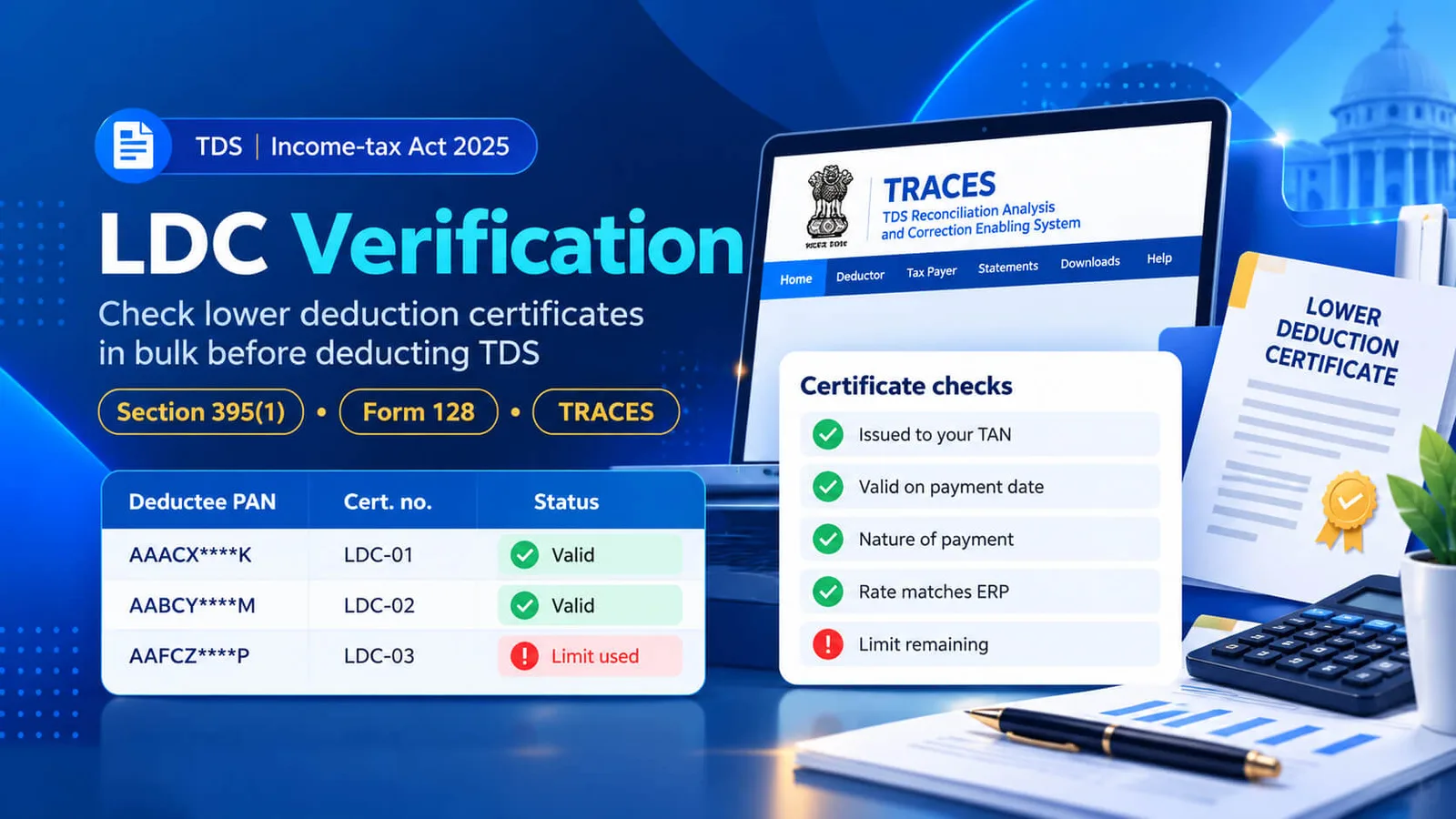
LDC verification checklist: what to check
| # | Check | What to compare | If it fails |
|---|---|---|---|
| 1 | Certificate is genuine | Certificate number validated on TRACES | Deduct at normal rate; ask deductee for a system-generated certificate |
| 2 | Issued to your TAN | TAN on certificate vs your deducting TAN | Deduct at normal rate; deductee must get a certificate (or child certificate) for your TAN |
| 3 | Same deductee | PAN on certificate vs PAN in vendor master | Fix master or deduct at normal rate |
| 4 | Valid on payment date | Validity from/to dates vs date of payment or credit, whichever is earlier | Normal rate for dates outside validity |
| 5 | Right nature of payment | Section / payment type on certificate vs section code in ERP | Normal rate for other payment types |
| 6 | Rate matches | Rate on certificate vs rate in ERP | Correct the ERP rate |
| 7 | Limit not exhausted | Certificate amount vs cumulative amount already paid or credited across all units | Normal rate on the excess |
| 8 | Not cancelled | Fresh TRACES check at each payment run, not only at onboarding | Normal rate from cancellation date |
How to verify a lower deduction certificate on TRACES
Log in to TRACES (www.tdscpc.gov.in) as a deductor. Go to Statements / Payments → Validate Lower Deduction Certificate. On TRACES this option has carried the label "u/s 197"; under the 2025 Act it covers certificates issued under Section 395. Enter the deductee's PAN, select the financial/tax year and click Go. Review the result. TRACES shows the certificate number, year, deductee PAN and name, valid-from and valid-to dates, cancellation date (if any), applicable section, nature of payment, reduced TDS rate, certificate limit, amount consumed to date and date of issue. Click the consumed amount to see the deduction entries already set off against the certificate.
Running LDC verification in bulk
Build a single LDC register
Hold every certificate in one register keyed by deductee PAN and your TAN: certificate number, rate, section, validity dates, certificate amount, and source (AO-issued or child certificate). Do not leave certificates scattered across business-unit mailboxes. Verify at receipt, then at every payment run
Validate when the certificate is first received, and again before each payment run. Certificates can be cancelled, and the remaining limit changes every time anyone in the group pays the deductee. Track consumption across units
Add up the amount paid or credited against each certificate across all branches, plants and ERPs. Switch the vendor back to the normal rate automatically once the limit is reached. Push the result back to the ERP
Only the verified rate should flow to the vendor master or payment system. Block lower-rate deduction for any deductee whose certificate failed a check. Validate again before filing
Before filing the quarterly statement (Form 140 for residents, Form 144 for non-residents), re-check every lower-deduction row. The deductee annexure of both forms has a "Reason for non/lower/higher Deduction" column and a "Certificate Number u/s 395" column: select the lower-deduction reason and quote the certificate number exactly as it appears on TRACES. Then review the justification report for short deduction defaults before the statement is processed. Handle failures quickly
If a certificate fails after deduction, decide whether to recover the shortfall from the next payment to the deductee, deposit it with interest, or correct the statement. Ask the deductee for a valid certificate or child certificate as soon as possible: Form 128 applications cannot be processed once the transaction is complete (Form 128 FAQs).
Lower deduction certificate vs Form 121 declaration
| # | Lower deduction certificate (Section 395) | Form 121 (old Form 15G/15H) |
|---|---|---|
| Who issues it | Assessing Officer, or deductee via child certificate | Deductee self-declaration |
| Effect | Lower or nil rate up to a stated amount | No deduction where conditions are met |
| Verification | On TRACES, against certificate database | Eligibility and declaration checks by deductor |
| Reporting | Certificate number quoted in the TDS statement | Unique ID allotted and reported by deductor |
How TaxCPC handles LDC verification
Bulk LDC verification, so certificates for many deductees are checked together instead of one at a time. Complete TRACES integration with live API validation, so records are checked against TRACES before the statement is filed. Bulk PAN verification, to catch PAN mismatches and inoperative PANs that also break lower-rate deduction. A justification report before filing, to find short deduction and other defaults early. Custom data templates for ERP extracts, and capacity for crores of records per quarter.
Frequently Asked Questions
Checking that a deductee's lower or nil deduction certificate is genuine, issued for your TAN, valid on the payment date, covers that payment type and has amount remaining, before deducting TDS at the lower rate.
From 1 April 2026, lower or nil deduction certificates are issued under Section 395(1) of the Income-tax Act, 2025, on an application in Form 128 filed online on TRACES.
Where a deductee expects more than 100 deductors whose details are not known, the certificate is issued in the deductee's name and the deductee generates a child certificate for each deductor on TRACES, within the main certificate's limit.
CPC (TDS) treats the difference as short deduction. You are liable for the shortfall and interest, and the default appears in your justification report.
Yes, within the period and amount stated in them. CBDT's FAQs on Section 536 (annexed to an office memorandum of 6 June 2026) say certificates issued before 1 April 2026 remain protected, and pending applications for tax year 2026-27 onwards are treated as filed under the 2025 Act. A certificate issued for FY 2025-26 does not cover payments made in tax year 2026-27.