

Bulk PAN Verification for TDS: Avoid Higher Deduction Under Section 206AA
Quick answer:
What Section 206AA (now Section 397(2)) requires
| Rate | When it applies |
|---|---|
| The rate in the relevant section of the Act | Always considered |
| The rate or rates in force | Always considered |
| 5% | For payments covered by Section 393(1), Table Sl. Nos. 8(ii) and 8(v), as specified in Section 397(2)(b)(i)(c) of the Income-tax Act, 2025. |
| 20% | In any other case |
An invalid PAN is treated as no PAN. A typo or a PAN belonging to someone else does not protect you. Declarations need to meet the applicable statutory conditions. Forms 15G and 15H have been replaced by Form 121 under the Income-tax Rules, 2026, for declarations under Section 393(6). Before applying a no-deduction benefit, verify the declarant's eligibility and the prescribed PAN requirements. Higher TDS does not apply where nothing is deductible, for example where the payment is below the threshold.
Salary and non-residents
Inoperative PAN: the most common cause of higher TDS
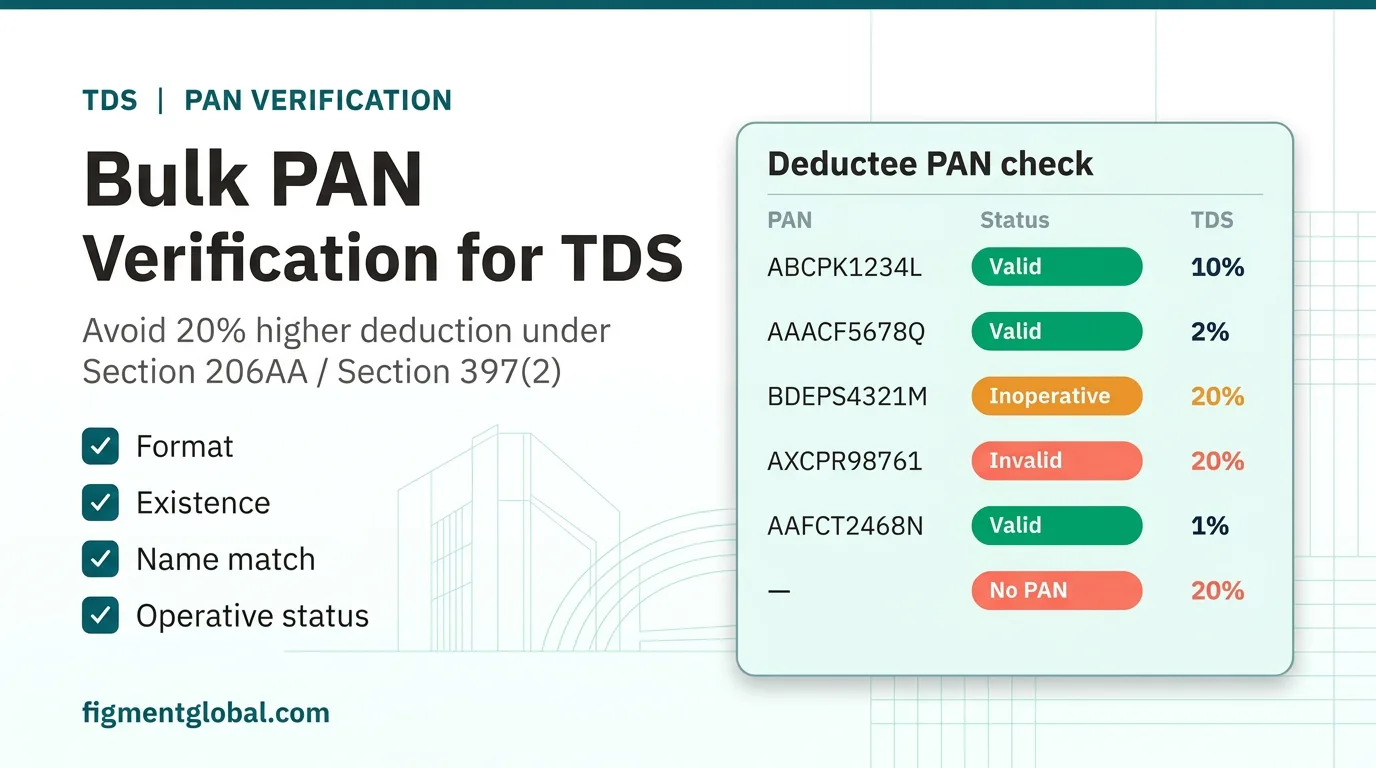
What "valid" means when you verify a PAN
| Check | What it catches | How to check |
|---|---|---|
| Format | Wrong length, wrong character pattern (5 letters, 4 digits, 1 letter) | Validation in your ERP or upload template |
| Existence | PANs that don't exist in the department's database | TRACES PAN verification, e-filing portal, or a PAN verification API |
| Name match | A real PAN that belongs to someone else | Compare the name returned with the vendor/deductee master |
| Operative status | Identifies whether the PAN is active or inoperative, including where applicable the consequences of failure to link Aadhaar | Check the status returned by the authorised PAN verification service and the applicable PAN–Aadhaar linking status. Confirm the exact status labels supported by TRACES before describing them. |
The cost of getting it wrong
A demand for the difference between the higher rate and the rate applied. Interest on the short deduction under Section 398(3) of the Income-tax Act, 2025, generally at 1% for every month or part of a month from the date tax was deductible until it is deducted, and at 1.5% for every month or part of a month from the date of deduction until payment, as applicable. The deductee cannot see the credit in Form 26AS if the PAN is wrong, which leads to complaints, revision requests and correction statements.
Step-by-step bulk PAN verification process
Clean the master
Pull all deductee PANs from the vendor master, depositor base, employee master and any one-off payees. Remove duplicates, trim spaces, convert to upper case and run the format check. Flag blanks. Verify in bulk against the department's records
Run the full list through a bulk verification: TRACES (for registered deductors), or a PAN verification API connected to your ERP. Capture, for each PAN, whether it exists, the name on record and whether it is operative. Match names
Compare the returned name with your master using a tolerance for initials and spacing. Treat clear mismatches as invalid until the deductee confirms. Set the TDS rate flag
Mark each deductee as "normal rate", "higher rate (no/invalid PAN)" or "higher rate (inoperative PAN)". This flag should drive the deduction in the ERP, not a manual override. Follow up with deductees
Ask deductees with invalid or inoperative PANs to correct their PAN or complete Aadhaar linking. Keep proof of communication. Re-verify before every quarterly return
PAN status changes. Re-run the bulk check before you file each quarter's return and before payment runs for large vendors.
Bulk PAN verification checklist
| No. | Old checklist item | New checklist wording |
|---|---|---|
| 1 | Section 206AA → Section 397(2), effective 1 April 2026 | Confirmed: Section 397(2) is the relevant higher-deduction provision under the Income-tax Act, 2025. |
| 2 | 5% rate mapping to Section 393(1) Table Sl. 8(ii) and 8(v) | Confirmed against the statutory wording in Section 397(2)(b)(i)(c). |
| 3 | Section 397(2) rates checked only against a third-party summary | Confirmed against the official Income-tax Act, 2025. |
| 4 | Form 121 invalid without PAN: Section 393(4) reference | Verify the PAN requirement against the applicable Form 121 eligibility and declaration provisions. |
| 5 | Salary: higher rate versus average rate under Section 392 | Section 392(1) prescribes average-rate salary TDS; confirm its interaction with Section 397(2) for the relevant payment. |
| 6 | Non-resident rule number under Income-tax Rules 2026 | Updated to Rule 217. |
| 7 | Inoperative PAN rule number | Updated to Rule 162 of the Income-tax Rules, 2026. |
| 8 | CBDT relief for tax year 2026–27 | Confirm whether a subsequent circular or notification grants relief for the relevant transaction period. |
| 9 | Categories exempt from PAN–Aadhaar linking | Tax team to confirm the current categories and applicable notifications. |
| 10 | TRACES PAN verification status labels | Product team to confirm the exact labels returned by TRACES. |
| 11 | Section 201(1A) → Section 398 | Updated to Section 398(3); confirm the application of the statutory interest provisions. |
| 12 | PANNOTAVBL and reporting format in Forms 138/140/144 | Product/tax team to confirm the current permitted indicator and reporting specifications. |
| 13 | FAQ 2: rates under Section 397(2) | Updated to match Section 397(2)(b)(i)(c) and the specified 5% rate. |
| 14 | FAQ 4: non-resident exception and rule number | Updated to Rule 217, subject to the prescribed conditions. |
How Figment handles bulk PAN verification
Bulk PAN verification across the full deductee list before deduction and before filing. Live API validation with TRACES, so records are checked against TRACES before the statement is filed, as part of complete TRACES integration. A justification report before filing, to find short deduction and other defaults while they can still be fixed. Form 15G/15H (Form 121) validation, creation and mapping to deductee records. Custom data templates and handling of lakhs of records per quarter, so data from SAP, core banking or payroll can be loaded without reformatting.
Key takeaways
A missing, invalid or inoperative PAN means TDS at the higher rate, usually 20%, under Section 206AA / Section 397(2). An inoperative PAN (not linked with Aadhaar) is treated as no PAN. Valid means four checks: format, existence, name match and operative status. Verify in bulk before deduction and again before each quarterly return. Missed higher deduction becomes a short-deduction demand with interest on the deductor.
Frequently Asked Questions
It is checking the PAN, name and operative status of all deductees in one batch, using TRACES or a PAN verification API, so the correct TDS rate is applied before deduction and before filing the quarterly return.
Under Section 397(2) of the Income-tax Act, 2025, TDS is generally deducted at the highest of the applicable rate under the Act, the rate or rates in force, or 20%. A 5% rate applies to the specified payments covered by Section 393(1), Table Sl. Nos. 8(ii) and 8(v), as provided under Section 397(2)(b)(i)(c).
Yes. A PAN that is inoperative because it is not linked with Aadhaar is treated as not furnished, so the higher rate applies unless the deductee is exempt from linking.
Section 397(2), read with Rule 217 of the Income-tax Rules, 2026, provides a conditional exception from higher deduction for specified payments to eligible non-residents without a PAN. The exception covers interest, royalty, fees for technical services, dividends and payments on the transfer of a capital asset, subject to the prescribed documentation and other applicable conditions.
At onboarding, and again before every quarterly TDS return, because PAN status can change during the year.