

What is a salary perquisite?
Quick answer:
Which rule applies to which year
| Salary for | Law | Valuation rule | TDS certificate | Quarterly salary TDS return |
|---|---|---|---|---|
| FY 2025-26 (AY 2026-27) and earlier | Income-tax Act, 1961, Section 17(2) | Rule 3, Income-tax Rules, 1962 | Form 16 | Form 24Q |
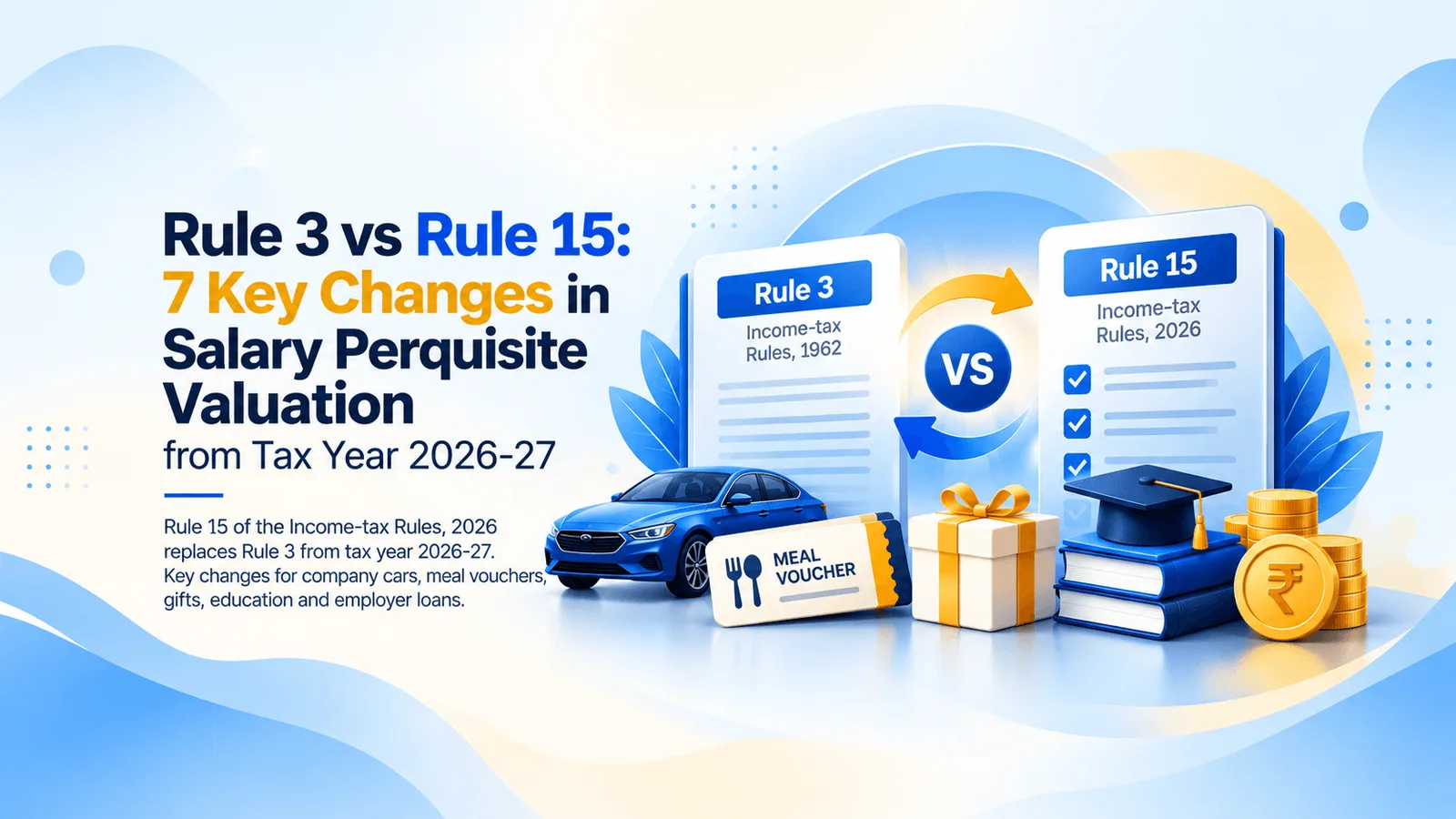
| Tax year 2026-27 onward | Income-tax Act, 2025, Section 17(1) | Rule 15, Income-tax Rules, 2026 | Form 130 | Form 138 |
| Rule 3 vs Rule 15: what changed at a glance | ||||
| Perquisite | Rule 3 (1962 Rules) | Rule 15 (2026 Rules) | Change | |
| Car owned or hired by employer, used partly for private purposes, expenses borne by employer (≤1.6 litre) | ₹1,800 a month | ₹5,000 a month | Up 2.8x | |
| Same, engine above 1.6 litres | ₹2,400 a month | ₹7,000 a month | Up 2.9x | |
| Same, private running expenses borne by employee (≤1.6 litre / above 1.6 litre) | ₹600 / ₹900 a month | ₹2,000 / ₹3,000 a month | Up 3.3x | |
| Chauffeur provided by employer | ₹900 a month | ₹3,000 a month | Up 3.3x | |
| Electric vehicles | No specific treatment | Valued like a car of up to 1.6 litres | New | |
| Employee's own two-wheeler or other conveyance, mixed use: deduction for official use | ₹900 a month | ₹3,000 a month | Up 3.3x | |
| Free or concessional education in employer's or similar institution: taxable only if cost per child exceeds | ₹1,000 a month | ₹3,000 a month | Up 3x | |
| Interest-free or concessional loan: no perquisite if aggregate loans do not exceed | ₹20,000 | ₹2,00,000 | Up 10x | |
| Free food or meal vouchers during working hours: exempt up to | ₹50 per meal | ₹200 per meal | Up 4x | |
| Gifts, vouchers or tokens: nil if aggregate in the year is below | ₹5,000 | ₹15,000 | Up 3x | |
| Use of employer's movable assets: excluded items | Laptops and computers | Laptops, computers, tablets and mobile phones | Wider | |
| Accommodation owned by non-government employer | 10% / 7.5% / 5% of salary | 10% / 7.5% / 5% of salary | No change | |
| Accommodation leased by employer | Lower of rent paid or 10% of salary | Lower of rent paid or 10% of salary | No change | |
| Hotel accommodation | Lower of actual charges or 24% of salary | Lower of actual charges or 24% of salary | No change | |
| ESOP / sweat equity: fair market value of listed shares | Average of opening and closing price on exercise date | Average of opening and closing price on exercise date | No change |
1. Residential accommodation (Rule 15(2))
| City population (2011 census) | Perquisite value |
|---|---|
| Above 40 lakh | 10% of salary |
| Above 15 lakh up to 40 lakh | 7.5% of salary |
| Other areas | 5% of salary |
Leased by the employer: actual lease rent or 10% of salary, whichever is lower. Government accommodation: the licence fee fixed by the government, less rent paid. Hotel: actual charges or 24% of salary, whichever is lower. Stays of up to 15 days on transfer are excluded. Furnished accommodation: add 10% a year of the cost of furniture and appliances, or the actual hire charges if the furniture is hired. Same house for more than one year: the value for later years cannot exceed the first-year value indexed by the Cost Inflation Index. The first year is tax year 2023-24 or the year the house was first provided, whichever is later. Transfer: if an employee keeps accommodation at both places, only the lower of the two is taxed for the first 90 days.
2. Motor car (Rule 15(3)), where the biggest change is
| Situation | Up to 1.6 litres or electric | Above 1.6 litres |
|---|---|---|
| Employer's car, official use only, logbook and certificate kept | Nil | Nil |
| Employer's car, private use only, expenses met by employer | Actual running cost + chauffeur + 10% a year wear and tear, less amount recovered | Same |
| Employer's car, mixed use, expenses met by employer | ₹5,000 a month (+ ₹3,000 for chauffeur) | ₹7,000 a month (+ ₹3,000 for chauffeur) |
| Employer's car, mixed use, private running expenses met by employee | ₹2,000 a month (+ ₹3,000 for chauffeur) | ₹3,000 a month (+ ₹3,000 for chauffeur) |
| Employee's own car, mixed use, expenses reimbursed by employer | Reimbursement minus ₹5,000 a month | Reimbursement minus ₹7,000 a month |
Electric vehicles are explicitly valued at the lower (up to 1.6 litre) rate, whatever their size. The ₹5,000 / ₹7,000 deduction for an employee's own car also works in the employee's favour. A larger part of a car reimbursement can now be treated as official use without a logbook.
| # | Rule 3 (FY 2025-26) | Rule 15 (tax year 2026-27) |
|---|---|---|
| Car | ₹1,800 × 12 = ₹21,600 | ₹5,000 × 12 = ₹60,000 |
| Chauffeur | ₹900 × 12 = ₹10,800 | ₹3,000 × 12 = ₹36,000 |
| Taxable perquisite | ₹32,400 | ₹96,000 |
3. Services and utilities (Rule 15(4))
Sweeper, gardener, watchman or personal attendant: the salary paid for the service, less any amount the employee pays. Gas, electricity and water: the amount paid to the supplier, or the manufacturing cost per unit if supplied from the employer's own resources. Education for household members: the employer's actual cost. In an employer-owned or other institution, the perquisite is the cost of similar education nearby, but only where it exceeds ₹3,000 per child per month (₹1,000 under Rule 3). Free travel by a passenger or goods carrier (other than airlines and railways): the price charged to the public, less amount recovered.
4. Other fringe benefits (Rule 15(5), Table IV)
| Benefit | Value under Rule 15 | What changed from Rule 3 |
|---|---|---|
| Interest-free or concessional loan | Interest at the SBI rate on the 1st day of the tax year on the maximum monthly outstanding balance, less interest paid | No value if aggregate loans do not exceed ₹2,00,000 (was ₹20,000). Loans for specified diseases (Rule 18) stay exempt |
| Holiday paid by employer | Actual expenditure | No change |
| Free food and non-alcoholic beverages | Actual cost, less recovery | Exempt up to ₹200 per meal during working hours or through meal vouchers (was ₹50). Tea and snacks, and meals in remote areas, stay exempt |
| Gifts, vouchers, tokens | Full value | Nil if the aggregate for the year is below ₹15,000 (was ₹5,000) [VERIFY whether the whole amount or only the excess is taxable once the limit is crossed; the long-standing view under Rule 3 was the whole amount] |
| Credit card expenses | Amount paid by employer, less recovery | No change. Nil for official use with records and a certificate |
| Club expenses | Actual expenditure, less recovery | No change. Initial fee for corporate membership is excluded |
| Use of movable assets | 10% a year of cost, or the hire charges | Tablets and mobile phones are now also excluded, along with laptops and computers |
| Transfer of movable assets | Cost less wear and tear (50% WDV for computers and electronics, 20% WDV for cars, 10% for others), less amount paid | No change |
| Any other benefit | Cost to employer at arm's length, less recovery | No change. Telephone and mobile expenses are excluded |
5. ESOPs and sweat equity (Rule 15(6) and (7))
Listed shares: the average of the opening and closing price on the exercise date. If listed on more than one exchange, use the exchange with the highest trading volume. If there was no trading that day, use the closing price on the closest earlier date. Unlisted shares and other specified securities: the value set by a SEBI-registered Category I merchant banker on the specified date. That is the exercise date, or any date up to 180 days before it.
What employers and payroll teams should do now
Old regime or new regime?
What employees should check
The perquisite break-up in your Form 130 (formerly Form 16) and your payslips from April 2026 That your company car is valued at the new ₹5,000 / ₹7,000 rate (and ₹3,000 for a driver), not the old rate That meal cards above ₹50 per meal, and gifts above ₹5,000 a year, are no longer taxed, as long as they stay within the new limits Any staff loan: no perquisite should be added if your total loans are ₹2,00,000 or less Rent-free accommodation: still 10%, 7.5% or 5% of salary, with rent you pay deducted
How Figment helps
Frequently Asked Questions
Rule 15 of the Income-tax Rules, 2026, read with Section 17(1) of the Income-tax Act, 2025. It replaces Rule 3 of the Income-tax Rules, 1962 from 1 April 2026.
For a car owned or hired by the employer and used for both official and private purposes, with expenses met by the employer: ₹5,000 a month for engines up to 1.6 litres (and electric cars), ₹7,000 a month above 1.6 litres, plus ₹3,000 a month if a chauffeur is provided.
Gifts, vouchers and tokens are not taxed if their total value in the tax year is below ₹15,000. The earlier limit was ₹5,000.
Up to ₹200 per meal for food and non-alcoholic beverages provided during working hours or through vouchers usable only at eating places. The earlier limit was ₹50.
Not if the total of such loans does not exceed ₹2,00,000, or if the loan is for treatment of a disease specified in Rule 18. Above that, the perquisite is interest at the SBI rate, less interest you pay.
No. They remain 10%, 7.5% or 5% of salary depending on the city's population, or the lower of rent paid and 10% of salary for leased accommodation.
No. Salary for FY 2025-26 (AY 2026-27) is valued under Rule 3 of the 1962 Rules. Rule 15 applies from tax year 2026-27.