

What GSTN has announced
| Item | Up to 31 Dec 2026 | From 1 Jan 2027 |
|---|---|---|
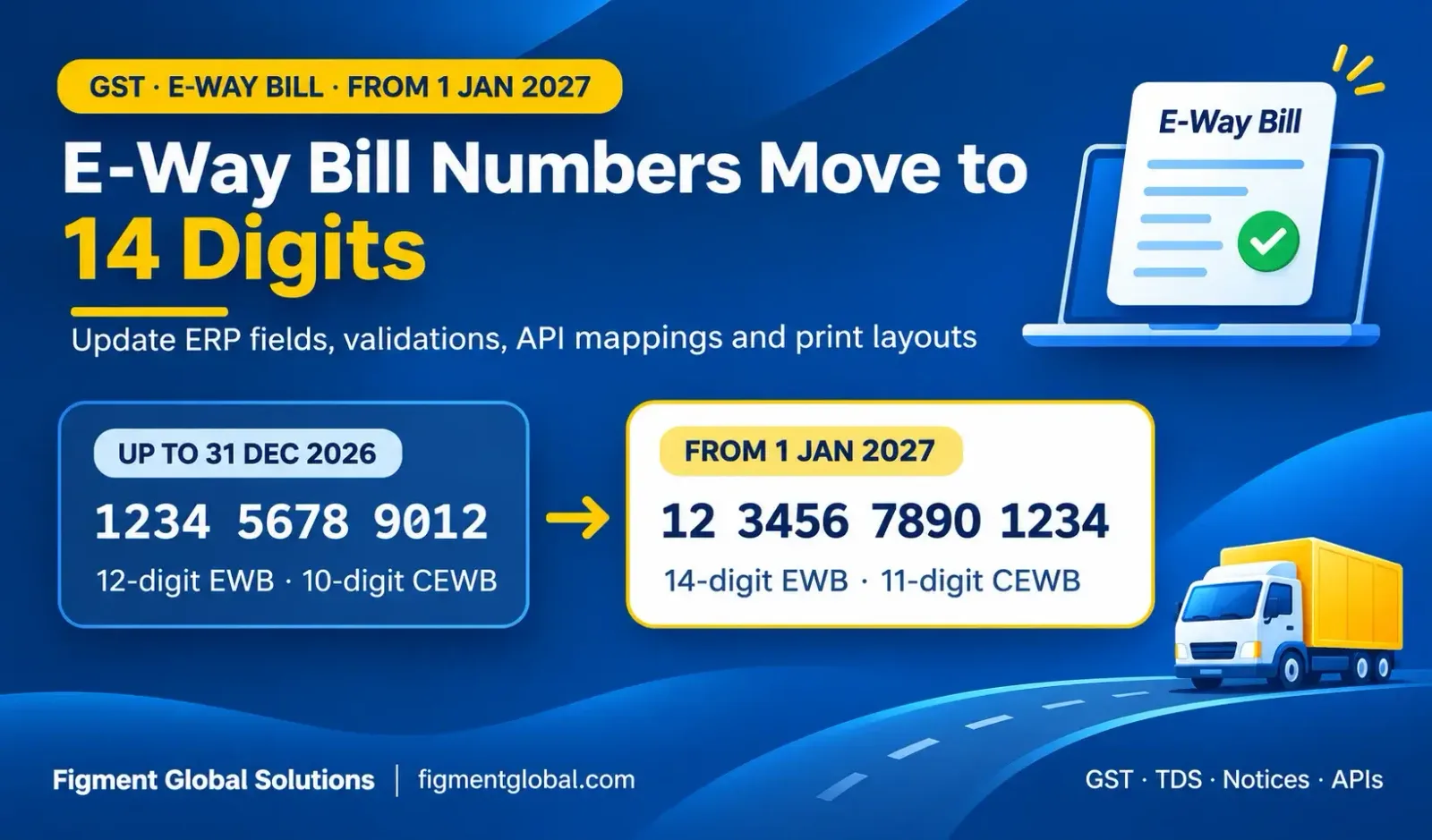
| E-way bill number (EWB-01) | 12 digits | 14 digits |
| Consolidated e-way bill number (EWB-02) | 10 digits | 11 digits |
| Who should act | Taxpayers, GSPs, ERP and software vendors, API integrators | Same |
| Testing | GSTN says the change will be released in the e-way bill sandbox "shortly" | Details to be published on the e-way bill portal |
What does not change
The e-way bill threshold (consignment value above ₹50,000, with some States using a different limit for intra-State movement). Validity rules: one day per 200 km for regular cargo, one day per 20 km for over-dimensional cargo. Part A / Part B structure, vehicle updates, extension, cancellation within 24 hours and rejection within 72 hours. The advisory does not ask anyone to renumber existing e-way bills.
Why a longer number can break working systems
Fixed-length database columns. A field defined as CHAR(12) or VARCHAR(12) will reject or cut a 14-digit number. The e-way bill is valid on the portal, but your dispatch record holds a wrong number. Validation rules. Screens and bulk-upload templates that check "exactly 12 digits" will stop users entering a valid new number, for example when a transporter shares a 14-digit EWB for an inward consignment. Numeric fields. Some systems store the EWB number as a number, not text. A 14-digit value can overflow a 32-bit integer field, and Excel may show it in scientific notation if the column is not formatted as text. API mapping. Request and response mappings between your ERP, middleware and GSP may assume the old length. This includes the e-way bill number returned when you generate an e-way bill from an IRN. Print layouts. Invoice, delivery challan and gate pass templates may have a fixed-width box for the EWB number. Downstream reports. Dispatch registers, logistics MIS, reconciliation tools and audit exports may join tables on the EWB number. A truncated number breaks the match. Consolidated EWBs. Transporters and trip-sheet software must handle 11-digit CEWB numbers as well.
Who needs to do what
| Team | What to check and update |
|---|---|
| IT / ERP team | Field lengths in SAP, Oracle, Tally customisations and in-house systems; validation rules; middleware mappings |
| GSP / API integrator | Confirm the GSP's January release supports 14-digit EWB and 11-digit CEWB numbers in every API: generation, Part-B update, extension, cancellation, consolidated EWB and lookup |
| Logistics and transport | TMS, trip sheets, driver apps and gate entry systems; consolidated EWB handling |
| Tax team | E-way bill vs GSTR-1 / e-invoice reconciliation logic; reports used for audit and notices |
| Warehouse / stores | Inward consignment entry screens where supplier or transporter EWB numbers are keyed in |
| Finance / MIS | Excel templates, Power BI or other dashboards that store or join on EWB numbers |
Readiness checklist before 1 January 2027
List every system that creates, stores, receives, prints or reports an EWB or CEWB number. Widen database fields. A text field of 15 or more characters gives headroom for future changes. Store EWB numbers as text, not numbers, in databases and spreadsheets. Update validation rules to accept both 12-digit and 14-digit EWB numbers, and both 10-digit and 11-digit CEWB numbers. Check API request and response mappings, including e-way bill details returned with e-invoice (IRN) generation. Update print layouts for invoices, delivery challans and gate passes. Get written confirmation from your GSP and ERP vendor that their release supports the new formats, and when it goes live. Test in the e-way bill sandbox once GSTN releases the change: generate, update Part B, extend, cancel, consolidate and fetch. Run a test with a dummy 14-digit value through every report and reconciliation. Plan a support desk for the first week of January for dispatch and gate teams. Brief transporters and key customers that new e-way bills will carry longer numbers.
Practical example
How Figment's e-way bill API handles it
Key takeaways
From 1 January 2027, e-way bill numbers have 14 digits and consolidated e-way bill numbers have 11 digits. The e-way bill rules, thresholds and validity do not change. Only the number format does. The risk is in your own systems: field lengths, validations, API mappings, print layouts and reports. Systems must accept both old and new formats, because 2026 e-way bills keep their 12-digit numbers. Test in the sandbox as soon as GSTN releases it, and get your GSP and ERP vendor to confirm readiness in writing.
Frequently Asked Questions
From 1 January 2027, as per GSTN's advisory dated 4 November 2026. Consolidated e-way bill numbers will move from 10 to 11 digits on the same date.
The advisory does not ask anyone to renumber existing e-way bills. GSTN has not yet said how in-transit bills will be handled after the switch, so your systems should handle both the old 12-digit and new 14-digit numbers.
No. The ₹50,000 threshold, distance-based validity, Part A / Part B, extension and cancellation rules stay the same. Only the number format changes.
Fields or validations built for exactly 12 digits. They can reject or truncate the new number even though the e-way bill was generated correctly on the portal.
GSTN has said the change will be released in the e-way bill sandbox shortly, with details on the e-way bill portal. Ask your GSP for sandbox access as soon as it is available.