

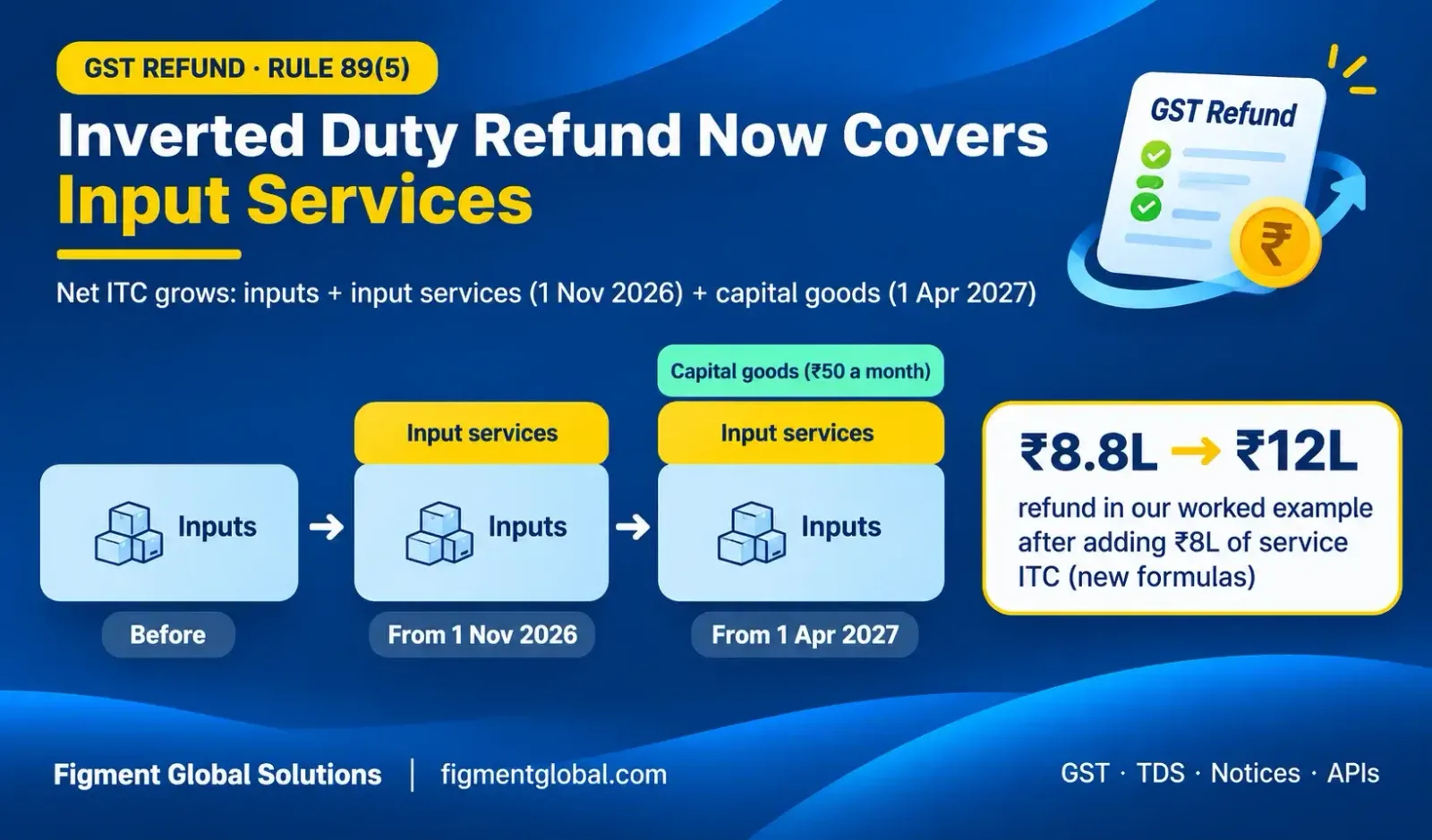
ITC on eligible input services availed on or after 1 November 2026, and ITC on capital goods availed on or after 1 April 2027, spread over 60 months.
What has changed at a glance
| Point | Before 1 Nov 2026 | From 1 Nov 2026 | From 1 Apr 2027 |
|---|---|---|---|
Who benefits
Textile and apparel makers (fabric and garments at lower rates, with dyes, chemicals and services at 18%). Footwear, fertiliser, solar and some food processing units. Manufacturers whose main inputs are taxed at 18% and finished goods at 5%. Any business whose output is taxed at 5% while large parts of its service costs (freight, job work, rent, IT) carry 18% GST. Check rates at HSN level for your own supply chain.
How the new formula works
Worked example
| Item | Amount (₹) |
|---|---|
Important conditions and limits
Only credit availed on or after 1 November 2026. Service credit taken into the ledger before that date does not enter Net ITC, even if the refund claim is filed later. No reopening of old periods. The notification does not provide for recomputing past claims. Do not refile earlier periods using the new formula without advice. "Eligible" input services. Credit blocked under Section 17(5) or reversed under Rules 42/43 stays out. Capital goods from April 2027. Only capital goods whose ITC is availed on or after 1 April 2027 count, at 1/60th per month over 60 months, net of reversals. From 1 December 2026, the substituted RFD-01 must carry a declaration that the goods are still in the business and used for the relevant supplies. The Act still says "inputs". Section 155 of the Finance Act, 2026 amended Section 54(6) and 54(14), not the eligibility condition in Section 54(3), which still refers to the rate on "inputs" being higher than the rate on output supplies. The expansion to input services and capital goods comes through Rule 89(5). It does not widen the class of persons eligible for an inverted duty refund. Existing exclusions continue. Nil-rated and fully exempt outputs are still not eligible, and goods notified as ineligible for inverted duty refund under Notification 5/2017–Central Tax (Rate), as amended, and the construction services restriction under Notification 15/2017–Central Tax (Rate) remain in place.
Faster processing too
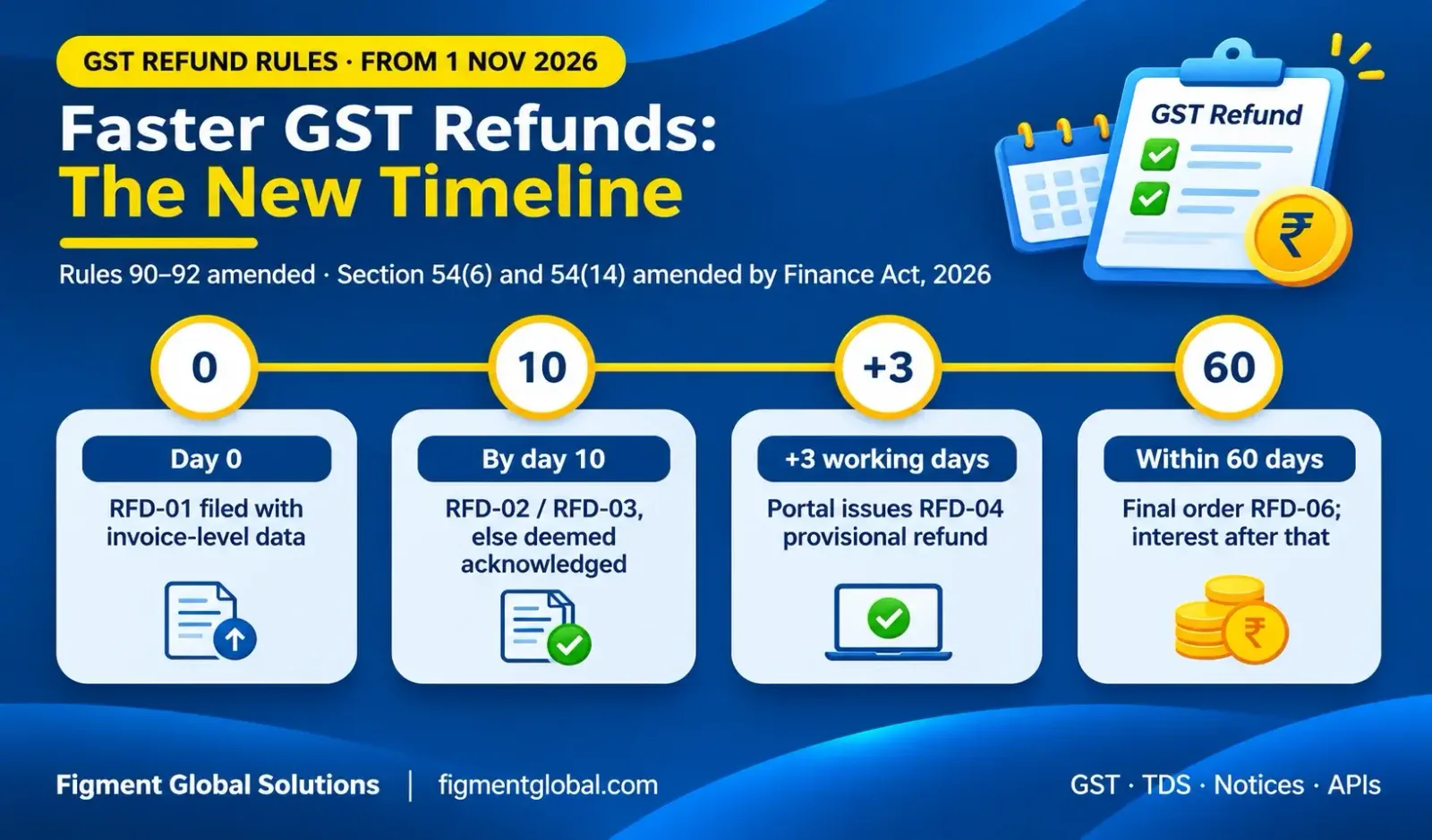
90% provisional refund. Section 155 of the Finance Act, 2026, brought into force by Notification 03/2026–Central Tax, extends the provisional refund under Section 54(6) to inverted duty claims. It was earlier limited to zero-rated supplies. Shorter acknowledgement. The officer must issue an acknowledgement or deficiency memo within 10 days instead of 15. If neither is issued, the claim is deemed acknowledged, and the portal can then issue the provisional refund order based on system risk checks.
Checklist for finance teams
Identify GSTINs with an inverted duty structure and a regular credit build-up. Tag service ITC availed on or after 1 November 2026 separately in your ITC register, by period and GSTIN. Remove blocked credits (Section 17(5)) and credits reversed under Rules 42/43 from the service ITC figure. Reconcile service ITC with GSTR-2B so every invoice in the claim is supported. From April 2027, start a capital goods register with availment date and 60-month schedule. Recompute your expected refund for November 2026 onwards with the new Net ITC. Do not refile periods before November 2026 under the new formula without advice. Keep the invoice-wise statement ready; the substituted RFD-01 (from 1 December 2026) asks for invoice details.
How Figment's products help
Key takeaways
From 1 November 2026, ITC on eligible input services counts in the inverted duty refund, but only for credit availed on or after that date. From 1 April 2027, ITC on capital goods availed on or after that date also counts, spread over 60 months. Net ITC is larger, but the full tax payable is now deducted; for most claimants with high service spend, the refund still goes up. Inverted duty claims now also qualify for a 90% provisional refund. Keep service credit tagged by availment date from November 2026; it is the key data point for future claims.
Frequently Asked Questions
Yes, for ITC on eligible input services availed on or after 1 November 2026, under Rule 89(5) as substituted by Notification 05/2026–Central Tax.
No. Only service credit availed on or after 1 November 2026 enters Net ITC, even if the claim is filed later.
For capital goods whose ITC is availed on or after 1 April 2027, apportioned at 1/60th per month over 60 months.
Yes. From 1 November 2026, Section 54(6), as amended by Section 155 of the Finance Act, 2026, allows a 90% provisional refund for eligible inverted duty claims.
The input services change is for inverted duty refunds under Rule 89(5). For zero-rated supplies, capital goods credit is added under Rule 89(4) from 1 April 2027, and the 1.5x turnover cap for exports of goods has been removed.