


GST on Cloud and SaaS Subscriptions Under RCM: ChatGPT, Claude, GitHub, Docker and GoDaddy
Why cloud subscriptions fall under RCM
| Buyer | Who pays GST | How |
|---|---|---|
| Individual or unregistered business | Foreign vendor | Vendor registers in India under the simplified OIDAR scheme and adds GST to the price (Section 14, IGST Act) |
| GST-registered business | Your business | You pay 18% IGST under reverse charge and claim ITC (Section 5(3), IGST Act; Notification 10/2017-Integrated Tax (Rate)) |
Step 1: Check who issued the invoice
| What the invoice shows | Treatment |
|---|---|
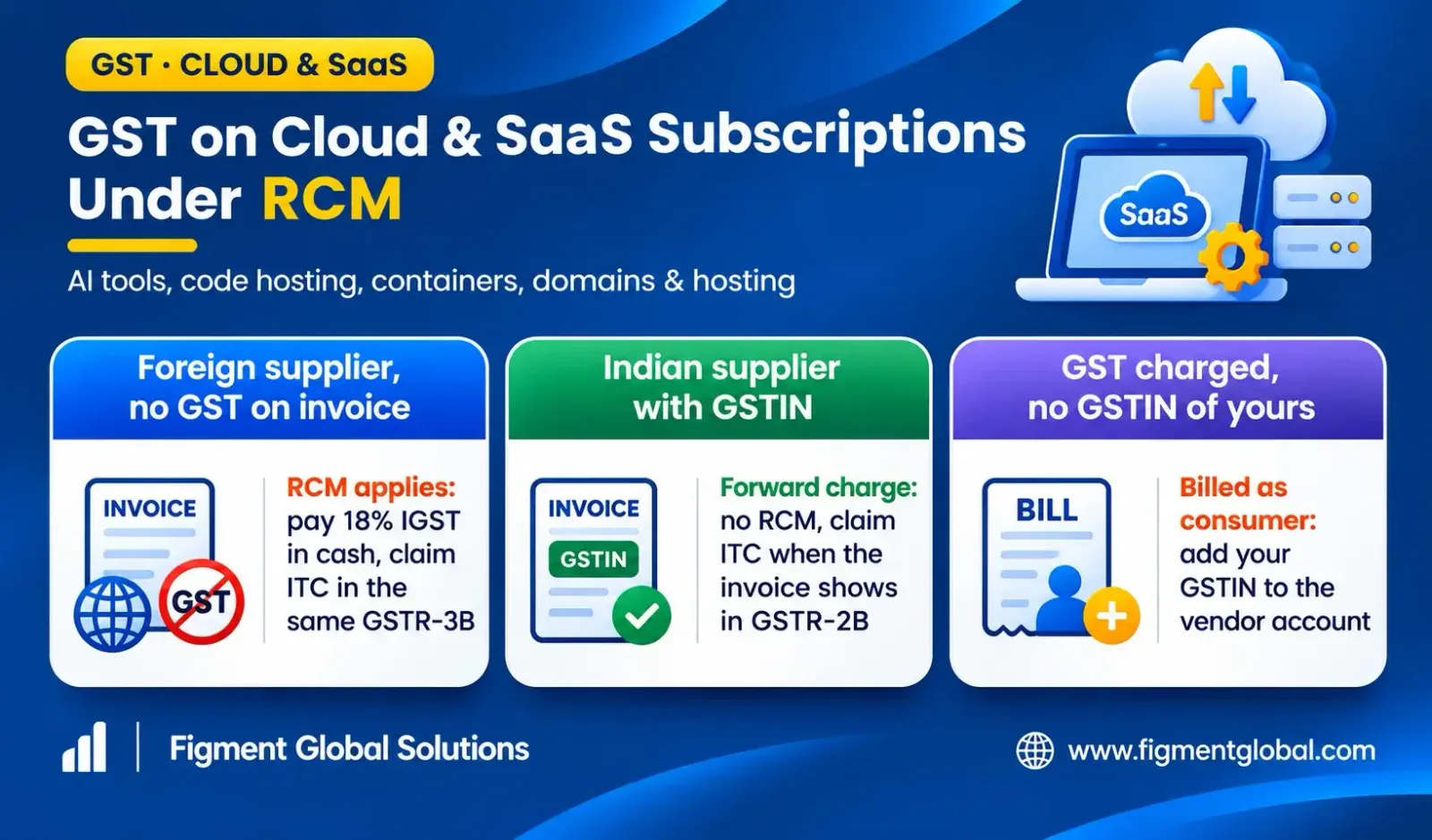
| Foreign supplier, no GST charged, your GSTIN on the invoice | RCM applies. Pay 18% IGST yourself and claim ITC |
| Foreign supplier, GST charged, no GSTIN of yours on the invoice | You were billed as a consumer. Add your GSTIN with the vendor and see FAQ 3 |
| Indian supplier with its own GSTIN, GST charged, your GSTIN on the invoice | Normal forward charge. No RCM. Claim ITC once the invoice appears in GSTR-2B |
| Paid through an Indian reseller or marketplace with GST charged | Normal forward charge on the reseller's invoice |
Tool-by-tool guide
| Tool | What to check | Likely treatment for a registered business |
|---|---|---|
| ChatGPT (OpenAI) | Plans are shown in rupees for India. Add your company name and GSTIN in billing settings, then check whether the next invoice still shows GST | RCM if the foreign entity bills you without GST |
| Claude (Anthropic) | Rupee pricing for India was introduced in 2026. Check the supplier entity on the invoice and whether your GSTIN appears on it | RCM if the foreign entity bills you without GST |
| GitHub | Add the company name and GSTIN in billing details and check the supplier entity on the invoice | RCM if the foreign entity bills you without GST |
| Docker | Docker's checkout shows a tax ID field only when you select that you are purchasing as a business. Enter your GSTIN there | RCM if the foreign entity bills you without GST |
| GoDaddy | GoDaddy validates GST IDs for Indian customers; if the ID is missing or invalid, it charges tax. GoDaddy also has an Indian company registered under GST. Check whether your invoice comes from the Indian entity or a foreign one | Forward charge if the Indian entity bills you with GST; RCM if a foreign entity bills you without GST |
Step 2: Pay the IGST and claim ITC
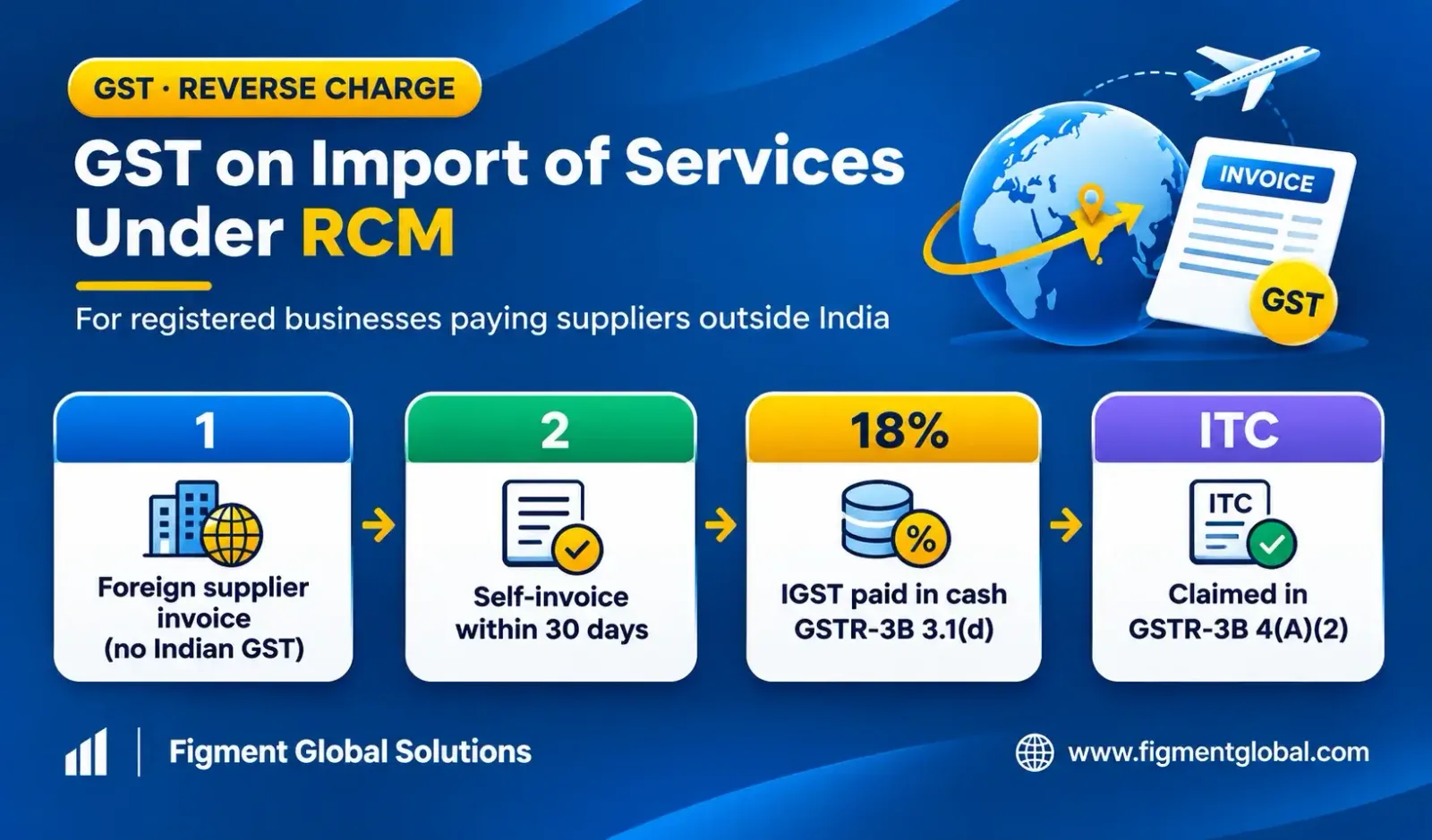
Time of supply: the earlier of the date of payment and the day after 60 days from the vendor's invoice. For card-paid subscriptions, this is normally the card debit date. Value in rupees: the subscription amount converted at the exchange rate on that date. Bank forex mark-up is not part of the vendor's value. Self-invoice: issue it within 30 days of receiving the service (Rule 47A). Many companies issue one self-invoice per vendor per month. Pay in cash: 18% IGST through the electronic cash ledger. ITC cannot be used to pay RCM. Report in GSTR-3B: liability in Table 3.1(d), ITC in Table 4(A)(2) "Import of services", in the same return. From 1 January 2027: if you are already an e-invoicing business, report these self-invoices to an IRP under the supply type RCMIMP. See our post on e-invoicing for RCM self-invoices.
Worked example: one month of tools
| Tool (foreign invoice, no GST) | Amount | Value in ₹ | IGST at 18% (RCM) |
|---|---|---|---|
| AI assistant team plan, 5 seats | USD 150 | ₹13,200 | ₹2,376 |
| Code hosting, team plan | USD 80 | ₹7,040 | ₹1,267 |
| Container platform, team plan | USD 60 | ₹5,280 | ₹950 |
| Total | USD 290 | ₹25,520 | ₹4,593 |
Common mistakes with SaaS subscriptions
Treating card payments as "no invoice, no GST". RCM is triggered by the payment, not by having a formal invoice. Download the receipt or invoice from the vendor's billing page each month. Leaving the GSTIN off the vendor account. The vendor then charges consumer GST, which you cannot claim as ITC because it does not appear in your GSTR-2B. Missing employee-paid tools. Subscriptions paid on personal cards and reimbursed are still imports of services by the company if the invoice is in the company's name. Annual plans. RCM is due on the full annual amount in the month of payment, not spread across 12 months. Forgetting the income-tax side. Large or recurring foreign payments may need Form 145/146 (earlier 15CA/15CB). See our guide on 15CA/15CB automation.
Monthly SaaS RCM checklist
Export all foreign-currency debits from company cards and bank accounts. Download each vendor's invoice and confirm the supplier entity and GST shown. Make sure your legal name and GSTIN are saved on every vendor account. List RCM items with payment date, USD amount, exchange rate and rupee value. Issue self-invoices within 30 days and payment vouchers. Pay IGST in cash and report in GSTR-3B Table 3.1(d). Claim ITC in Table 4(A)(2). For Indian-entity invoices with GST, match them with GSTR-2B instead.
How GSTCPC handles it
Key takeaways
Foreign cloud, AI and SaaS subscriptions bought by a registered business attract 18% IGST under RCM. Check each invoice: a foreign supplier without GST means RCM; an Indian supplier with GST means normal ITC through GSTR-2B. Save your GSTIN on every vendor account so you are not billed as a consumer. Pay in cash, report in Table 3.1(d), and claim ITC in Table 4(A)(2) in the same return.
Frequently Asked Questions
If your business is GST-registered and the invoice comes from the foreign company without GST, yes. You pay 18% IGST under reverse charge and can claim it as ITC if the tool is used for business.
Yes. The time of supply is the payment date. Download the invoice or receipt, issue a self-invoice and pay the IGST in that month's GSTR-3B.
This usually means your GSTIN was not on the account and you were billed as a consumer. That GST does not appear in GSTR-2B, so ITC on it is generally not available. Add your GSTIN, ask the vendor for a corrected invoice or credit, and take advice on the past months.
No. Without consideration from an unrelated vendor there is no supply, so no GST is payable.
It depends on the invoice. If GoDaddy's Indian entity bills you with its GSTIN and charges GST, it is a normal domestic purchase. If a foreign GoDaddy entity bills you without GST, RCM applies.