GST on Import of Services Under RCM: A Complete Guide for Registered Businesses
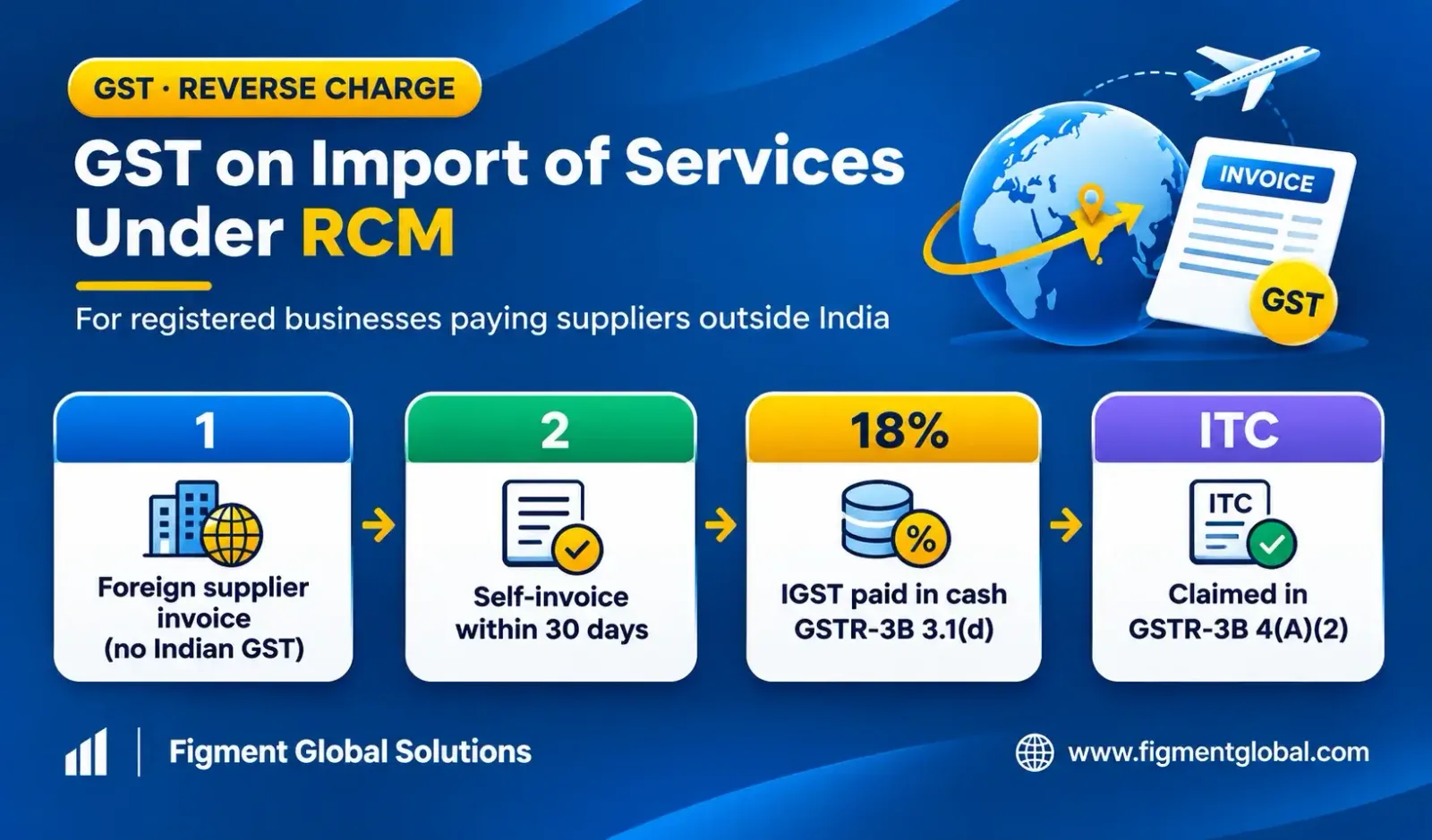
GST on import of services under RCM applies whenever a GST-registered business in India pays a supplier outside India for a service: a software subscription, cloud hosting, consulting by a foreign firm, an overseas marketing agency, legal fees to a foreign law firm, or management charges from a parent company. The foreign supplier is not registered in India and does not charge Indian GST. The Indian business, as the recipient, pays IGST itself under the reverse charge mechanism (RCM) and, in most cases, claims the same amount back as input tax credit (ITC).
The tax usually costs nothing in cash flow terms if it is handled correctly. The problems come from missing it: interest, a notice after a GSTR-3B versus books mismatch, or ITC lost because the self-invoice was never issued. This guide covers the law, the step-by-step process, the GSTR-3B reporting and a monthly checklist. For a practical walk-through of foreign SaaS tools such as ChatGPT, Claude, GitHub, Docker and GoDaddy, see our companion post on GST on cloud and SaaS subscriptions under RCM.
What counts as an import of services
Section 2(11) of the IGST Act defines import of services as the supply of a service where all three conditions are met:
the supplier is located outside India, the recipient is located in India, and the place of supply is in India.
Import of services is treated as an inter-State supply, so IGST applies, not CGST and SGST. Unlike goods, there is no customs clearance. The tax is collected through the recipient's GST return.
The legal basis for reverse charge
| Provision | What it says |
|---|
| Section 5(3), IGST Act | The Government can notify supplies on which the recipient pays IGST on reverse charge |
| Notification 10/2017-Integrated Tax (Rate), entry 1 | Services supplied by a person in a non-taxable territory to a person in the taxable territory: the recipient pays, except where the recipient is a non-taxable online recipient |
| Section 14, IGST Act | For online information and database access or retrieval (OIDAR) services to a non-taxable online recipient, the foreign supplier pays the tax itself |
| Section 2(16), IGST Act | Non-taxable online recipient: broadly, an unregistered person receiving OIDAR services in India (wording amended from 1 October 2023) |
| Section 49(4), CGST Act (read with Section 20, IGST Act) | The electronic credit ledger can only be used for output tax, so RCM tax must be paid in cash |
The practical result is simple:
Registered business importing a service: the business pays IGST under RCM. Unregistered individual or business buying an online service (OIDAR): the foreign supplier charges GST and pays it under Section 14. Registered business buying an online service but not giving its GSTIN to the vendor: the vendor may charge GST as if the buyer were a consumer. See the FAQ on this below.
GST rate on imported services
The GST rate applicable to imported services is generally the same as the rate charged for the same service when supplied within India. Most imported business services, including software, cloud hosting, IT consulting and professional services, attract 18% IGST under the reverse charge mechanism. However, the applicable rate depends on the service classification under the relevant Services Accounting Code (SAC). Certain services may attract a different GST rate or qualify for an exemption, so it is important to verify the applicable SAC and GST rate before determining the tax liability.
Step-by-step: paying GST on an imported service
Step 1: Fix the time of supply
Under Section 13(3) of the CGST Act, the time of supply for services taxed under reverse charge is the earlier of:
the date of payment, as entered in the recipient's books or debited in its bank account, whichever is earlier, or the date immediately after 60 days from the date of the supplier's invoice.
For services from an associated enterprise outside India (for example, a foreign parent), the time of supply is the date of entry in the recipient's books or the date of payment, whichever is earlier.
In practice, for card-paid monthly subscriptions, the payment date usually decides the month.
Step 2: Convert the value into rupees
The taxable value of imported services is generally the amount paid or payable to the foreign supplier for the services, including any additional charges billed by the supplier. The amount must be converted into Indian rupees using the applicable exchange rate determined in accordance with Rule 34(2) of the CGST Rules, 2017, on the date of the time of supply, as determined under Section 13 of the CGST Act, 2017. For services, the exchange rate is the rate determined in accordance with generally accepted accounting principles (GAAP).
Importantly, bank conversion charges or credit/debit card foreign-currency mark-ups charged separately by the bank are generally not included in the taxable value of the imported service, as they are separate charges and not amounts charged by the foreign supplier.
Step 3: Issue a self-invoice and a payment voucher
The registered recipient issues an invoice to itself for the supply received, and a payment voucher when it pays the supplier (Sections 31(3)(f) and 31(3)(g) of the CGST Act, applied to IGST by Section 20 of the IGST Act). Rule 47A of the CGST Rules, in force since 1 November 2024, requires the self-invoice within 30 days of receiving the supply.
The self-invoice is also the document on which you claim ITC, so a missing self-invoice can cost the credit, not just the paperwork.
Step 4: Pay IGST in cash
Pay the IGST through the electronic cash ledger by the GSTR-3B due date of the month in which the time of supply falls. ITC balances cannot be used. Late payment attracts interest at 18% a year under Section 50.
Step 5: Report in GSTR-3B and claim ITC
| GSTR-3B table | What goes in |
|---|
| 3.1(d) Inward supplies liable to reverse charge | Taxable value and IGST on the imported service |
| 4(A)(2) Import of services | ITC of the IGST paid, if the service is used for business and not blocked |
Both entries normally go in the same return, so the net cash cost is nil when full ITC is available. ITC is not available where the service is used for exempt supplies or non-business purposes, or where Section 17(5) blocks it.
Step 6: E-invoicing from 1 January 2027
From 1 January 2027, businesses already required to issue e-invoices must also report self-invoices for import of services to an Invoice Registration Portal under the new supply type RCMIMP and obtain an IRN (Notification 04/2026-Central Tax). Our guide on e-invoicing for RCM self-invoices covers the details.
Worked example
A registered software company in Pune pays a US consulting firm USD 2,000 on 12 December 2026. Assume an exchange rate of ₹88 per USD on that date (illustrative only).
| Item | Amount |
|---|
| Value of service (2,000 × ₹88) | ₹1,76,000 |
| IGST at 18% under RCM | ₹31,680 |
| Self-invoice to be issued by | 11 January 2027 (within 30 days) |
| Paid in cash with December GSTR-3B (monthly filer) | ₹31,680, by 20 January 2027 |
| ITC claimed in the same GSTR-3B, Table 4(A)(2) | ₹31,680 |
| Net cash cost | Nil (if full ITC is available) |
If the company forgets and only pays in March 2027, it owes interest from the original due date, and its December GSTR-3B no longer matches its books.
Special cases
Services from a related party abroad
Under Entry 4 of Schedule I of the CGST Act, 2017, the import of services by a person from a related party or from any of its other establishments outside India, in the course or furtherance of business, is treated as a supply even when no consideration is charged.
This provision is particularly relevant for transactions involving foreign group companies, such as management fees, cost recharges, shared-service arrangements and other inter-company services.
However, an important clarification is provided under CBIC Circular No. 210/4/2024-GST dated 26 June 2024. Where the Indian recipient is eligible for full input tax credit (ITC), the value declared in the invoice issued by the recipient may be treated as the open market value under Rule 28 of the CGST Rules. If the recipient has not issued an invoice, the value may be treated as Nil, provided the prescribed conditions are satisfied.
Therefore, businesses should carefully evaluate related-party service arrangements, their valuation and eligibility for full ITC when determining their GST liability under the reverse charge mechanism.
Free trials and free tiers
A genuinely free service from an unrelated foreign supplier has no consideration, so there is no supply and no RCM.
Exempt or partly exempt businesses
Banks, NBFCs, insurers and hospitals that make exempt supplies still pay RCM in full, but can claim only partial ITC under Rule 42. For them, import of services is a real cost.
Unregistered businesses
An unregistered business purchasing OIDAR services from a foreign supplier is treated as a non-taxable online recipient, and the foreign supplier is responsible for charging and paying GST. However, non-OIDAR imported services, such as foreign consulting, are generally subject to GST under the reverse charge mechanism, and the Indian recipient may be required to obtain GST registration under Section 24 of the CGST Act, even if otherwise unregistered.
The income-tax side
GST is only half of the compliance on a foreign payment. Payments to non-residents may also attract income-tax withholding, and remittances usually need Form 145 and Form 146 (earlier Forms 15CA and 15CB) before the bank releases the money. Under the Income-tax Act, 2025, withholding on payments to non-residents falls under section 393(2) (earlier section 195 of the Income-tax Act, 1961). Whether tax must be withheld depends on the nature of the payment and the applicable tax treaty. The equalisation levy of 6% on online advertising services was abolished from 1 April 2025, and the 2% levy on e-commerce supplies from 1 August 2024. See our guide on 15CA/15CB automation.
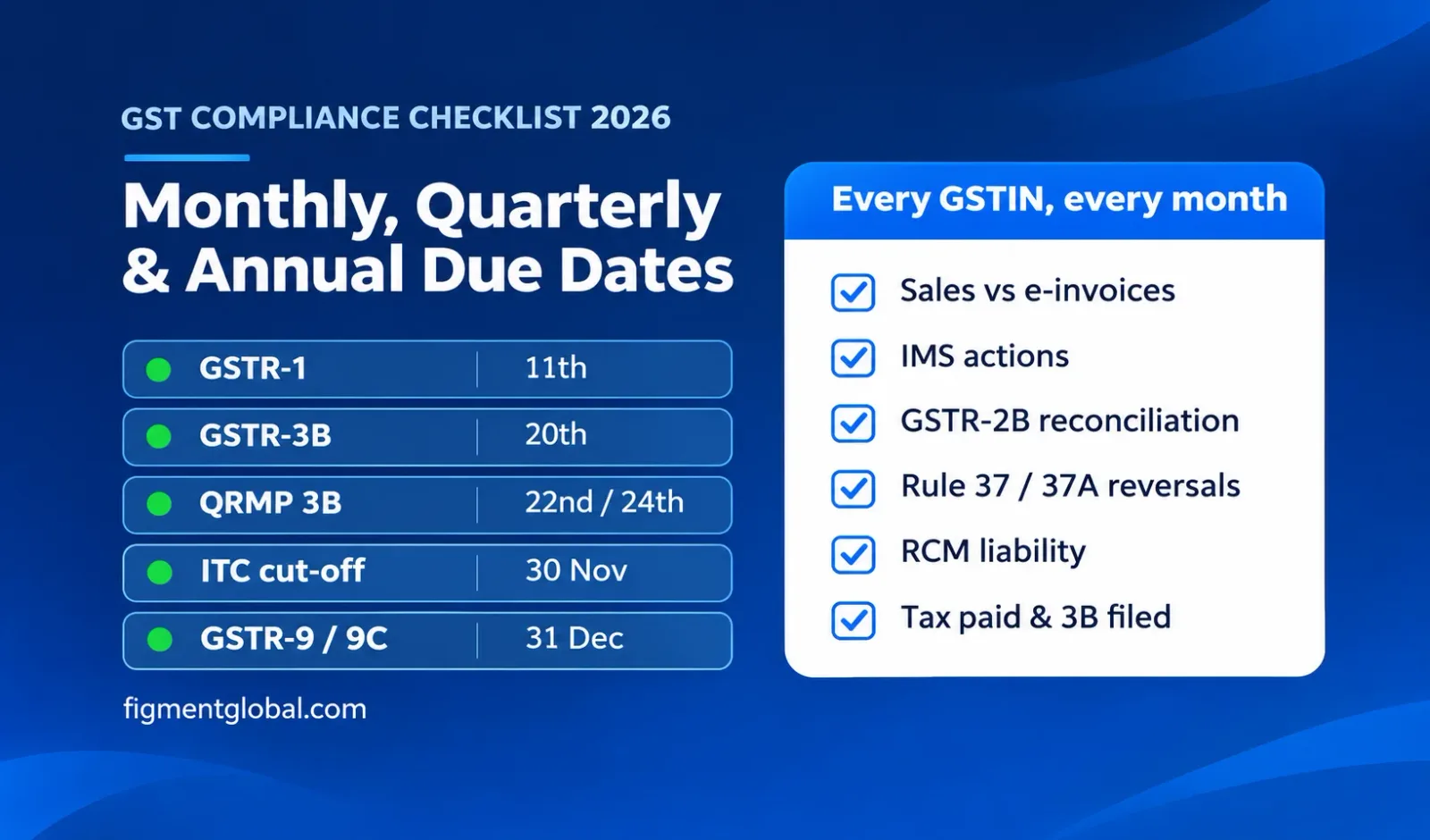
Monthly checklist for import of services
Pull all foreign-currency payments from bank and card statements for the month. Tag each one: imported service, OIDAR with GST already charged, or Indian supplier. Fix the time of supply (payment date or 60 days from invoice) for each. Convert to rupees at the rate on the time-of-supply date. Issue self-invoices within 30 days and payment vouchers on payment. Pay IGST in cash; report in GSTR-3B Table 3.1(d). Claim ITC in Table 4(A)(2), subject to Rule 42 and Section 17(5). From 1 January 2027, generate IRNs under RCMIMP if you are an e-invoicing business. Check withholding tax and Form 145/146 before each remittance. Reconcile the year's RCM liability and ITC before filing GSTR-9.
How GSTCPC handles it
GSTCPC is Figment's GST compliance software for businesses with one or many GSTINs. It prepares and files GSTR-1, GSTR-3B, GSTR-9 and GSTR-9C, and reconciles the purchase register with GSTR-2A, GSTR-2B and IMS data, with mismatch reports before GSTR-3B is filed. Returns go through review and approval before filing, which is where a missing RCM entry for an imported service is usually caught. Because e-invoice data comes from the same records, the RCMIMP requirement from January 2027 can be handled in the same system. Companies that want to generate IRNs from their own ERP can use Figment's e-invoice API.
Key takeaways
A registered business that buys a service from a supplier outside India pays 18% IGST under RCM in most cases. Time of supply is the earlier of payment or 60 days from the supplier's invoice. Issue a self-invoice within 30 days, pay in cash, and claim ITC in the same GSTR-3B. Services from a foreign group company can be taxable even without payment. From 1 January 2027, e-invoicing businesses must report these self-invoices as RCMIMP.