

MSME Form 1: Who Must File, Due Dates and the Data You Need
Quick answer:
What is MSME Form 1?
Who must file MSME Form 1
Applicability at a glance
| Situation | File MSME Form 1? |
|---|---|
| Company has payments to micro or small enterprise suppliers pending for more than 45 days during the relevant half-year | Yes |
| All payments to micro and small enterprise suppliers are settled within 45 days, with no qualifying dues pending beyond 45 days | No — nil return is not required |
| Company paid an MSE invoice after 45 days, but before the half-year ended | Report the late payment when filing the applicable return. The revised form captures amounts paid after 45 days; the filing trigger remains subject to the Order's requirements. |
| Outstanding dues are only to medium enterprises | No — MSME Form 1 covers micro and small enterprises, not medium enterprises. |
| Supplier's Udyam registration or MSE eligibility has not been verified | Verify before excluding the supplier. Confirm qualifying status and applicable registration requirements, and retain supporting evidence. |
| Buyer is an LLP, partnership firm or proprietorship | Generally no — MSME Form 1 is a Companies Act filing for covered companies. Separate MSMED Act payment obligations and applicable income-tax provisions may still apply. |
| Foreign company has suppliers qualifying as micro or small enterprises in India | Potentially yes — the revised form includes an FCRN field. Confirm applicability based on the company's legal status and circumstances. |
MSME Form 1 due dates
| Half-year | Period covered | Due date |
|---|---|---|
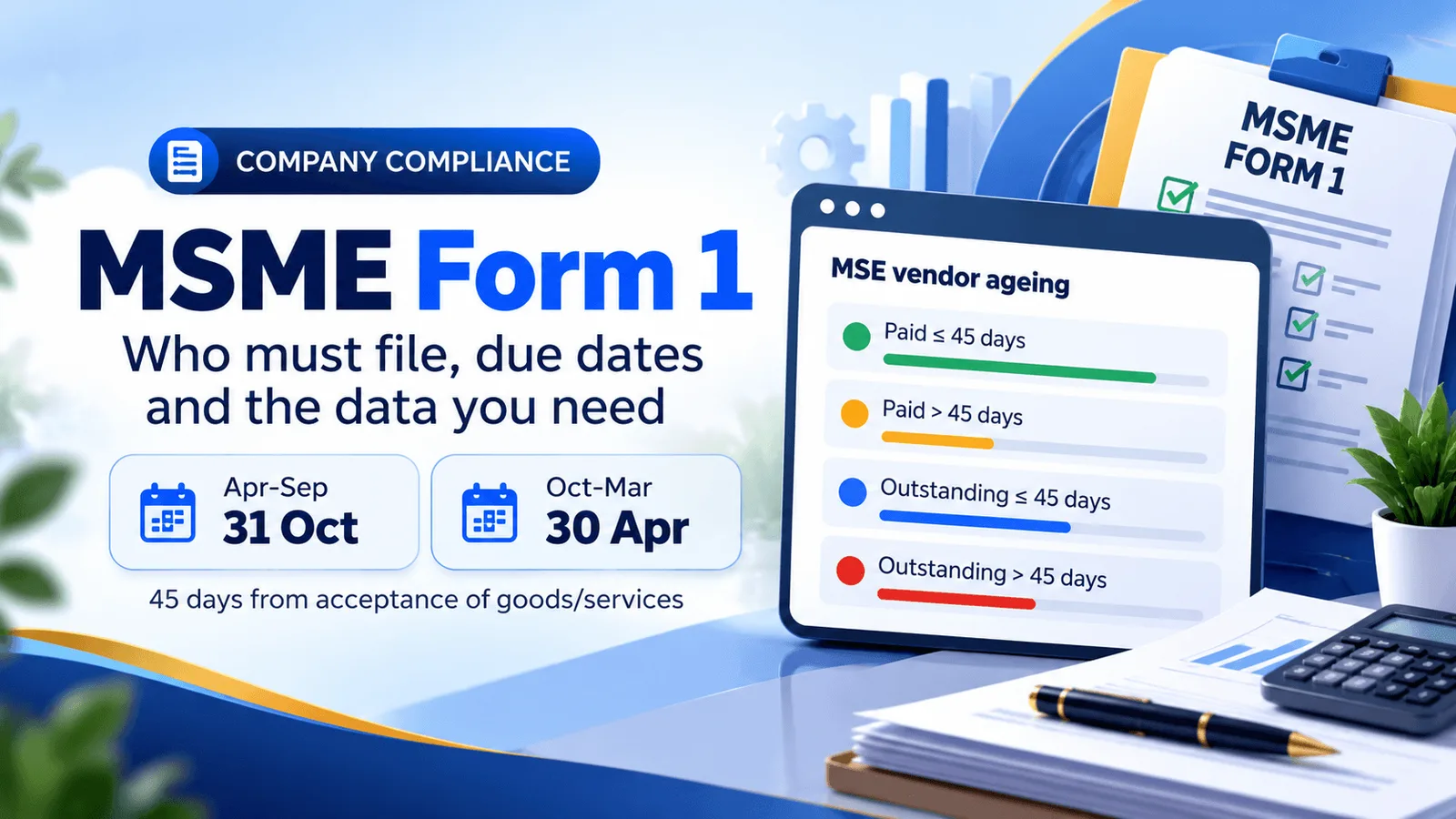
| H1 | 1 April to 30 September | 31 October |
| H2 | 1 October to 31 March | 30 April |
The 45-day rule: how acceptance dates work
Acceptance: the day the goods are delivered or services rendered, where the buyer accepts them. Deemed acceptance: if the buyer raises no written objection within 15 days of delivery, the day of actual delivery is treated as the acceptance date. Objection later removed: if the buyer objects within 15 days and the supplier then fixes the problem, acceptance is the day the objection is removed.
Data you need for MSME Form 1
| Data field | Source | Why it matters |
|---|---|---|
| Supplier name and PAN | Vendor master | Required in revised MSME Form 1. These are the explicit supplier-level identification fields. |
| Udyam registration number and category (micro/small/medium) | Udyam certificate or verification records | Internal verification to establish whether the supplier qualifies as a micro or small enterprise. The revised form does not have a separate Udyam number field. |
| Category and registration status on the relevant date | Udyam certificate and status history | Helps establish supplier eligibility and retain evidence if classification or registration status changes. |
| Invoice number, date and amount | Accounts payable (AP) ledger | Supports invoice-level reconciliation and ageing calculations; not a separate field in the revised form. |
| Acceptance or deemed acceptance date | Goods receipt note (GRN), service-entry records and objection log | Establishes the starting point for calculating the applicable payment deadline under the MSMED Act. |
| Agreed payment terms | Purchase order or contract | Establishes the agreed period; without a written agreement, payment is generally due within 15 days, subject to the MSMED Act. |
| Payment date and amount | Bank records and payment run | Supports classification of payments as paid within 45 days or paid after 45 days. |
| Outstanding balance and ageing | AP ageing report | Supports reporting outstanding amounts for 45 days or less and for more than 45 days. |
| Reason for delay or outstanding amount | AP team and business owner | Required field in revised MSME Form 1 for the reason for delay in payment or the outstanding amount. |
Amount paid within 45 days Amount paid after 45 days Amount outstanding for up to 45 days Amount outstanding for more than 45 days
Step-by-step: preparing MSME Form 1 from your ERP
Refresh MSE status of every vendor
Re-verify Udyam status and category for all active vendors at the start of each half-year. A supplier that registered under Udyam after onboarding is often missing from the vendor master. Record the date of each check. Extract invoice-level data for the half-year
Pull every invoice from micro and small suppliers that was open at the start of the period, booked during it, or paid during it. Fix the acceptance date
Apply your agreed rule (GRN, service-entry or objection-removal date). Flag invoices with no GRN for manual review. Age each invoice against 45 days
Classify every invoice into the four buckets above. Use the agreed payment terms to also flag invoices that crossed the 15-day limit where there was no written agreement. Capture reasons for delay
Ask business owners for a reason against each delayed invoice: quality dispute, missing documents, pending approval, and so on. Generic reasons invite questions. Reconcile before filing
Tie the Form 1 totals to the AP ledger, the Schedule III MSME note and the Section 43B(h) workings (see the table below). File and keep evidence
File on the MCA V3 portal with the digital signature of the authorised signatory. Keep the invoice-level working file, the Udyam verification evidence and the reasons for delay.
Reconciling MSME Form 1 with other disclosures
| Disclosure | What it reports | Link to MSME Form 1 |
|---|---|---|
| Schedule III note (financial statements) | Principal and interest unpaid at year-end; payments made beyond the appointed day; interest due for the period of delay; accrued unpaid interest; and further interest payable in subsequent years. | Reconcile the annual disclosure with supplier balances and delayed-payment records. Do not assume it must match H2 Form 1 exactly, as the reporting periods and disclosure requirements differ. |
| Form 3CD Clause 22 | Interest inadmissible under Section 23 of the MSMED Act, along with amounts required to be paid to micro and small enterprises under Section 15, classified by whether they were paid within the prescribed time. | Uses the same supplier, acceptance-date and delayed-invoice records, with additional tax-audit calculations. |
| Section 43B(h) / Section 37(2)(g) | Under the Income-tax Act, 1961, Section 43B(h) defers the deduction for payments beyond the Section 15 deadline until actual payment. Its corresponding provision under the Income-tax Act, 2025 is Section 37(2)(g). | Uses the same delayed-payment records but applies the Section 15 deadline: 15 days without a written agreement, or the agreed period capped at 45 days. |
| MSMED Act Section 16 interest | Compound interest at three times the RBI-notified bank rate, with monthly rests, on delayed payments as prescribed by the Act. Such interest is not deductible under Section 23. | Calculate interest using delayed-payment records and reconcile it with Schedule III and Form 3CD. |
Penalty for not filing
Key takeaways
MSME Form 1 is required only where a company's payments to micro or small suppliers exceed 45 days from acceptance. Due dates: 31 October (April–September) and 30 April (October–March). The 45 days run from acceptance or deemed acceptance, not the invoice date. The revised 2024 form reports amounts paid and outstanding on both sides of 45 days. Build one dataset and reconcile it with Schedule III, Form 3CD Clause 22 and Section 43B(h).
Frequently Asked Questions
A half-yearly return filed with the Registrar of Companies by companies whose payments to micro or small enterprise suppliers exceed 45 days from the date of acceptance or deemed acceptance. It is prescribed under Section 405 of the Companies Act, 2013.
31 October for the April–September half-year and 30 April for the October–March half-year.
Generally, no. Under the MCA's 2024 amendment, only specified companies with payments pending to micro or small enterprise suppliers for more than 45 days from the date of acceptance or deemed acceptance must file MSME Form 1. If no such qualifying overdue payments exist, a nil return is not required.
No. The Order covers micro and small enterprise suppliers only, though medium enterprises are still covered by other MSMED Act provisions.
Under Section 405(4) of the Companies Act, 2013, failure to comply with an applicable information-furnishing order, or furnishing materially incorrect or incomplete information, attracts a penalty of ₹20,000, plus ₹1,000 for each day of continuing default after the first day, subject to a maximum of ₹3 lakh. The company and every officer in default are liable to these penalties.