

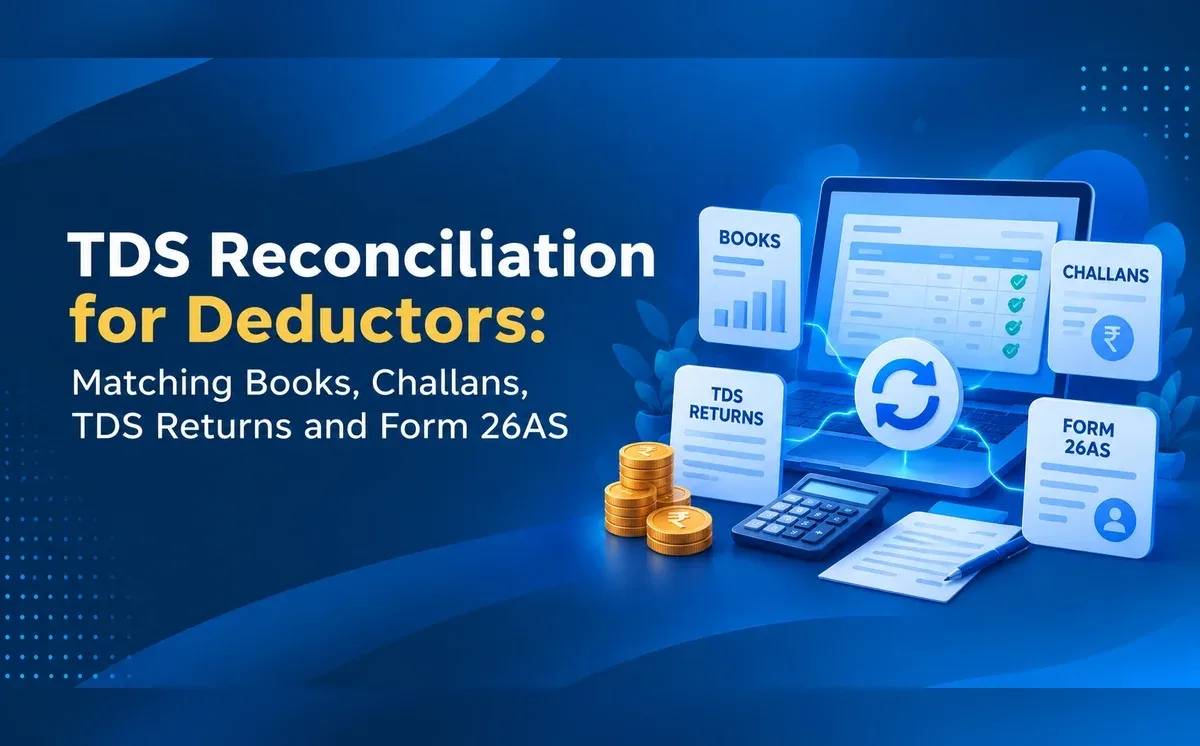
The four records to reconcile
| Record | Where it comes from | What it should show |
|---|---|---|
| TDS ledger in books | Your ERP or accounting system | TDS deducted on each payment, by deductee and nature of payment |
| Challans | Bank / e-Pay Tax, verified through Challan Status Inquiry (CSI) | TDS deposited, with BSR code, date, serial number and amount |
| Quarterly TDS returns | Forms 138, 140, 144 and 143 as filed | Every deduction, linked to a challan and a deductee PAN |
| TRACES / Form 26AS data | Processing of your returns | Defaults, unconsumed challans and the credit each deductee receives |
Step 1: Books to challans (every month)
Every rupee deducted should be covered by a challan deposited on time. Download the CSI data for your TAN and compare BSR code, date, challan serial number and amount with your challan register. Late deposits attract interest; record it when you deposit, not when a default arrives. The TDS interest calculator works it out.
Step 2: Challans to the TDS return (every quarter, before filing)
The total of deductions linked to a challan should not exceed the challan amount. Deductee PANs should be valid and operative; invalid PANs lead to higher deduction rates and to credit that does not reach the deductee. The nature of payment should match the rate applied. The TDS rate chart lists rates and the new payment codes.
Step 3: The TDS return to TRACES (after processing)
Download the justification report for any default and the Conso file if a correction is needed. Check for short payment (deductions not fully covered by challans), short deduction (rate applied lower than required), interest on late deduction or deposit and late filing fee. Look for unconsumed challans: tax deposited but not used in any statement, which can be used to clear defaults in a correction.
Step 4: Deductee credit in Form 26AS
Common mismatches and fixes
| Mismatch | Where you see it | Fix |
|---|---|---|
| TDS deducted, not deposited | Books vs challans | Deposit with interest; link in the statement |
| Challan details wrong | Challans vs CSI | Correct the challan (online where allowed) or through the statement |
| Challan over-used | Challans vs return | Re-link rows; file a correction |
| Invalid or inoperative PAN | Return vs TRACES (PAN error default) | Get the correct PAN; correct the statement; apply the right rate |
| Wrong section or payment code | Return vs TRACES (short deduction) | Correct the code; pay any short deduction with interest |
| Unconsumed challan | TRACES | Use it in a correction to clear defaults |
| Deductee cannot see credit | Form 26AS | Trace to PAN, challan link or rejected statement; correct |
A reconciliation calendar
Monthly: books to challans, with CSI download. Before each quarterly filing: challans to return; PAN verification; code check. After processing: return to TRACES; download justification reports; plan corrections. Year-end: confirm no open defaults, no unconsumed challans and no deductee complaints before the books close.
How TaxCPC supports TDS reconciliation
Challan import and verification against CSI. Bulk PAN verification and record validation before the FVU file is generated. Interest and late filing fee calculation. TRACES connectivity for Conso files, justification reports and default resolution (short deduction, short payment, PAN errors). Regular and correction statements for multiple TANs and branches. TDS reconciliation with Form 26AS.
Key takeaways
TDS reconciliation matches four records: the TDS ledger, challans, quarterly returns and TRACES/26AS data. Reconcile books to challans monthly, challans to returns before each filing, and returns to TRACES after processing. Most defaults come from challan and PAN mismatches, not wrong rates. Clear defaults with correction statements and keep justification reports on file.
Frequently Asked Questions
The regular matching of TDS deducted in the books, challans deposited, quarterly TDS returns and TRACES/Form 26AS data, so that gaps are fixed before they become default notices.
Books to challans every month, challans to returns before each quarterly filing, and returns to TRACES after each statement is processed.
It arises when the deductions reported in a statement are not fully covered by the challans linked to them, often because of a wrong or missing challan link.
Tax deposited that has not been used against any deduction in a filed statement. It can be used in a correction statement to clear a default.
Usually because of a wrong PAN, a wrong challan link, or a statement that was rejected or not yet processed. Correcting the statement fixes it.