

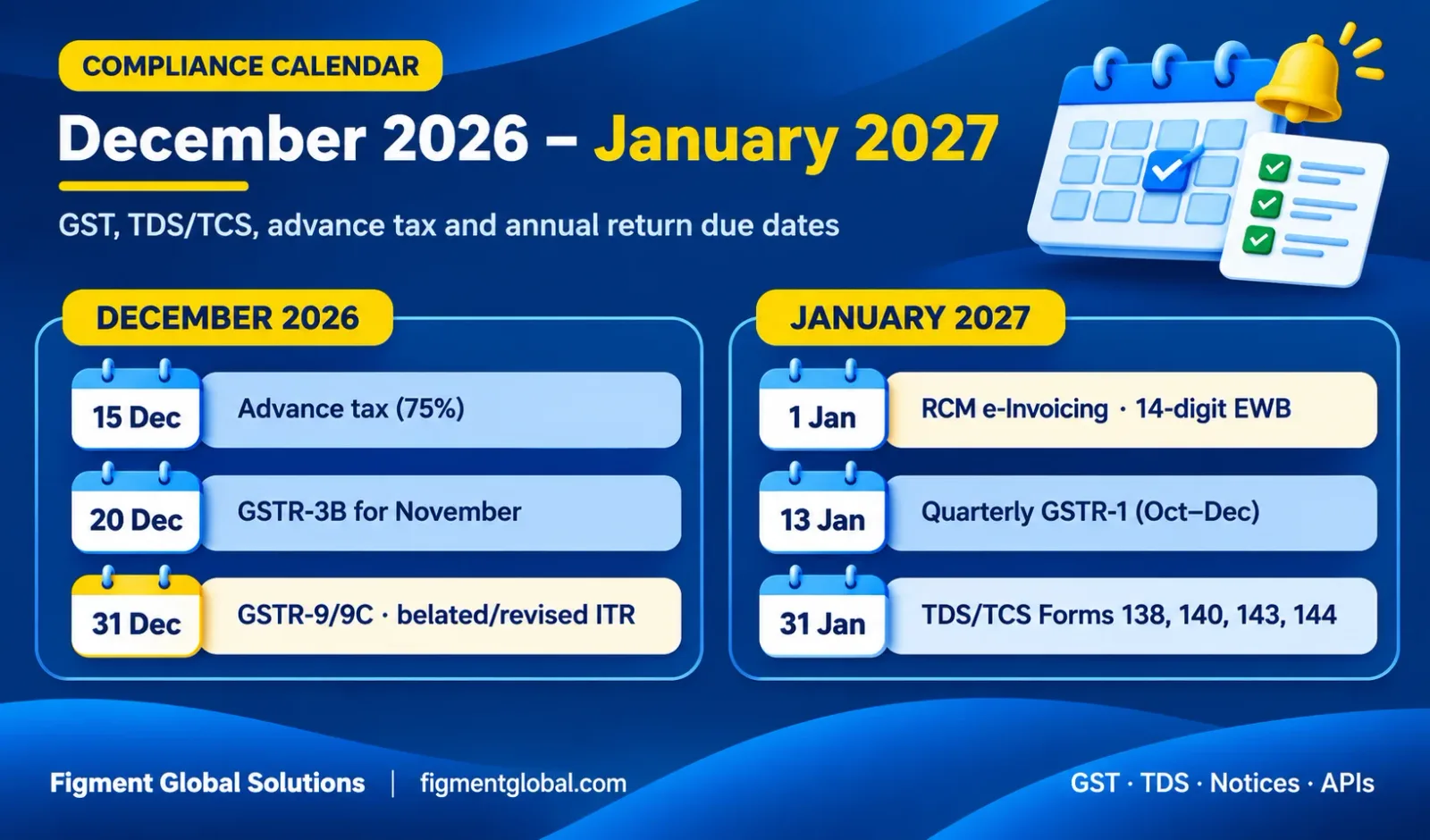
December 2026 due dates
| Due date | Compliance | Who should track it |
|---|---|---|
January 2027 due dates
| Due date | Compliance | Who should track it |
|---|---|---|
Points CA firms should not miss
Annual returns. GSTR-9 and GSTR-9C for FY 2025-26 were enabled on the GST portal on 8 October 2026. All GSTR-1 and GSTR-3B returns for the year must be filed before the GSTR-9 tile opens, so clear pending monthly returns first. See our GSTR-9 and GSTR-9C checklist. Two Acts, two sets of forms. AY 2026-27 returns, including belated and revised returns due by 31 December 2026, are still under the Income-tax Act, 1961. TDS and TCS for tax year 2026-27 use the new forms under the Income-tax Act, 2025: Form 138 for salary, Form 140 for other payments to residents, Form 144 for payments to non-residents and Form 143 for TCS. 31 January falls on a Sunday. Plan the October–December TDS and TCS statements for the last working week of January. Weekend dates. 13 December, 20 December and 10 January fall on Sundays; file before the weekend. 1 January system changes. E-invoicing for RCM self-invoices becomes mandatory, and e-way bill numbers grow from 12 to 14 digits. Check ERP and API readiness in December. See our guides on e-invoicing for RCM self-invoices and 14-digit e-way bill numbers.
How Figment helps
Two dates matter most
Frequently Asked Questions
31 December 2026.
15 December 2026, by when 75% of the estimated tax for the year should have been paid.
31 December 2026, under the Income-tax Act, 1961.
31 January 2027, for Forms 138, 140 and 144 (TDS) and Form 143 (TCS).
E-invoicing becomes mandatory for RCM self-invoices (RCMDOM and RCMIMP), and e-way bill numbers change from 12 to 14 digits.